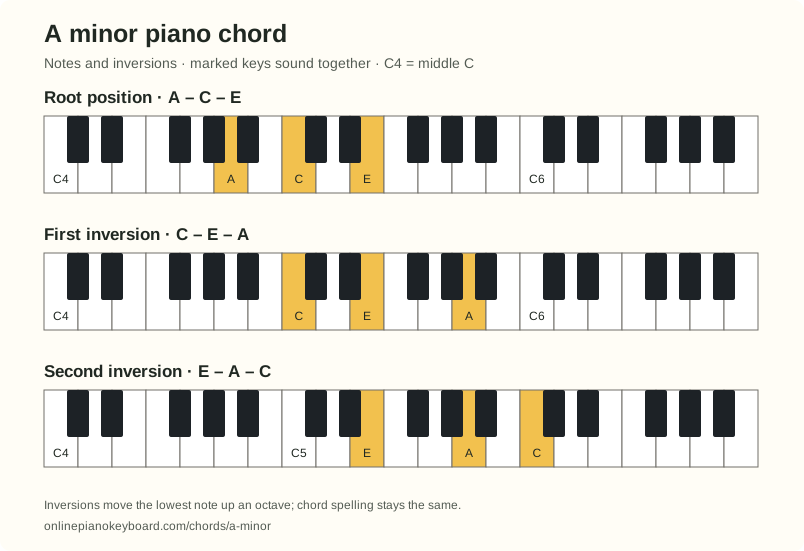
A minor (Am) is a three-note chord: A, C and E. All of its notes are white keys. On the keyboard above, the chord is lit starting in the octave of middle C, and Play chord lets you hear it.
How to find Am on the keyboard
- A is the white key between the second and third of the three black keys.
- C is the white key just left of a pair of black keys.
- E is the white key just right of a pair of black keys.
Press Practice chord to find A, C and E on the keyboard, one at a time in any order. Each correct key leaves the highlighted set. Change inversion to try another position; Stop ends the exercise or a demonstration. Practice checks the selected notes without grading timing or how long you hold them.
Fingering
In root position, play Am with the right hand using fingers 1, 3 and 5 (thumb, middle finger and little finger); with the left hand, use 5, 3 and 1. Keep your wrist level and your fingers curved, and press the keys at the same moment so the chord sounds as one.
Inversions
The same notes can be stacked in a different order. Each inversion moves the lowest note up an octave.
- Root position, the root in the bass: A – C – E. Right hand 1-3-5, left hand 5-3-1.
- First inversion, C in the bass: C – E – A. Right hand 1-2-5, left hand 5-3-1.
- Second inversion, E in the bass: E – A – C. Right hand 1-3-5, left hand 5-2-1.
Chords that sit next to each other in a key often share one or two notes, so choosing the right inversion can keep your hand almost still when the chord changes.
How Am is built
Am has a root, a minor third three half steps above it (C) and a perfect fifth seven half steps above the root (E). Between A and C are three half steps, and between C and E four. The smaller third at the bottom is what makes the chord minor, darker than A major (A, C♯ and E), whose middle note is one key higher.
Keys that use Am
Am belongs to these keys (the roman numeral shows its place in each):
Progressions to try
Open a pattern in the progression generator, then press Play.
- i – iv – v in A minor: Am – Dm – Em. Swap the last chord for a major E (the V of harmonic minor) for a stronger pull home.
- i – VI – III – VII in A minor: Am – F – C – G.
- I – V – vi – IV in C major, where Am is the vi chord: C – G – Am – F.
Play each chord for four beats and repeat the loop. The chord finder shows every chord in these progressions. To hear the changes together, choose the key and pattern in the chord progression generator, then adjust the inversions to reduce hand movement.
Frequently asked questions
What notes are in the A minor chord?
A minor (Am) is A, C and E. All three are white keys.
How do you play Am on the piano?
Put your right thumb on A and play C with your middle finger and E with your little finger, pressing all the keys together. With the left hand, use fingers 5, 3 and 1.
What are the inversions of Am?
First inversion: C E A; Second inversion: E A C. Each keeps the same notes and moves the lowest one to the top.
What is the relative major of A minor?
C major. Its root is three half steps above A, and the two keys share the same key signature.
Which keys contain the A minor chord?
A minor (as i), G major (as ii), F major (as iii), C major (as vi), E minor (as iv), D minor (as v).