A piano chord is three or more notes played together, usually stacked a third apart on a root, the note that names the chord: C, E and G make C major. Pick a root and a chord type in the finder above to see and hear it; below are the formulas, inversions, progressions and a chart of all 24 major and minor triads.
How chords are built from intervals
An interval is the distance between two notes, counted in half steps: every key, black or white, is one half step from the next. Chords are built from the major 2nd (2 half steps), minor 3rd (3), major 3rd (4), perfect 4th (5), diminished 5th (6), perfect 5th (7), augmented 5th (8), major 6th (9), minor 7th (10), major 7th (11) and major 9th (14).
A major triad is a major 3rd with a minor 3rd on top: from C, count four half steps up to E, then three more to G. A minor triad swaps them, three half steps up to Eb and four more to G. Formulas number the notes of the root's major scale, and a flat (b) or sharp (#) lowers or raises a note by a half step.
The 15 chord types in the finder
| Chord type | Symbol | Formula | Half steps from root | Notes in C |
|---|---|---|---|---|
| Major | C | 1 3 5 | 0 4 7 | C E G |
| Minor | Cm | 1 b3 5 | 0 3 7 | C Eb G |
| Diminished | Cdim | 1 b3 b5 | 0 3 6 | C Eb Gb |
| Augmented | Caug | 1 3 #5 | 0 4 8 | C E G# |
| Suspended second | Csus2 | 1 2 5 | 0 2 7 | C D G |
| Suspended fourth | Csus4 | 1 4 5 | 0 5 7 | C F G |
| Dominant seventh | C7 | 1 3 5 b7 | 0 4 7 10 | C E G Bb |
| Major seventh | Cmaj7 | 1 3 5 7 | 0 4 7 11 | C E G B |
| Minor seventh | Cm7 | 1 b3 5 b7 | 0 3 7 10 | C Eb G Bb |
| Diminished seventh | Cdim7 | 1 b3 b5 bb7 | 0 3 6 9 | C Eb Gb Bbb |
| Half-diminished seventh | Cm7b5 | 1 b3 b5 b7 | 0 3 6 10 | C Eb Gb Bb |
| Major sixth | C6 | 1 3 5 6 | 0 4 7 9 | C E G A |
| Minor sixth | Cm6 | 1 b3 5 6 | 0 3 7 9 | C Eb G A |
| Added ninth | Cadd9 | 1 3 5 9 | 0 4 7 14 | C E G D |
| Dominant ninth | C9 | 1 3 5 b7 9 | 0 4 7 10 14 | C E G Bb D |
- Triads: a diminished triad stacks two minor 3rds and sounds tense; an augmented triad stacks two major 3rds and sounds unsettled.
- Seventh chords add a fourth note. A dominant seventh pulls toward the chord a 5th below, the way G7 leads to C, and a diminished seventh stacks three minor 3rds.
The last note of Cdim7 is spelled Bbb (B double flat) because it is a 7th above C, but you play it on the A key.
Inversions
A chord is in root position when its root is the lowest note. Move the bottom note up an octave and you get an inversion, with the same notes and the same name.
- Root position: C E G
- First inversion, 3rd at the bottom: E G C
- Second inversion, 5th at the bottom: G C E
- Third inversion, seventh chords only, 7th at the bottom: Bb C E G for C7
Inversions keep your hand from jumping. Play C major (C E G), then F major in second inversion (C F A), then G major in first inversion (B D G): shared notes stay put and the rest move to nearby keys.
Common chord progressions in C
Build a triad on each note of the C major scale, all white keys, and you get the seven chords of C major, numbered in Roman numerals: uppercase for major, lowercase for minor and ° for diminished.
| I | ii | iii | IV | V | vi | vii° |
|---|---|---|---|---|---|---|
| C | Dm | Em | F | G | Am | Bdim |
- I–IV–V–I: C – F – G – C. The three primary chords, which together contain every note of the scale; the basis of many folk songs, hymns and the 12-bar blues.
- I–V–vi–IV: C – G – Am – F. A loop heard in a great many pop songs.
- ii–V–I: Dm – G – C. The core of jazz harmony, usually played as Dm7 – G7 – Cmaj7.
The numbers work in any key: in G major, for example, I–IV–V–I is G – C – D – G.
Major and minor triads in all 12 keys
A triad uses every other letter name, like C–E–G, so black keys are spelled with sharps in sharp keys and with flats in flat keys.
| Root | Major chord | Notes | Minor chord | Notes |
|---|---|---|---|---|
| C | C major | C E G | C minor | C Eb G |
| C# / Db | Db major | Db F Ab | C# minor | C# E G# |
| D | D major | D F# A | D minor | D F A |
| D# / Eb | Eb major | Eb G Bb | Eb minor | Eb Gb Bb |
| E | E major | E G# B | E minor | E G B |
| F | F major | F A C | F minor | F Ab C |
| F# / Gb | F# major | F# A# C# | F# minor | F# A C# |
| G | G major | G B D | G minor | G Bb D |
| G# / Ab | Ab major | Ab C Eb | G# minor | G# B D# |
| A | A major | A C# E | A minor | A C E |
| A# / Bb | Bb major | Bb D F | Bb minor | Bb Db F |
| B | B major | B D# F# | B minor | B D F# |
Black-key chords can also be spelled from the other name of their root: C# major, for example, is C# E# G#, where E# is the white key F, and Gb major is Gb Bb Db. C, F and G major and D, E and A minor use only white keys, so start with those.
How to practice piano chords
- Play C, then Cm, and listen to how one moved note changes the mood.
- Use fingers 1-3-5 in the right hand and 5-3-1 in the left for root-position triads, counting the thumb as 1.
- Walk each chord through its inversions up the keyboard and back.
- Practice progressions slowly at a steady beat, with the root in your left hand and the triad in your right, moving to the nearest inversion.
- Work out a chord from its formula, then check your answer in the chord finder.
For lessons on C, F, G and Am, see chords for beginners, then move on to piano scales and the easy songs.
Every major, minor and 7th chord
Each chord has its own page with the notes, where to find them, fingering for both hands, the inversions and progressions to try.
Minor
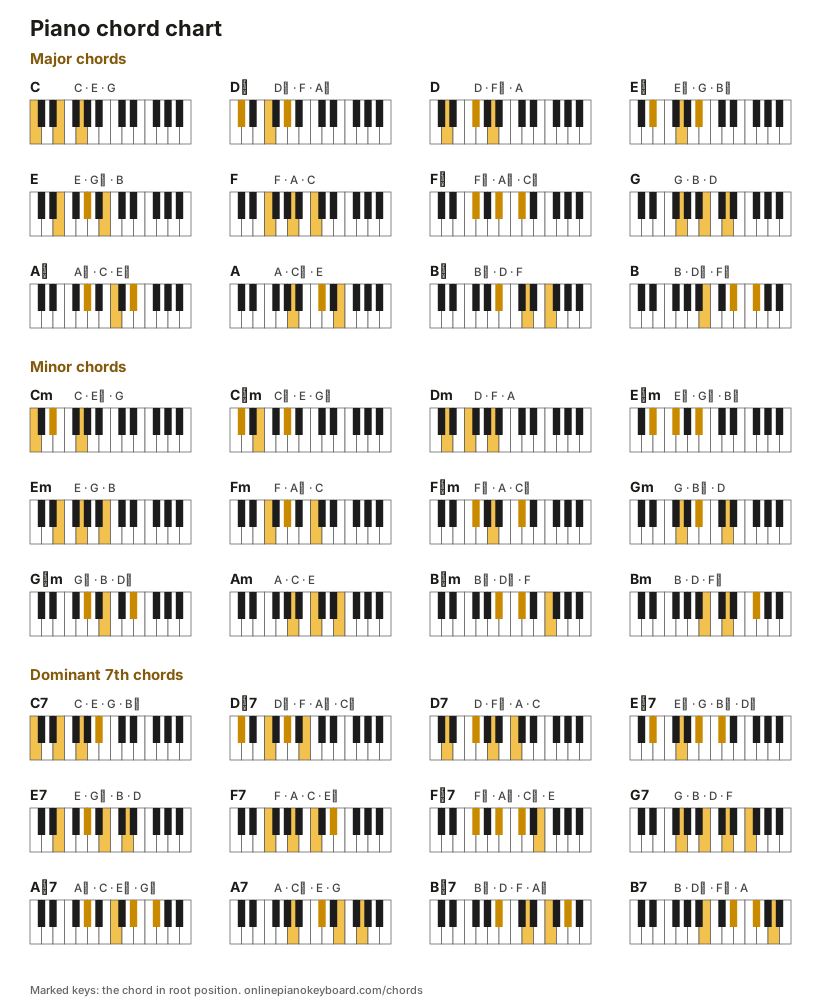
Printable piano chord chart
All 36 chords on one page, each on a small keyboard with its keys marked and its notes named. Open the image to print it or save it.
Frequently asked questions
What are the easiest piano chords for beginners?
C major (C E G), F major (F A C), G major (G B D) and A minor (A C E). They use only white keys and the same hand shape, and together they are the I, IV, V and vi chords of C major.
What is the difference between a major and a minor chord?
The middle note. A major chord has a major 3rd, four half steps, above the root, and a minor chord has a minor 3rd, three half steps: C major is C E G and C minor is C Eb G.
How many chords are there on the piano?
There is no fixed number, since any group of notes can form a chord. The chord finder covers 15 widely used chord types on all 12 roots, 180 chords in all, each with its inversions.
What does sus mean in a chord name?
Sus is short for suspended: the 3rd is replaced by the 2nd or the 4th, so Csus2 is C D G and Csus4 is C F G. With no 3rd, the chord is neither major nor minor.
What is the difference between Cadd9 and C9?
Cadd9 is a C major triad plus D, the 9th: C E G D. C9 also contains the flat 7th, so it is C E G Bb D.
What does the 7 in a chord name mean?
It adds a 7th above the root. A plain 7 means the flat 7th, so C7 is C E G Bb, while maj7 means the major 7th, so Cmaj7 is C E G B. Cm7 puts the flat 7th on a minor triad: C Eb G Bb.