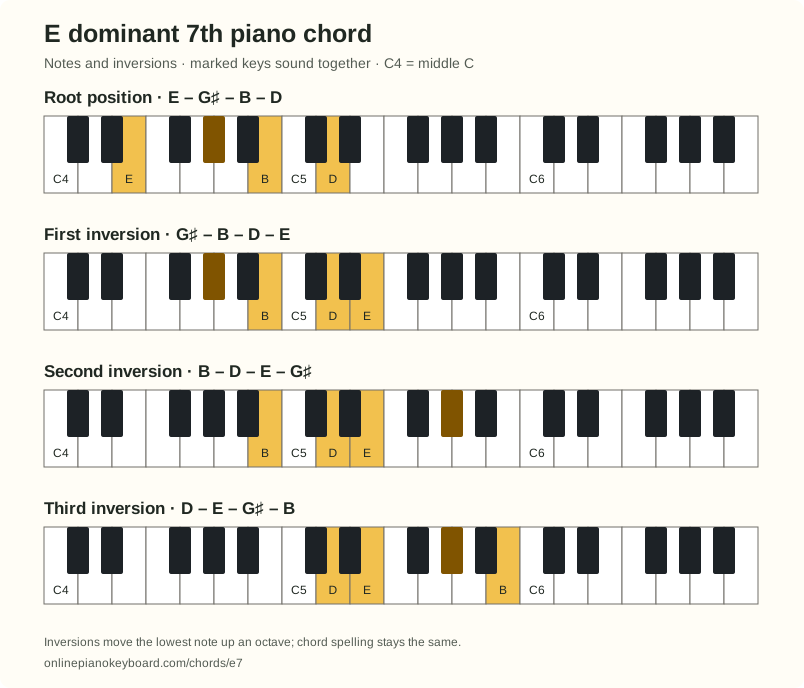
E7 is a four-note chord: E, G♯, B and D. G♯ is a black key; the other notes are white keys. On the keyboard above, the chord is lit starting in the octave of middle C, and Play chord lets you hear it.
How to find E7 on the keyboard
- E is the white key just right of a pair of black keys.
- G♯ is the middle black key of a group of three.
- B is the white key just right of a group of three black keys.
- D is the white key between the two black keys of a pair.
Press Practice chord to find E, G♯, B and D on the keyboard, one at a time in any order. Each correct key leaves the highlighted set. Change inversion to try another position; Stop ends the exercise or a demonstration. Practice checks the selected notes without grading timing or how long you hold them.
Fingering
In root position, play E7 with the right hand using fingers 1, 2, 3 and 5 (thumb, index, middle and little finger); with the left hand, use 5, 3, 2 and 1. Keep your wrist level and your fingers curved, and press the keys at the same moment so the chord sounds as one.
Inversions
The same notes can be stacked in a different order. Each inversion moves the lowest note up an octave.
- Root position, the root in the bass: E – G♯ – B – D. Right hand 1-2-3-5, left hand 5-3-2-1.
- First inversion, G♯ in the bass: G♯ – B – D – E. Right hand 1-2-4-5 is a common choice, left hand 5-4-2-1 is a common choice.
- Second inversion, B in the bass: B – D – E – G♯. Right hand 1-2-4-5 is a common choice, left hand 5-4-2-1 is a common choice.
- Third inversion, D in the bass: D – E – G♯ – B. Right hand 1-2-4-5 is a common choice, left hand 5-4-2-1 is a common choice.
Chords that sit next to each other in a key often share one or two notes, so choosing the right inversion can keep your hand almost still when the chord changes.
How E7 is built
E7 has a E major triad (E, G♯ and B) with a minor seventh on top, D, ten half steps above the root. The added seventh makes the chord restless. G♯ and D are six half steps apart, a tritone, and that tension pulls the chord toward A: the 3rd, G♯, tends to rise a half step and the 7th, D, to fall.
Keys that use E7
E7 belongs to these keys (the roman numeral shows its place in each):
Progressions to try
- V7 – I: E7 resolves to A. The strongest way to end a phrase in A major.
- ii – V7 – I: Bm – E7 – A, the most common chord move in jazz.
- A 12-bar blues in E uses dominant 7th chords on three roots: E7, A7, B7.
Play each chord for four beats and repeat the loop. The chord finder shows every chord in these progressions. The chord progression generator plays three-note triads. Use the chord finder to hear the seventh chords above.
Frequently asked questions
What notes are in the E7 chord?
E7 (E7) is E, G#, B and D: a E major triad plus the minor 7th, D. G# is a black key.
How do you play E7 on the piano?
Put your right thumb on E and play G#, B and D with fingers 2, 3 and 5, pressing all the keys together. With the left hand, use fingers 5, 3, 2 and 1.
What are the inversions of E7?
First inversion: G# B D E; Second inversion: B D E G#; Third inversion: D E G# B. Each keeps the same notes and moves the lowest one to the top.
Where does E7 resolve?
Usually to A, the chord a fifth below. E7 is the V7 chord of A major and of A minor.
Which keys contain the E7 chord?
A major (as V7), A minor (as V7).