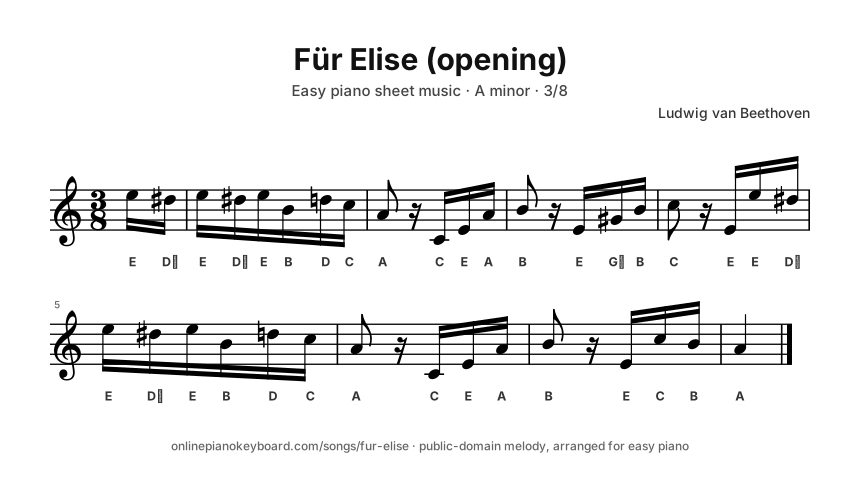
The Für Elise sheet music above covers the famous opening theme, the part most people recognize, with the letter name under every note. It starts high, rocking between E and D#, the black key just below it, then drops through B, D and C to A. It is marked intermediate here because it moves quickly, jumps around the keyboard and uses two black keys, D# and G#.
About Für Elise
Für Elise is Ludwig van Beethoven's Bagatelle No. 25 in A minor, WoO 59. A bagatelle is a short, light piano piece, and WoO stands for Werk ohne Opuszahl, German for a work without an opus number. The manuscript was dated 1810, but the piece was not published until 1867, forty years after Beethoven's death, when the scholar Ludwig Nohl printed it. The manuscript he worked from has since been lost.
Nobody knows for certain who Elise was, and researchers have proposed several candidates. The full piece is a rondo, in which this opening theme returns between two contrasting sections.
How to play the opening
Place your right hand with your thumb on A (A4), finger 2 on B, 3 on C, 4 on D and 5 on E. Finger 4 also covers D#, the black key between D and E.
- The alternation. E and D# swap back and forth for five notes at the start. Play them with fingers 5 and 4, keeping both fingers on the keys so the movement is a small rocking motion rather than a lift. Then B, D, C and A take fingers 2, 4, 3 and 1.
- The broken chords. After each long note comes a quick group of three rising notes: C E A after the first A, and E G# B after the B. Start each group with your thumb. C E A is the A minor chord in its first inversion, and E G# B is the E major chord, which pulls the music back toward A minor. G# is the black key just below A. You can see and hear both chords, and step through their inversions, on the chord finder.
- The jump back up. At the end of the first line, a single low E leads straight back to the high E that starts the theme again. Move your hand up quickly so finger 5 is ready.
- The second ending. When the phrase comes round again, the group after B changes to E C B, which leads home to A.
Counting in 3/8
Für Elise is in 3/8: three eighth-note beats in each bar. The opening notes are sixteenth notes, two to a beat, so count "1 and 2 and 3 and". The first E and D# are a pickup on "3 and", and the next bar has six quick notes, one on every count.
Each long note (the A, the B and the C) lasts one beat and is followed by a short rest before the next group. Count the rest rather than rushing into the broken chord; it gives the theme its breathing space.
Practice tips
- Start with the rocking figure. Repeat the five-note E and D# alternation on its own until it is smooth, even and quiet.
- Let Practice guide the jumps. Practice waits at each key, so you can find the low C, E and G# without pressure. Once the jumps feel familiar, go back to Listen to hear how they should flow.
When you know the opening, Minuet in G and Canon in D are two more intermediate classics to learn.
Printable sheet music
Here is the same arrangement on a single page, with the letter name under every note. Open the image to print it or save it; the Print sheet music button above the keyboard prints it too.
Frequently asked questions
What are the letter notes for Für Elise?
The notes of the opening theme are shown above. It begins E D# E D# E B D C A: E and the black key D# alternate, then the melody steps down to A.
What key and time signature is Für Elise in?
A minor, in 3/8 time, which means three eighth-note beats per bar. The quick opening notes are sixteenth notes, two to each beat.
Which fingers play the E and D# at the start?
With your thumb on A, use finger 5 for E and finger 4 for D#, then fingers 2, 4, 3 and 1 for B, D, C and A. Keep fingers 4 and 5 resting on their keys so the alternation is a small, even rocking movement.
Does this page have the whole of Für Elise?
No. It covers the famous opening theme: one phrase that ends on C, then the same phrase again ending on A. The full bagatelle is a rondo, with two contrasting sections between returns of this theme.
Who was Elise?
No one knows for certain. A popular theory holds that the title was misread and the piece was meant for Therese Malfatti, a friend and student of Beethoven's, but other candidates have been suggested.
Is Für Elise in the public domain?
Yes. Beethoven died in 1827 and the piece was published in 1867, so the music is free to play, record and share.