William Tell Overture sheet music above gives a short piano version of the opening of Rossini's famous finale. Every note on the staff has a letter name; Listen plays the rhythm while highlighting the current key, and Practice waits for your next note. This page keeps one melodic line near middle C and adds a long E at the end as a place to stop. The complete overture has four large sections and is written for an orchestra. This excerpt is the energetic E-major finale, not the quiet opening of the whole overture.
The finale from Rossini's opera
Gioachino Rossini wrote the overture for Guillaume Tell, his opera about William Tell, first performed in 1829. The overture moves through several contrasting scenes before its high-energy final section. The finale's repeated short notes and steady two-beat motion make it instantly recognizable. In the orchestral score the melody is reinforced by many instruments; playing the line alone on a piano lets you hear exactly how much of that energy is already in the rhythm.
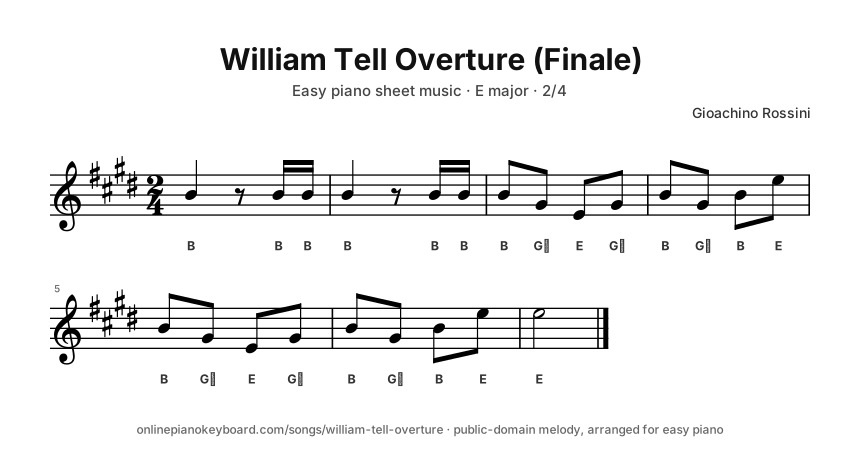
This short arrangement begins with the repeated B figure, then follows the E-major answer that moves between B, G sharp and E. It leaves out the orchestra's harmony, the more elaborate later repetitions and the long ending. The final held E is an ending for this teaching page, not the end of Rossini's score.
Find B, G sharp and E
Find middle C just left of a pair of black keys. E is two white keys to its right. G sharp is the middle black key in the next group of three, and B is the white key just to the right of that group. Those three pitches form an E-major chord, although this page plays them one at a time. Try B–G sharp–E–G sharp slowly. Then try B–G sharp–B–E. Both shapes come after the repeated opening and can be learned without any fast notes at first.
The E-major key signature has four sharps: F, C, G and D. Only G sharp appears in this small excerpt. If the black key is unfamiliar, use Practice to stop there and look for the middle key of the group of three. Keep your hand close to B and let a finger move down to G sharp, then to E; there is no need for a large leap.
Count the springing start
The finale is in 2/4: two quarter-note beats per bar. The first bar plays B for one beat, rests for half a beat, then plays two B notes for a quarter beat each. Count “one, two-and.” The second bar repeats the same pattern. The rest is what makes the two quick Bs feel like a little push toward the next bar. If you ignore the rest, the melody loses its characteristic bounce.
The following bars use four even eighth notes, two notes per beat. Count “one-and, two-and” as the B–G sharp–E–G sharp figure moves down and back up. When that is steady, join it to the repeated B opening. Do not increase the tempo until you can keep the short rest in the same place every time. For another brisk classical excerpt with quick turns, try Turkish March; The Entertainer offers a different kind of offbeat rhythm.
Printable sheet music
Here is the same arrangement on a single page, with the letter name under every note. Open the image to print it or save it; the Print sheet music button above the keyboard prints it too.
Frequently asked questions
What notes start the William Tell Overture finale?
In this E-major excerpt, the finale starts with repeated B notes separated by a short rest, then moves through B, G sharp, E and G sharp.
Is this the entire William Tell Overture?
No. It is a short one-hand version of the famous finale's opening. The complete overture has four contrasting sections and a much longer orchestral ending.
What key and meter is the finale in?
The finale is in E major and 2/4 time. The key signature has four sharps, though this brief melody only plays G sharp among its black keys.
Who composed the William Tell Overture?
Gioachino Rossini composed it for his opera Guillaume Tell, first performed in 1829. The famous galloping melody is in the overture's final section.
Why does the opening sound like a gallop?
The brief rest followed by two quick B notes gives each two-beat bar a springing rhythm. Keep the rest precise instead of filling it with another note.
How fast should I practice it?
Begin slowly enough to keep the rest and the two quick notes even. Raise the speed only after the repeated opening and the E-major answer are reliable.