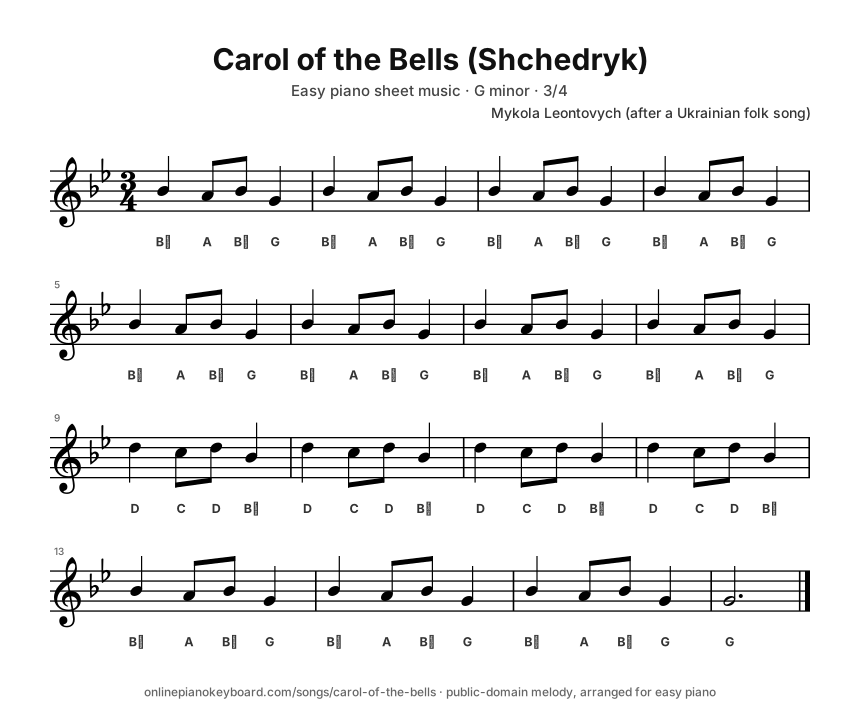
The Carol of the Bells sheet music above is a short version of the melody from Shchedryk, arranged for the right hand. The staff has a letter name under every note, and the Letter notes tab shows the same notes without a staff. Listen plays the excerpt and highlights each note. Practice lights the next key and waits until you press it. This page teaches the famous repeating figure and its higher answer; it does not try to turn the original four-part choral work into a full piano score.
The Ukrainian melody behind the familiar carol
The melody comes from Shchedryk, a traditional Ukrainian New Year song that Mykola Leontovych arranged for mixed choir. His choral setting was first performed in 1916 and published in 1921. The title is often translated as “the little swallow”: the older New Year song tells of a swallow bringing news of good fortune. English-speaking listeners later came to know the music as Carol of the Bells, but this page follows the earlier Ukrainian melody and leaves out the later English words and choral arrangement.
In Leontovych's score, the soprano begins alone with a four-note figure and repeats it. Other voices enter one after another, adding harmony while that little figure keeps returning. This arrangement takes the soprano's opening idea, then its higher contrasting idea, and returns to the opening before a simple final G. It is shorter and easier than the full work, so you can learn the recognizable melody without having to read four voice parts or coordinate two hands.
Find the notes on the keyboard
The first figure is B-flat, A, B-flat, G. Find B, the white key immediately left of the C above middle C; B-flat is the black key just to B's left. A and G are the two white keys to its left. You can put right-hand fingers 3, 2 and 1 on B-flat, A and G. Finger 3 returns to B-flat after A. Keep your hand near those three keys rather than moving your whole wrist for each note.
The higher answer goes D, C, D, B-flat. Move the hand a little to the right for D, the white key just above C, then come back to the familiar B-flat. Practice waits at each note, which gives you time to make that small shift. The melody uses only G, A, B-flat, C and D. B-flat is the only black key you actually play in this excerpt, even though the G minor key signature also contains E-flat.
Count the repeated rhythm
The time signature is 3/4, meaning three quarter-note beats in each bar. Each four-note figure has the same rhythm: the first note takes one beat, the next two are eighth notes sharing one beat, and the last note takes one beat. Count “one, two-and, three.” Play B-flat on one, A on two, B-flat on “and,” and G on three. Start the next B-flat on the following one. The higher D–C–D–B-flat figure follows exactly the same count.
This repeated pattern gives the carol its insistent sound. At first, resist the temptation to speed up after several bars; keep every new bar equally spaced. Let the first note of each bar speak clearly, then make the two quick middle notes light. On the final bar, hold G for all three beats so the short arrangement comes to rest.
A short practice route
First play B-flat, A, B-flat, G slowly four times without following the sheet. Then try it while looking at the staff and the letter names below it. Once that feels secure, switch to the higher D, C, D, B-flat phrase and repeat it four times. Finally, use Listen to hear where the higher phrase begins, and Practice to follow the entire excerpt one key at a time. When you can play it without stopping, try the same notes a little more quietly, then a little more firmly, while keeping the pulse unchanged.
For another minor-key carol, try God Rest Ye Merry, Gentlemen. The Christmas songs page groups the other carols with sheet music and guided practice.
Printable sheet music
Here is the same arrangement on a single page, with the letter name under every note. Open the image to print it or save it; the Print sheet music button above the keyboard prints it too.
Frequently asked questions
What are the letter notes for Carol of the Bells?
The opening figure is B-flat, A, B-flat, G. The higher phrase is D, C, D, B-flat. This page shows every note of its short arrangement above, both on a staff and as letter notes.
Is this the entire Carol of the Bells?
No. It is a short, right-hand arrangement of the repeating opening and the higher contrasting phrase from Leontovych's Shchedryk. The full work is for a four-part choir.
What key and time signature is this version in?
G minor and 3/4 time, like the source choral score. Count three beats in each bar: a quarter note, two eighth notes and another quarter note.
Which black keys do I need?
Only B-flat. It is the black key immediately left of B. The other melody notes in this excerpt are G, A, C and D, all white keys.
Where does this melody come from?
It comes from Shchedryk, Mykola Leontovych's choral setting of a traditional Ukrainian New Year song. His version was first performed in 1916.
Does this page use the English Christmas lyrics?
No. It uses the public-domain melody from Shchedryk and our own short piano ending. It does not include the later English words or their choral arrangement.