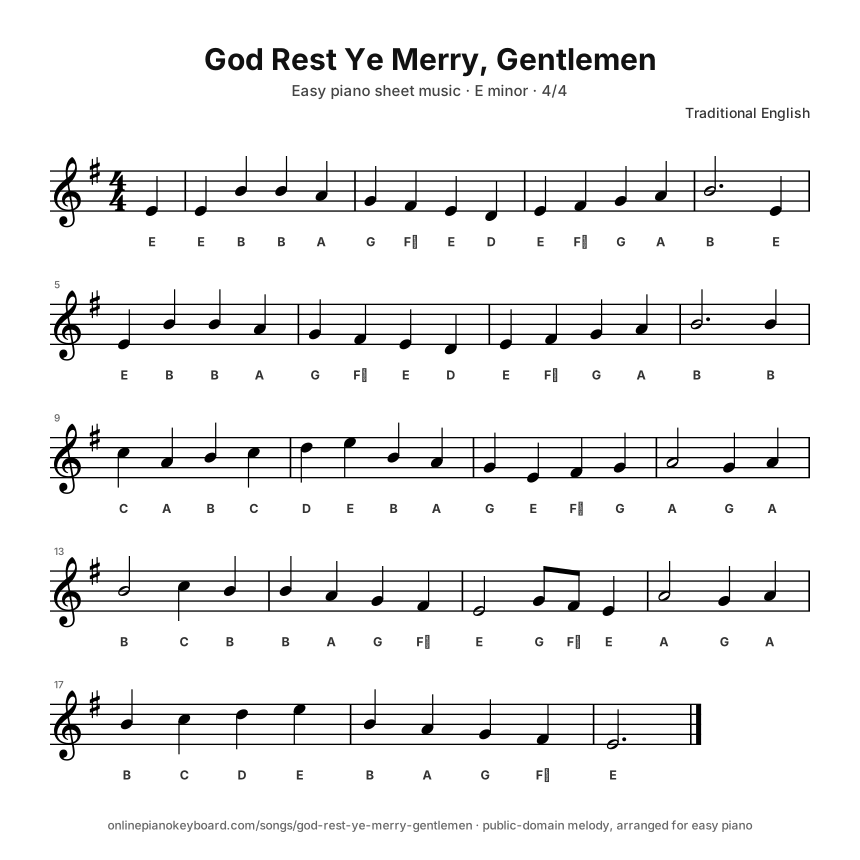
The God Rest Ye Merry, Gentlemen sheet music above is in E minor and 4/4 time, with the letter name printed under every note, and the Letter notes tab shows the same melody as plain letters. It covers one verse and its refrain, arranged for the right hand, and it stays between the D just above middle C and the E an octave and a step above it. The only black key is F sharp. Press Listen to hear it with each note highlighted in the sheet, or Practice to have the next key light up and wait for you. It moves almost entirely in steady quarter notes, which makes it an easy carol despite its serious sound.
About God Rest Ye Merry, Gentlemen
The carol is centuries old. A manuscript from the early 1650s already contains a version beginning "Sit you merry gentlemen", and the earliest known printing is a song sheet of about 1760. The collector William Sandys made it widely popular by including it in his Christmas Carols Ancient and Modern in 1833, and Charles Dickens refers to it in A Christmas Carol ten years later.
The title is often misread. "God rest you merry" is an old way of saying "may God keep you merry", so the comma belongs after "merry". Many songbooks print "ye" instead of "you".
The minor-key tune has been linked with the carol since at least the middle of the 1700s. It was in print by 1815, and the full melody sung today was published in 1855. E minor is its usual key, and this page keeps it there.
How to play God Rest Ye Merry, Gentlemen
- The hand position. Put your thumb on the E above middle C, with fingers 2, 3, 4 and 5 on F sharp, G, A and B. The first line fits under this hand: E, E, a leap up to B, then B A G F sharp E, a dip to D with the thumb, and back up E F sharp G A to a long B.
- The second line. It is exactly the same as the first.
- The third line. It climbs higher, to C, D and the high E, the top note of the carol. Move your hand so your thumb is on A: B, C, D and E are fingers 2 to 5. The line then comes back down through G, E and F sharp; let the thumb reach for them.
- The refrain. Return to the E position. It starts on a long B, touches C, and steps down B A G F sharp to E, then a quick G and F sharp pair and E again. The last phrase climbs B C D E once more before falling through B A G F sharp to the final E.
Counting the rhythm
The carol is in 4/4: four beats to a bar. It begins with a single E on beat 4, a pickup. Nearly every note is a quarter note, one beat each, so the main thing to watch is the long notes. The Bs that end the first two lines last three beats, the refrain has a few half notes of two beats, and the final E lasts three beats, completing the bar that began with the pickup. Near the end of the refrain one beat splits into two eighth notes, G and F sharp.
Practice tips
- Learn the first line well. It is also the second line, so it covers almost half the carol.
- Rehearse the leap. The jump from E up to B at the start of the first two lines is a fifth; practice it until finger 5 finds B without looking.
- Take the third line slowly. It is the only line in the higher position, so give it extra turns in Practice.
- Compare it with the scale. Play the E natural minor scale, E F sharp G A B C D E, on the scales page; the carol uses exactly those notes.
For another carol in E minor, try We Three Kings, which moves from minor to major for its refrain.
Printable sheet music
Here is the same arrangement on a single page, with the letter name under every note. Open the image to print it or save it; the Print sheet music button above the keyboard prints it too.
Frequently asked questions
What are the letter notes for God Rest Ye Merry, Gentlemen?
After a pickup E, the first line is E B B A, G F sharp E D, E F sharp G A, and a long B. The whole carol, with its refrain, is written out above.
What key is God Rest Ye Merry, Gentlemen in?
It is in E minor, the key it is usually printed in, so nothing is transposed. E minor shares its key signature with G major: one sharp, F sharp.
What does God rest ye merry mean?
It is an old way of saying may God keep you merry, or may God grant you peace and happiness. The comma belongs after merry: the gentlemen are being wished joy, not described as merry.
Is God Rest Ye Merry, Gentlemen in a minor key?
Yes. It is in E minor and uses the natural minor scale, with D rather than D sharp, which gives it its old, folk-like sound.
Who wrote God Rest Ye Merry, Gentlemen?
No one knows. The words are traditional English and survive in a manuscript from the 1650s and a printed song sheet of about 1760, and the minor-key tune was in print by 1815.
Is God Rest Ye Merry, Gentlemen in the public domain?
Yes. The words and tune are centuries old, so the carol is free to play and share. This simple arrangement is our own.