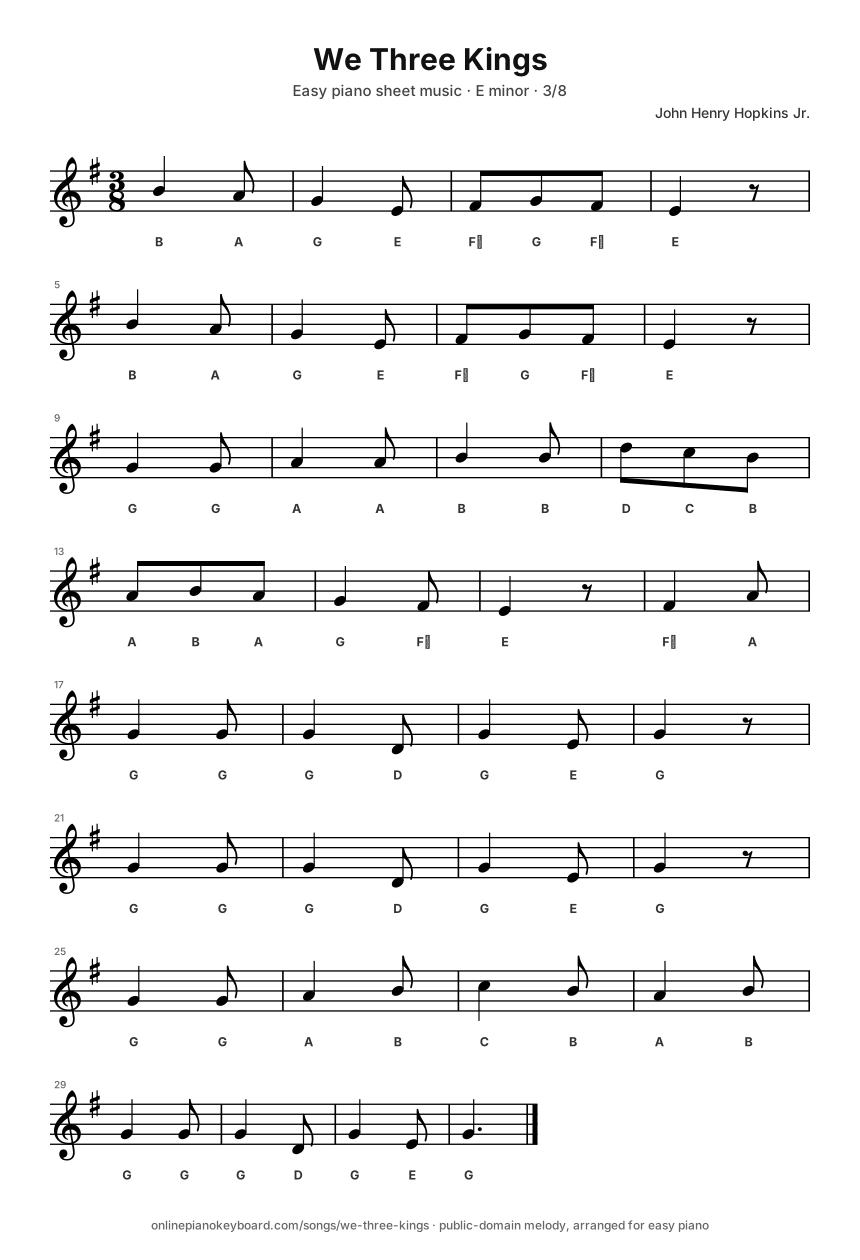
The We Three Kings sheet music above is written in 3/8 time with the key signature of one sharp, and the letter name is printed under every note; the Letter notes tab lists the same melody as plain letters. It covers the complete verse and refrain for the right hand, from the D above middle C to the D an octave higher. The verse is in E minor and the refrain in G major, but both use only one black key, F sharp. Listen plays the carol and lights each note in the sheet as it sounds; with Practice, the next key lights up and waits for your press. Short bars and a repeating rhythm make it an easy carol to learn.
About We Three Kings
John Henry Hopkins Jr. wrote We Three Kings in 1857 for a Christmas pageant in New York City. Unusually for the time, he wrote both the words and the music. The carol, first called "Three Kings of Orient", was sung among his family and friends for several years before he published it in 1863 in his collection Carols, Hymns, and Songs.
It became the first Christmas carol written in the United States to win wide popularity, and it crossed the Atlantic too: English carol books included it, and The Oxford Book of Carols of 1928 praised it as one of the most successful modern carols. Its verse, in a minor key with a slow swaying rhythm, has often been compared to much older music.
How to play We Three Kings
- The verse. Put your thumb on the E above middle C, with F sharp, G, A and B under fingers 2, 3, 4 and 5. The first line, B A, G E, F sharp G F sharp, E, starts with finger 5 and walks down to your thumb. The second line is identical.
- The third line. It climbs step by step: G G, A A, B B, then up to D and back down C, B. Move your hand up so your thumb is on G: A, B, C and D are fingers 2 to 5.
- The end of the verse. A B A, then G, F sharp and E close the verse; let your hand slide back down to the E position.
- The refrain. It rests on G, which comes again and again with dips down to D and to E. Put your thumb on D: E, F sharp, G and A are fingers 2, 3, 4 and 5. The refrain opens with F sharp and A, then keeps returning to G, finger 4.
- The climb near the end. One refrain line rises G, A, B, up to C and back to B and A. Shift your hand up for it, then return for the last line, which ends on a long G.
Counting the rhythm
In 3/8 each bar holds three eighth notes. At a steady pace, feel one slow beat per bar and count the three eighth notes inside it, "1-2-3". Most bars use a long-short pattern: a quarter note for two counts and an eighth note for one. A few bars have three even eighth notes, such as F sharp G F sharp in the first line. Most phrases end with a short rest, and the very last G lasts the whole bar.
Practice tips
- Learn the first line. It is also the second line, so two of the verse's four lines are learned at once.
- Hear the change of key. Play the last bars of the verse and the first bars of the refrain back to back; the move from E to G as the home note is what brightens the refrain.
- Keep the rests. The short silences at the ends of phrases give the carol its breathing rhythm, so do not hold the last note through them.
- Count the repeated Gs. In the refrain, G returns almost every bar; counting "1-2-3" keeps the long-short pattern even.
For another minor-key carol, try God Rest Ye Merry, Gentlemen.
Printable sheet music
Here is the same arrangement on a single page, with the letter name under every note. Open the image to print it or save it; the Print sheet music button above the keyboard prints it too.
Frequently asked questions
What are the letter notes for We Three Kings?
The first line is B A, G E, F sharp G F sharp, E: it starts on B and settles on E. The full verse and refrain are shown above as sheet music and letter notes.
What key is We Three Kings in?
The verse is in E minor and the refrain in G major. Both keys share one sharp, F sharp, so the key signature stays the same and no new black keys appear.
What time signature is We Three Kings in?
It is written in 3/8: three eighth notes in each bar, felt as one swaying beat. The long-short pattern, a quarter note then an eighth, fills most bars.
Who wrote We Three Kings?
John Henry Hopkins Jr. wrote both the words and the music in 1857 for a Christmas pageant in New York, and published the carol in 1863 in his Carols, Hymns, and Songs.
Why does the refrain sound brighter than the verse?
The verse is in a minor key and ends on E, while the refrain moves to G major and ends on G. The notes come from the same scale, but the new home note changes the mood.
Is We Three Kings in the public domain?
Yes. The carol was published in 1863, so it is free to play and share. This simple arrangement is our own.