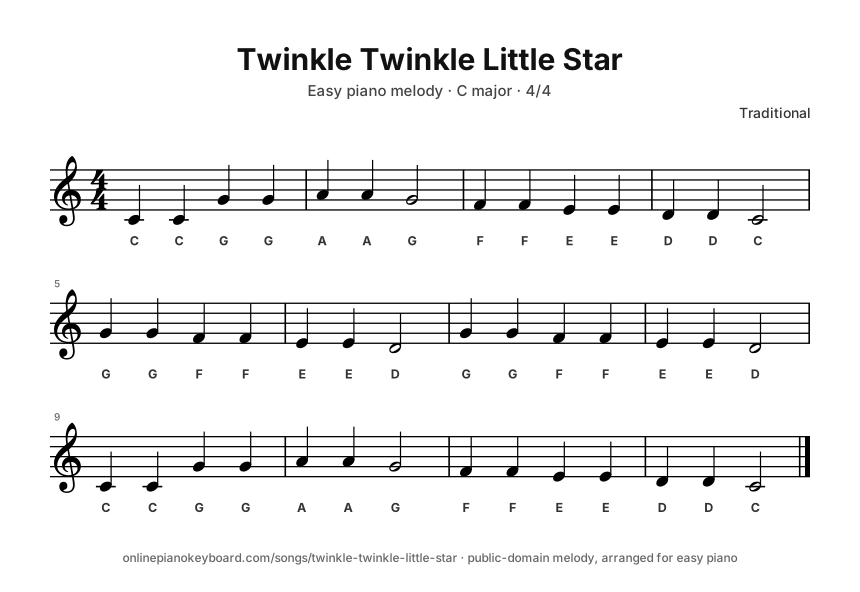
The sheet music and letter notes for Twinkle Twinkle Little Star are shown above, with a keyboard that plays the song for you in Listen mode and waits for you in Practice mode. The tune uses six white keys, C, D, E, F, G and A, and it starts and ends on middle C. It also repeats itself a great deal: learn two short lines and you know the whole song.
Where the tune comes from
The melody is older than the words. It is a French tune, "Ah! vous dirai-je, maman," first published in 1761. The English words come from "The Star," a poem by Jane Taylor that appeared in 1806 in Rhymes for the Nursery, a collection she wrote with her sister Ann. The same melody is sung as the ABC song and as "Baa, Baa, Black Sheep," and Mozart wrote a set of twelve variations on the French tune for piano.
How to play it
Put your right hand in the C position: thumb (finger 1) on middle C, then fingers 2, 3, 4 and 5 on D, E, F and G. Every note in the song is now under a finger except A, the white key just to the right of G. When the tune reaches its two As, stretch your little finger over to A, then bring it back to G for the note that follows.
The song opens with a jump from C up to G, from your thumb straight to your little finger. After the As, the first line walks back down to C one key at a time, mostly in pairs. The middle line never goes above G or below D, so fingers 5, 4, 3 and 2 cover it with no stretch at all: it steps down from G to D in pairs of notes, then does the same thing again.
Count four beats in every bar. Each letter gets one beat except the note that ends every second bar, which is held for two: the G after the two As, the C that closes the first line, and the long Ds in the middle line. If you say the first line of the words, "Twinkle, twinkle, little star," as you play, each syllable lands on one key and "star" is the long G.
Add the left hand
The lower staff gives a simple accompaniment using C3, F3 and G3, all in the left hand's C position. Place finger 5 on C3, finger 2 on F3 and the thumb on G3. In the first bar, hold C3 for four beats while the right hand plays four separate notes. The next bar changes from F3 to C3 after two beats. Read the note values on the lower staff to find the later changes.
Choose Left hand and press Listen, then Practice. When that part is familiar, choose Both hands. Green keys show each new attack: a bass note you are already holding does not need to be pressed again when the next melody note starts. Practice does not measure how long you hold it, so use Listen at 50% to check the rhythm. The score and Print button include both hands; the printable section also has the melody alone.
Practice tips
- Repeat keys cleanly. Nearly every note comes twice in a row, so let the key rise all the way before you press it again.
- Learn the middle line on its own. It is one short idea played twice, and once it is secure only the first line is left, since the last line repeats it.
- Look ahead to G. Every jump in this song goes up to G, from C or from D, so glance at G before you leave the note below it.
- Say the finger numbers. For the first line they are 1 1 5 5 5 5 5, then 4 4 3 3 2 2 1, with the little finger stretching to A in the middle.
If middle C and finger numbers are new to you, the lessons on the piano keys and hand position cover both. After this song, Mary Had a Little Lamb needs only four keys, and London Bridge Is Falling Down uses the same six as this one. Once you can play Twinkle all the way through, record it on the full piano and share the link with someone.
Printable sheet music
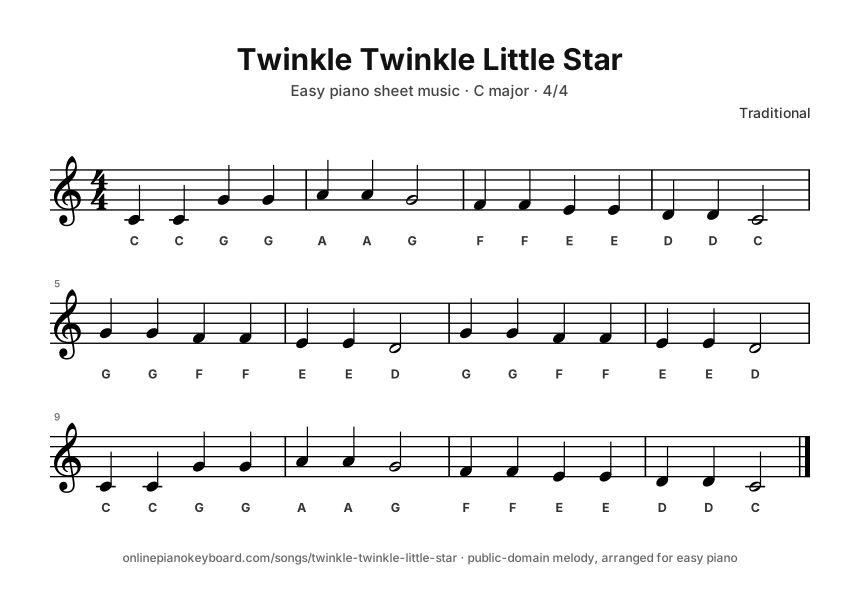
Here is the two-hand beginner arrangement, with the letter name under every note. Open the image to print or save it. The Print sheet music button above the keyboard lays the score out across paper pages. You can also open the melody-only sheet.
Frequently asked questions
What are the letter notes for Twinkle Twinkle Little Star?
The full letter notes are shown at the top of this page. The first line is C C G G A A G, then F F E E D D C, and the last line repeats it exactly.
What key is Twinkle Twinkle Little Star in?
This version is in C major. The melody uses white keys from middle C to the A above it. The optional left-hand accompaniment uses the lower C3, F3 and G3.
Which fingers do I use for Twinkle Twinkle Little Star?
Use your right hand in the C position, with your thumb on middle C and one finger on each white key up to G. For the two As, stretch your little finger one key to the right, then bring it back to G.
How do I play Twinkle Twinkle Little Star with both hands?
Choose Left hand to learn the C3, F3 and G3 bass notes shown on the lower staff, then choose Both hands. In the first bar, hold C3 for all four beats while the right hand plays C C G G. The two-hand sheet prints from the button above the keyboard.
Is Twinkle Twinkle Little Star in the public domain?
Yes. The French melody was published in 1761 and Jane Taylor's English words in 1806, so both are long out of copyright.
Is Twinkle Twinkle Little Star the same tune as the ABC song?
Yes. The ABC song and "Baa, Baa, Black Sheep" are sung to the same melody, with the rhythm adjusted in places to fit their words.