The sheet music and letter notes for Mary Had a Little Lamb are at the top of this page, and the keyboard with them can play the song for you or light each key in turn while you play it yourself. The melody needs only four notes, C, D, E and G, all white keys within reach of one hand near middle C. Your fingers never have to move to a new position, so all of your attention can go to playing the notes in the right order.
About the song
The words come from "Mary's Lamb," a poem by the American writer Sarah Josepha Hale, published in Boston in 1830 in her book Poems for Our Children. In the 1830s the composer Lowell Mason set the rhyme to music. The tune most people know today, credited as traditional, is also sung as "Merrily We Roll Along." The rhyme has a place in the history of sound recording too: in 1877 Thomas Edison recited it as the first recording on his newly invented phonograph.
How to play it
Put your right hand in the C position: thumb on middle C and one finger on each white key up to G. Finger 4 has nothing to do in this song, because the key under it, between E and G, is never played; let it rest there so your hand keeps its shape. The melody starts on E with finger 3 and turns down to C and back up again, so the first notes are played by fingers 3, 2, 1, 2 and then 3 again.
The one stretch comes at the end of the first line, where the tune jumps from E to G, skipping the key between them. Both Gs go to finger 5, and the second is held.
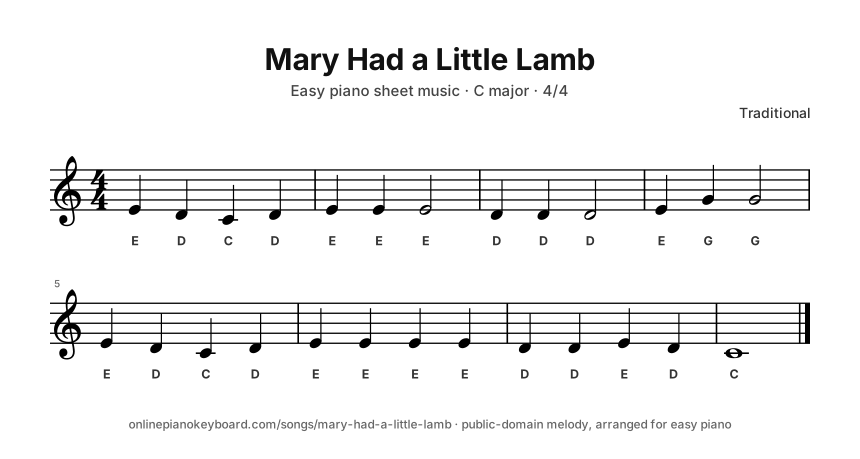
Count four beats in each bar. Most notes get one beat; the last note of the second, third and fourth bars gets two, and the final C gets all four. The second line begins exactly like the first, but where the first line held its third E, the second plays four even Es, and from there it heads home to that long C.
Practice tips
- Name the fingers first. The opening goes 3, 2, 1, 2, 3, 3, 3. Say it once, then play it without looking at your hand.
- Practice the leap to G by itself. Go from finger 3 on E to finger 5 on G a few times until your little finger finds the key on its own.
- Keep your thumb over C even while it rests. The thumb is the anchor that stops your hand from drifting up the keyboard.
- Hear the difference between the lines. The long E in the first line and the four short Es in the second are the easiest place to go wrong, and Listen mode makes the difference clear.
This song is also taught step by step in the first song lesson, alongside Ode to Joy. Afterward, try Hot Cross Buns, which uses three of these keys, or Twinkle Twinkle Little Star, which adds two more keys. And since Edison chose this rhyme for his first recording, it is a fitting first song to record yourself: the full piano records what you play and gives you a link that plays it back for anyone who opens it.
Printable sheet music
Here is the same arrangement on a single page, with the letter name under every note. Open the image to print it or save it; the Print sheet music button above the keyboard prints it too.
Frequently asked questions
What are the letter notes for Mary Had a Little Lamb?
You can read them at the top of this page. The first line is E D C D E E E, D D D, E G G, and the second line starts the same way.
What key is Mary Had a Little Lamb in?
This version is in C major and ends on C, so every note is a white key. Its four notes, C, D, E and G, sit side by side except for one skipped key between E and G.
Which fingers play Mary Had a Little Lamb?
Use your right hand in the C position: thumb on middle C, finger 2 on D, finger 3 on E and finger 5 on G. Finger 4 rests on the key between E and G but never plays.
How do I play Mary Had a Little Lamb with both hands?
Hold a low C with your left hand under each bar, except the third bar and the second-to-last bar, which are mostly D: play a low G under those. End on C in both hands together.
Who wrote Mary Had a Little Lamb?
The words are by Sarah Josepha Hale, who published them as "Mary's Lamb" in 1830. The composer Lowell Mason set the rhyme to music in the 1830s, and the tune is credited as traditional.
Is Mary Had a Little Lamb in the public domain?
Yes. The words were published in 1830 and the tune is traditional, so you are free to play it, record it and share your recording.