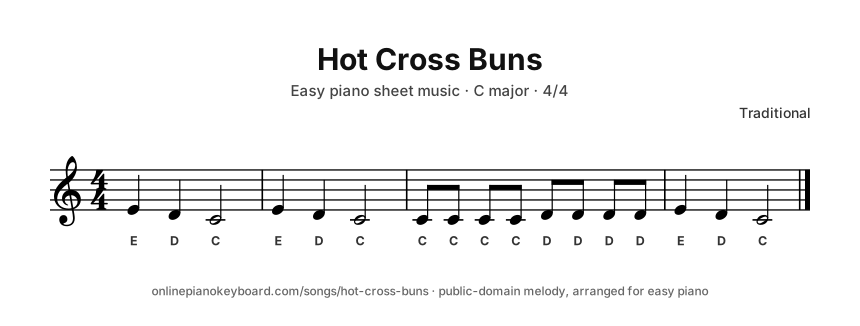
The sheet music and letter notes for Hot Cross Buns are shown above. The whole song uses three neighboring white keys, C, D and E, so your right thumb, index finger and middle finger can each stay on one key from the first note to the last. Choose Listen to hear the tune, then Practice to play it with each next key lit up for you.
About the song
Hot Cross Buns began as an English street cry, called out by sellers of the spiced, cross-marked buns eaten on Good Friday. Lines of the cry were printed in Poor Robin's Almanack for 1733, and it later settled into the nursery as a rhyme. It has also served for a long time as a teaching tune for children starting a new instrument, and on the piano it fits under three fingers with nothing to spare.
How to play it
If you are not sure where middle C is, the lesson on piano keys shows how to find it using the black keys. Put your right thumb on middle C, finger 2 on D and finger 3 on E. From then on, E is always finger 3, D always finger 2 and C always your thumb.
The first line is one short figure played twice: three notes stepping down from E to C, with the C held for two beats. That figure comes back to end the song, so you play it three times in all. In those bars, count "1, 2, 3-4": E on 1, D on 2, and C held through 3 and 4.
The second line opens with the only quick notes in the song, four Cs and then four Ds, each lasting half a beat. Count them "1 and 2 and" for the Cs and "3 and 4 and" for the Ds, so every note falls on a number or on an "and." The line then finishes with the same falling figure as the first line.
If you would rather play on your computer keyboard, set Labels to Computer keys, and each piano key shows the letter on your keyboard that plays it.
Practice tips
- Tap the quick bar first. Before playing the second line, tap its rhythm on a table: eight quick, even taps, then two longer ones and one held twice as long.
- Keep repeated notes light. For four Cs in a row, let the key rise a little each time and press again with the same thumb; keep your wrist still and move only the finger.
- Don't rush the Ds. The usual slip is to hurry the four Ds after the Cs. Say the counting out loud until both groups take the same time.
- Listen for evenness. Play the song in Listen mode and notice how steady the quick bar sounds, then match it.
The hand position lesson explains finger numbers and the C position this song is built on. When Hot Cross Buns feels easy, Mary Had a Little Lamb uses these same three keys and adds one more. Short songs make good first recordings, too: play it on the full piano, then download it as a MIDI file or copy a share link.
Printable sheet music
Here is the same arrangement on a single page, with the letter name under every note. Open the image to print it or save it; the Print sheet music button above the keyboard prints it too.
Frequently asked questions
What are the letter notes for Hot Cross Buns?
The whole tune is written out at the top of this page. The first line is E D C, E D C, with each C held for two beats.
What key is Hot Cross Buns in?
It is written in C major and ends on C. It uses only C, D and E, the first three notes of the C major scale, so every key is white.
Which fingers play Hot Cross Buns?
Your right thumb plays C, finger 2 plays D and finger 3 plays E. No finger ever moves to a different key, which makes it an ideal first song.
How can I add my left hand to Hot Cross Buns?
Play a low C with your left hand on the first beat of every bar. Because each bar starts on E or C, that single note fits all four bars, and it is an easy first step toward playing with both hands.
Where does the name Hot Cross Buns come from?
Hot cross buns are spiced buns marked with a cross and eaten on Good Friday. The rhyme began as the street cry of people selling them in England, was in print by 1733, and later became a nursery rhyme.
Is Hot Cross Buns in the public domain?
Yes. It is a traditional English rhyme printed in the 18th century, so the words and tune are free for anyone to play, record and share.