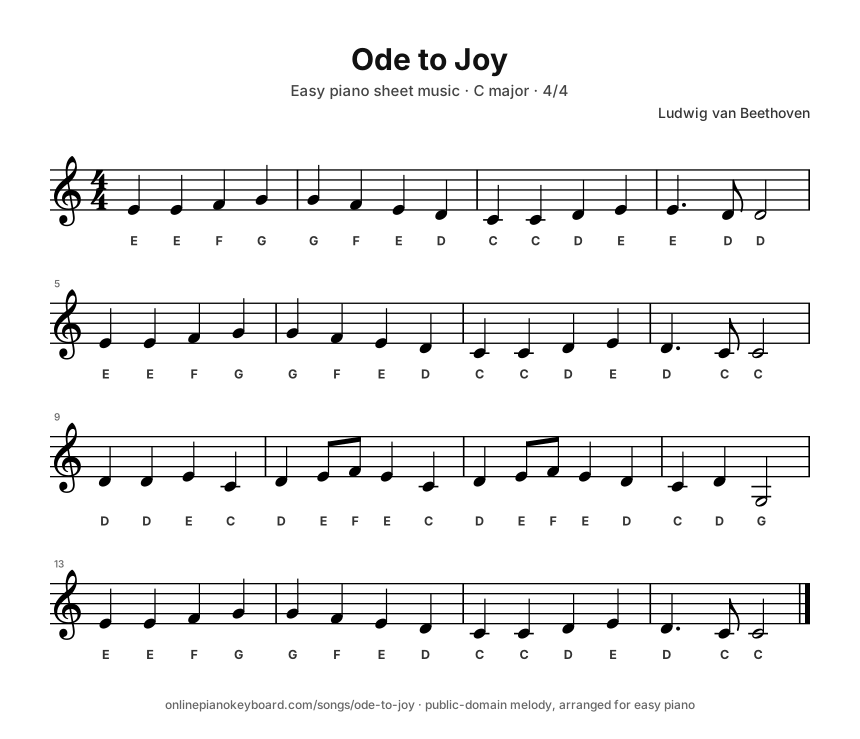
The sheet music and letter notes for Ode to Joy are shown above, with a keyboard that plays the theme in Listen mode and waits for you in Practice mode. Nearly the whole melody lies in the C position, C, D, E, F and G under the five fingers of your right hand, and most of it moves by step from one key to the next. Only one note, a low G in the third line, sits outside that position.
About the music
Ode to Joy is the main theme of the final movement of Ludwig van Beethoven's Symphony No. 9, which he completed in 1824. It was first performed in Vienna that May, when Beethoven was almost completely deaf. The movement sets "An die Freude" ("To Joy"), a poem Friedrich Schiller wrote in 1785, for vocal soloists and chorus. In the symphony the theme is introduced by the cellos and double basses in D major; the version here is in C major, which keeps it on the white keys. The melody has been the anthem of the Council of Europe since 1972 and of the European Union since 1985.
How to play it
Place your right thumb on middle C and let fingers 2, 3, 4 and 5 fall on D, E, F and G. The tune opens on E with finger 3, climbs to G and walks back down, so the first two bars are played 3, 3, 4, 5, 5, 4, 3, 2.
Three of the four lines are nearly identical: they share their first three bars and differ only in the last. The first line ends on D and sounds unfinished, like a question; the second and fourth lines end on C and sound like the answer. All three endings use the same rhythm, a dotted note, a short note and a long one. Say "1, 2-and, 3, 4" as you play it: the dotted note lasts a beat and a half, the short note slips in on the "and" of 2, just before 3, and the last note fills counts 3 and 4.
The third line is the one to practice on its own. It starts on D, has two quick pairs of E and F, each note half a beat, and ends with a jump from D down to the G below middle C, marked G3 in the letter notes; the last line then jumps straight back up to E. That low G is the only note outside the C position, so play it with your left thumb: when your left hand rests in its own C position, with the little finger on the C below middle C, its thumb sits right on that G.
Practice tips
- Master the first line. The second and fourth lines only change its ending, so one line learned well is most of the song.
- Work through the third line in Practice. Practice waits for each key, so take the quick E and F pairs and the drop to the low G at whatever pace you need.
- Keep your fingers home. In the first, second and last lines no finger ever needs to move, so if you find yourself stretching, a finger is on the wrong key.
The first song lesson walks through Ode to Joy step by step in the C position, and basic chords shows how chords like C and G support a melody. For a longer-term goal, try Beethoven's Für Elise, rated intermediate.
Printable sheet music
Here is the same arrangement on a single page, with the letter name under every note. Open the image to print it or save it; the Print sheet music button above the keyboard prints it too.
Frequently asked questions
What are the letter notes for Ode to Joy?
All four lines are at the top of this page. The first phrase is E E F G, G F E D, C C D E, E D D, with that last E held for a beat and a half and the final D for two.
What key is Ode to Joy in?
This version is in C major, on white keys only. Beethoven's orchestra plays the theme in D major; in C major it fits the C position.
Which fingers do I use for Ode to Joy?
Use your right hand in the C position, with the thumb on middle C and one finger on each key up to G. The only note outside that position is the low G at the end of the third line, which your left thumb can play.
How do I play Ode to Joy with both hands?
With your left hand in its own C position, play C under the first and third bars of the first, second and fourth lines and G under the second and fourth, changing from G to C in the last bar of lines two and four. In the third line, play G under each D and C under each C or E, and let your left thumb take the low G.
Did Beethoven write the words to Ode to Joy?
No. The words are from "An die Freude," a 1785 poem by Friedrich Schiller; the melody is Beethoven's own.
Is Ode to Joy in the public domain?
Yes. Beethoven completed the Ninth Symphony in 1824 and died in 1827, so the melody has long been in the public domain.