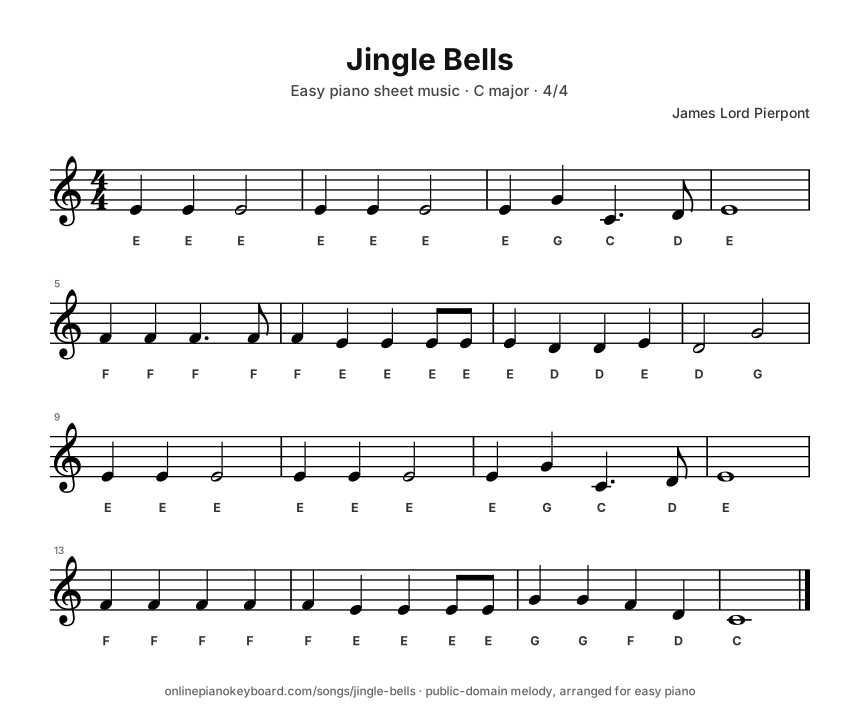
The sheet music and letter notes for Jingle Bells are shown above, and the keyboard with them can play the tune in Listen mode or lead you through it one lit key at a time in Practice mode. The notes are the chorus, the part that begins with the words of the title, and they use exactly five keys: C, D, E, F and G. Put one finger on each and your hand never has to move.
About the song
James Lord Pierpont published the song in 1857 as "The One Horse Open Sleigh," and it was republished in 1859 as "Jingle Bells, or The One Horse Open Sleigh." Its words describe a sleigh ride in the snow and never mention Christmas; the song became tied to winter and Christmas in the 1860s and 1870s. Medford, Massachusetts, and Savannah, Georgia, have both claimed to be where Pierpont wrote it, but where and when he composed it is not known. In December 1965 it was even played in space: during the Gemini 6 mission, astronauts Wally Schirra and Tom Stafford performed it on a tiny harmonica and a set of bells.
How to play it
Rest your right thumb on middle C and your other fingers on the next four white keys, so finger 2 is on D, 3 on E, 4 on F and 5 on G. Finger 3 does most of the work, because E is the note this song repeats most: in the first line, eight of the eleven notes are Es. Group them in threes as you play. After the two groups of three, the tune reaches up to G with finger 5, drops to C with your thumb and climbs back through D to a long E.
That C is dotted: it lasts a beat and a half, and the D after it lasts half a beat. Play C on beat 3, hold it through beat 4, and play D on the "and" just before the next bar. The E that follows is held for all four beats of its bar.
The second line starts with five Fs on finger 4, the third of them dotted, then moves down to a run of Es and ends on two long notes, a D and a G, that lead back to the start of the chorus. The third line repeats the first exactly. The fourth line starts like the second, with even Fs this time, and ends by coming down to a long C.
Practice tips
- Count every E out loud. Most slips in this song are one E too many or too few. Say "1, 2, 3-4" for each group of three, with the third E held.
- Learn the two endings side by side. The second and fourth lines differ mainly at the end: one rises to G, the other comes home to C. Once you can tell them apart, you know the whole chorus.
- Play the Es from the finger, not the arm. Keep your wrist loose and let finger 3 do the repeating, so the notes stay light and even.
- Use Practice for the dotted notes. Practice waits for each key, so you can check exactly where the quick D and the quick fourth F fall before you play the chorus straight through.
For the left hand, the answers below use C, F and G, the three main chords of C major covered in basic chords. For a winter pair, try Silent Night next, and if you want another tune that sits in the same hand position for all but one note, try Ode to Joy.
Printable sheet music
Here is the same arrangement on a single page, with the letter name under every note. Open the image to print it or save it; the Print sheet music button above the keyboard prints it too.
Frequently asked questions
What are the letter notes for Jingle Bells?
The whole chorus is written out at the top of this page. It opens E E E, E E E, E G C D E, with the third E of each group held for two beats and the final E for four.
What key is Jingle Bells in here?
It is in C major and 4/4 time, and it uses only the white keys C, D, E, F and G. That makes it a five-finger song, with one finger for each key and no stretches.
Which fingers play Jingle Bells?
Put your right thumb on middle C and fingers 2, 3, 4 and 5 on D, E, F and G. Finger 3 plays every E, which is about half of all the notes.
How do I play Jingle Bells with both hands?
Play one low note per bar with your left hand. Use C for every bar of the first and third lines; in the second line use F, C, G and G, and in the last line F, C, G and C.
Is this the whole of Jingle Bells?
No. These are the notes of the chorus, the best-known part of the song; the verses that come before it have a different melody.
Is Jingle Bells in the public domain?
Yes. James Lord Pierpont published it in 1857, so the melody and the original words are in the public domain. Newer arrangements and recordings can have their own rights, but the tune itself is free to play.