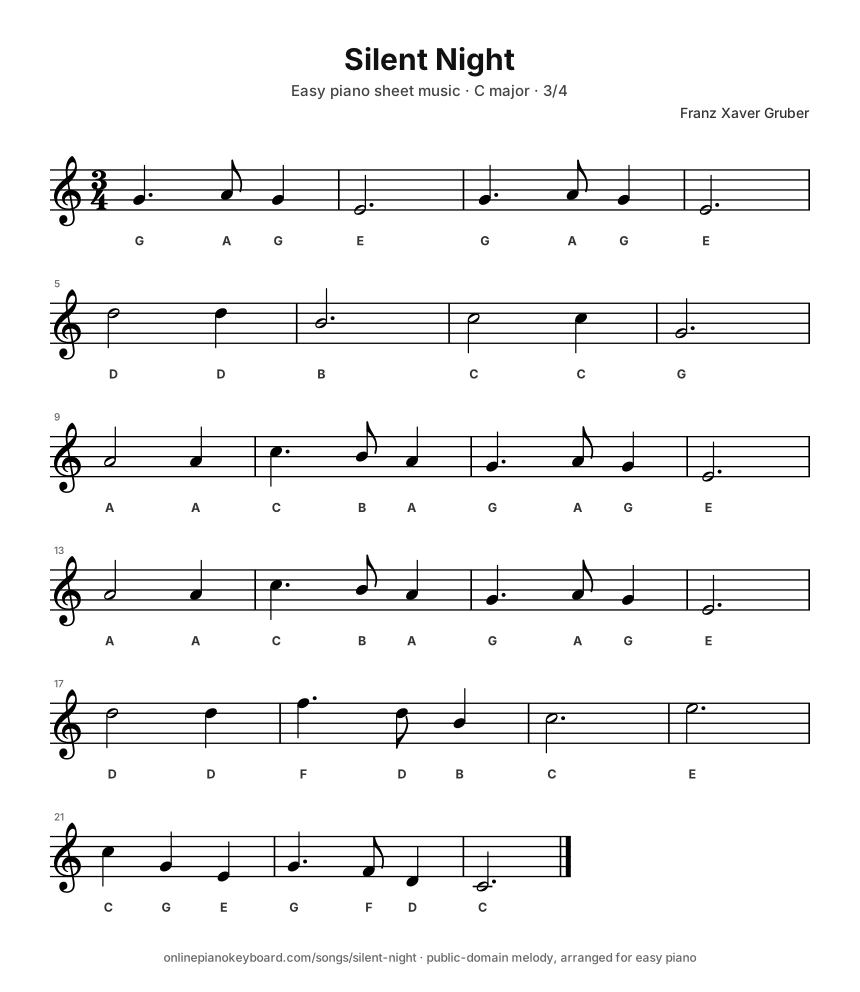
The Silent Night sheet music above is in C major, with the letter name under every note; the Letter notes tab lists the same notes as text. The carol uses only white keys, from middle C up to the F more than an octave above it, and it moves gently, mostly by step. Its lilting rhythm, a long note, a short one, then a note on the beat, runs through almost every line, so once the first bar feels right, much of the rest follows.
About Silent Night
Silent Night began as "Stille Nacht, heilige Nacht", a German carol with words by Joseph Mohr and music by Franz Xaver Gruber. It was composed in 1818 in Oberndorf, a small town near Salzburg in Austria, where Mohr was the assistant priest and Gruber a schoolteacher and organist. It was first sung there on Christmas Eve that year, with a guitar accompaniment.
The English words most people sing today come from a translation made in 1859 by John Freeman Young, an American clergyman. As the carol traveled, its tune changed a little too: the melody most English-speaking singers know differs slightly from Gruber's original in a couple of places. This page uses that common English-language version.
How to play Silent Night
The melody covers more than an octave, so plan on moving your right hand a few times. Practice waits for you at every key, which makes it a good place to work out each move.
- Opening. Put your thumb on E, the E just above middle C, so finger 3 rests on G and finger 4 on A. The first line is then fingers 3 4 3 1, twice.
- The leap. The second line jumps from E up to D, almost an octave higher. Move your whole hand up so your thumb is on G and your little finger on D; the line then fits under your fingers (5 5 3, then 4 4 1).
- The middle. The third and fourth lines are the same. Each starts on A with your thumb on G, then returns to the opening pattern, so move back to the E position for its last four notes.
- The high point. The fifth line climbs to F, the highest note in the song. Put your thumb on B so your little finger can reach F; the E that follows is finger 4.
- The ending. The last line comes down to middle C, the final note, which lasts a full bar.
Counting in 3/4
Silent Night is in 3/4, three beats to a bar. The opening uses a dotted rhythm: G lasts a beat and a half, A is a quick half beat, and the next G takes beat 3. Count "1 2-and 3": play G on 1 and hold it through 2, play A on the "and", and G on 3. The E after it lasts a whole bar, three counts.
The same long-short pattern comes back in every line except the second, so it is worth getting it smooth at the start.
Practice tips
- Learn the repeats once. The two halves of the first line are the same, and so are the third and fourth lines, so there is less to learn than it looks.
- Practice the leap on its own. Play E, then jump to the high D, a few times on the keyboard until your hand lands there without searching.
- Keep it calm. Silent Night is a quiet carol; it sounds best slow and even, with every long note given its full count before you move on.
- Add sustain on the full piano. The main piano has a sustain pedal on the space bar and can record what you play, so you can listen back to your own Silent Night.
For another carol, try Jingle Bells; for another gentle tune in 3/4, try Brahms' Lullaby.
Printable sheet music
Here is the same arrangement on a single page, with the letter name under every note. Open the image to print it or save it; the Print sheet music button above the keyboard prints it too.
Frequently asked questions
What are the letter notes for Silent Night?
The complete letter notes are shown above. The first line is G A G E, played twice, with the E held for a full bar each time.
What key and time signature is Silent Night in?
This version is in C major and 3/4 time, three beats to a bar, and it uses only white keys.
Which fingers should I use for Silent Night?
Start with your right thumb on E so fingers 3 and 4 cover G and A. Move your thumb up to G for the line that leaps to the high D, and higher again, thumb on B, for the line that reaches F.
Who wrote Silent Night?
Franz Xaver Gruber composed the melody in 1818 in Oberndorf, Austria, to German words by Joseph Mohr. The English words most people sing come from John Freeman Young's translation of 1859.
Is this the original melody?
It is the melody most English-speaking singers know. It differs slightly from Gruber's original in a couple of places, but it is the same carol.
Is Silent Night in the public domain?
Yes. The carol dates from 1818, so the music is free to play, record and share.