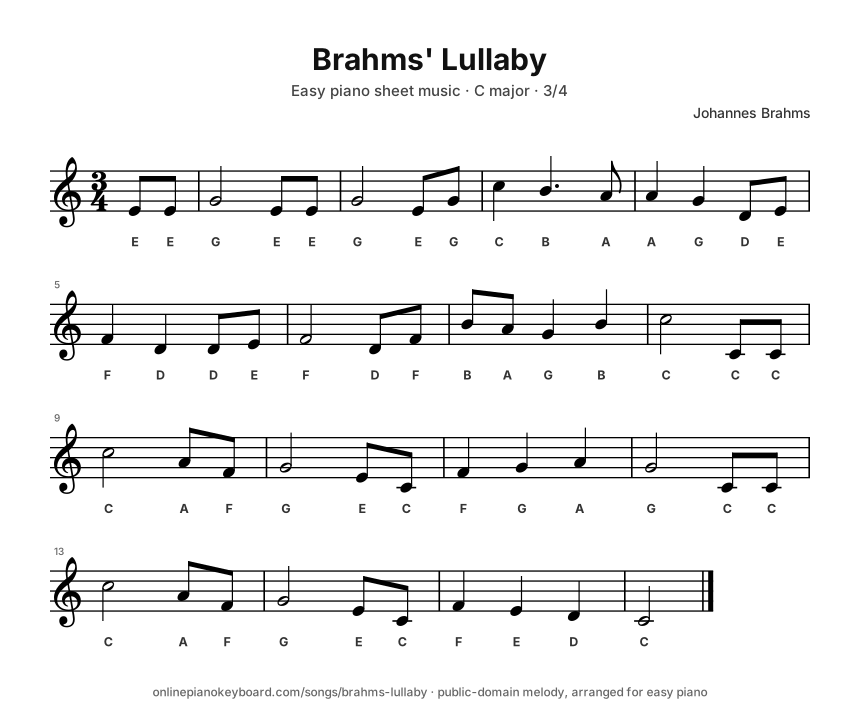
The Brahms' Lullaby sheet music above is in C major, with the letter name under every note; the Letter notes tab lists the same notes as text. Every note is a white key between middle C and the C an octave above it, and the melody sways gently in 3/4 time, like a rocking cradle. Most bars end with a pair of quick notes that lead into the next bar, which gives the song its soft, swinging feel.
About Brahms' Lullaby
Johannes Brahms (1833–1897) wrote "Wiegenlied: Guten Abend, gut' Nacht" (Cradle Song: Good evening, good night) in 1868 and published it that year as Op. 49 No. 4, one of a set of five songs for voice and piano. He wrote it for his friend Bertha Faber to celebrate the birth of her son. The words of the first verse come from Des Knaben Wunderhorn, a well-known collection of German folk poetry.
The original is a song for voice with a piano accompaniment. This page gives the vocal melody on its own, in C major, so you can play it with one hand.
How to play Brahms' Lullaby
This is a short song, but the melody moves around the octave, so your hand shifts a few times. These positions cover the tricky parts:
- The opening. Put your thumb on E, finger 2 on G, 3 on A, 4 on B and 5 on the high C, skipping the white key between E and G. This slightly open hand covers the whole first line until the tune dips down to D.
- The dip to D. Move your thumb down to D, so fingers 1, 2 and 3 cover D, E and F. When the tune climbs again toward the high C, move up so your thumb is on G.
- The octave leap. Each line of the second half starts on the high C, reached by a jump from two quick middle Cs. Play the middle Cs with your thumb, then move your whole hand up so your little finger lands on the high C. With your thumb now on F, the next notes, A and F, are fingers 3 and 1.
- The same shape again. The notes that follow, G E C, use the same fingers, 5 3 1, back in C position with your thumb on middle C.
Counting in 3/4
Count "1 2 3" in every bar. The quick pairs are eighth notes that share one beat, usually the third, so count them "3-and". The song starts with one such pair, E E, on "3-and" before the first full bar, and the G that follows lasts two beats.
Keep the pairs light and the long notes full. In a lullaby the long notes carry the tune, and the quick pairs just rock toward the next bar.
Practice tips
- Play it softly. A lullaby should sound calm. On the full piano, a MIDI keyboard lets you play quietly, because the sampled grand piano sounds softer when you press the keys gently.
- Practice the leap first. Before playing the second half, jump from middle C to the C above it a few times on the keyboard. Look at the high C before you leave the low one.
- Hum the German first line. "Guten Abend, gut' Nacht" fits the first six notes and helps you feel the swing of 3/4.
- Learn the second half as one pattern. Its two lines start the same way, with the high C and the same 5 3 1, 5 3 1 shape; only their endings differ.
For another gentle 3/4 tune with a long history, try Silent Night.
Printable sheet music
Here is the same arrangement on a single page, with the letter name under every note. Open the image to print it or save it; the Print sheet music button above the keyboard prints it too.
Frequently asked questions
What are the letter notes for Brahms' Lullaby?
The complete letter notes are shown above. The melody starts E E G, E E G, E G, then rises to C and steps back down: C B A, A G.
What key and time signature is Brahms' Lullaby in?
This version is in C major and 3/4 time, three beats per bar, using only white keys. It starts with two quick pickup notes before the first full bar.
What is the original title of Brahms' Lullaby?
Wiegenlied: Guten Abend, gut' Nacht, Op. 49 No. 4, which means Cradle Song: Good evening, good night. Brahms published it in 1868.
What is the hardest part to play?
The octave leap in the second half, where two quick middle Cs jump to the C an octave higher. Play the low Cs with your thumb, then move your whole hand so your little finger lands on the high C.
Is Brahms' Lullaby good for beginners?
Yes, once you can play a simple five-finger tune. It uses only white keys and a gentle rhythm, but your hand moves a few times, so it makes a good next step after the very easy songs.
Is Brahms' Lullaby in the public domain?
Yes. Brahms published it in 1868 and died in 1897, so the melody is free to play, record and share.