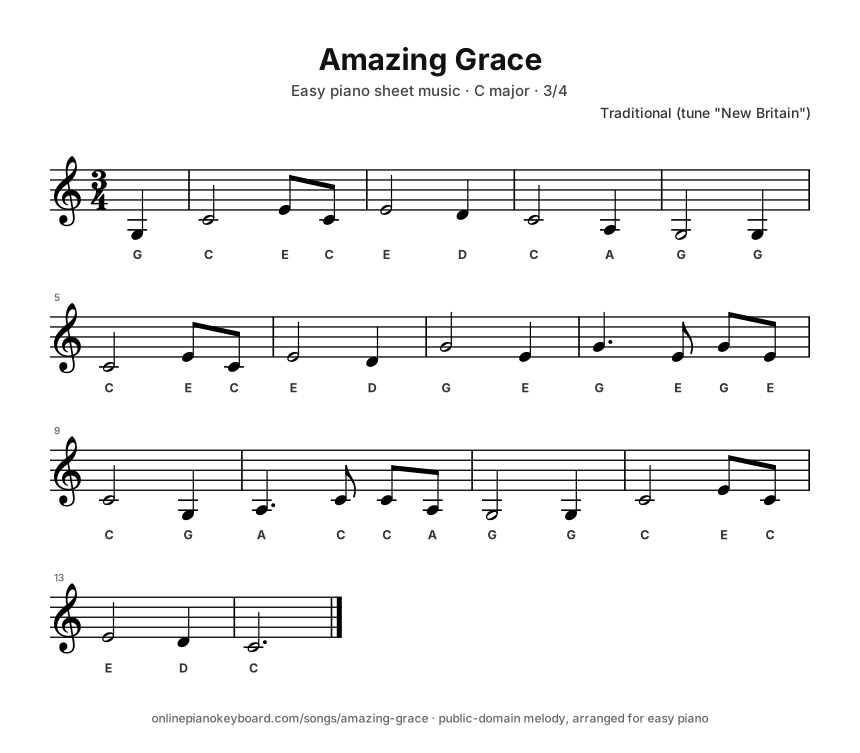
The Amazing Grace sheet music above is written in C major, with the letter name under every note; the Letter notes tab lists the same notes as text. The melody uses only five different notes, C, D, E, G and A, spread over one octave from the G below middle C to the G above it. All of them are white keys, and the tune moves in small steps and skips at a slow, singing pace, which makes it a good first hymn.
About Amazing Grace
The words were written by John Newton, an English clergyman who had earlier worked in the Atlantic slave trade. They were published in 1779 in Olney Hymns, a collection he made with the poet William Cowper.
The tune almost everyone sings today is called New Britain. It was first printed in 1829, in an American tune book, and its composer is unknown. Newton's words and this tune were joined a few years later; the pairing is usually traced to William Walker's tune book Southern Harmony (1835).
The melody's five notes, C, D, E, G and A, form the C major pentatonic scale, a five-note scale that is common in folk music around the world. You can hear it on its own on the scales page by choosing C and Major pentatonic.
How to play Amazing Grace
The melody spans eight white keys, from G3 up to G4, so it does not quite fit under five fingers. This plan needs just one move up and back:
- Starting position. Put your right thumb on G3, the G just below middle C, finger 2 on A, finger 3 on middle C, 4 on D and 5 on E. Leave out the white key between A and middle C; the hymn never uses it. The whole first line fits under your hand.
- The high G. Near the end of the second line, the tune climbs to G4, the G above middle C. Move your hand up so your thumb is on middle C and your little finger on G. The quick notes that follow swing between G and E, fingers 5 and 3.
- Back down. When the melody returns toward the low G, move back to the starting position.
Counting in 3/4
Amazing Grace is in 3/4, three beats to a bar, so count "1 2 3". The song begins with a single pickup note, the low G, on beat 3 before the first full bar. The first full bar holds middle C for two beats and fits two quick notes, E and C, into the third: count "1 2 3-and".
In the third line, two bars use a dotted rhythm: the first note lasts a beat and a half, and three quick notes fill the rest of the bar. Count "1 2-and 3-and", letting the long note lean into the quick ones. The final C lasts the whole last bar, three beats.
Practice tips
- Sing or hum as you play. On the first line, "Amazing grace, how sweet the sound", the syllable "-zing" falls on the two quick notes, E and C.
- Rehearse the move. Practice waits for you, so you can take the shift up to the high G slowly until your hand finds it without looking.
- Add chords later. The hymn can be accompanied with the three primary chords of C major, I, IV and V; the basic chords lesson shows how to play them under a melody.
For another slow tune in 3/4, try Silent Night.
Printable sheet music
Here is the same arrangement on a single page, with the letter name under every note. Open the image to print it or save it; the Print sheet music button above the keyboard prints it too.
Frequently asked questions
What are the letter notes for Amazing Grace?
The complete letter notes are shown above. The first line reads G, then C E C, E D, C A and G G: it starts on the G below middle C, rises to E and settles back on G.
What key and time signature is Amazing Grace in here?
This version is in C major and 3/4 time, three beats per bar, and it starts with a one-beat pickup. Hymnals print it in other keys too; C major keeps every note on a white key.
Which fingers should I use for Amazing Grace?
Start with your right thumb on the G below middle C, finger 2 on A, 3 on middle C, 4 on D and 5 on E. When the tune climbs to the high G, move your hand up so your thumb is on middle C and your little finger on G, then come back down.
Why does the melody use only five different notes?
New Britain is a pentatonic tune: it uses the five notes of the major pentatonic scale, which in C are C, D, E, G and A. You can hear that scale on its own on the scales page.
Who wrote Amazing Grace?
John Newton wrote the words, published in 1779. The tune, New Britain, was first printed in 1829 and its composer is unknown, which is why the music is credited as traditional.
Is Amazing Grace in the public domain?
Yes. Newton's words and the New Britain tune are both well over 150 years old, so you can play, record and share them freely.