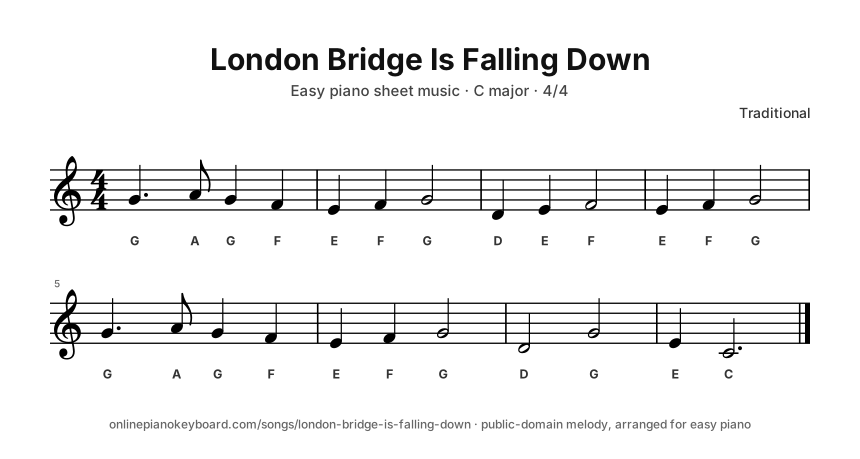
The sheet music and letter notes for London Bridge Is Falling Down are shown above, and the keyboard with them can play the song for you in Listen mode or light one key at a time in Practice mode. The song uses six white keys, C, D, E, F, G and A, but C appears only once, as the final note. For almost the whole tune, your hand rests on the five neighboring keys from D to A.
About the rhyme
London Bridge Is Falling Down is an English nursery rhyme and singing game, with versions dating to at least the 17th century. The tune most people know is younger: it was first written down in a collection published in the United States in 1879. In the game, two players join hands to make an arch and the others pass through it in a line; when the song ends, the arch drops to catch whoever is passing under. What the words first referred to is not known, and none of the many theories about them has been proven.
How to play it
Most beginner songs start in the C position, but this one does not. Put your right thumb on D, the white key just above middle C, and let fingers 2, 3, 4 and 5 rest on E, F, G and A. Now every note except the last is under a finger. The song opens on G with finger 4, touches A with finger 5 and comes back down, and much of the rest is made of short three-note climbs played with three neighboring fingers.
Each line starts with a dotted rhythm. The first G lasts a beat and a half and the A after it only half a beat, so count "1, 2-and": G on 1, A on the "and" after 2, then G on 3 and F on 4. Most of the other bars end with a note held for two beats.
The ending is the one spot that needs care. Near the end of the second line, the melody jumps from a long D up to a long G, fingers 1 and 4. Then it falls to E and finishes on middle C, held for three beats. Play the E with finger 2 and move your thumb one key to the left, from D to C, for that last note.
Practice tips
- Resist the C position. Starting with your thumb on C is a habit, but then no finger is left for A. Check that your thumb is on D before you begin.
- Say the first line of the words. Each syllable of "London Bridge is falling down" gets one key, which keeps the long-short opening in its place.
- Learn the first line, then the ending. The second line repeats the first two bars of the first line, so the only new material is its last two bars.
- Play the game. One person plays the song while the others make the arch, and the arch falls on the long final C.
After this song, Twinkle Twinkle Little Star uses the same six keys with your thumb starting on C, and Row, Row, Row Your Boat adds a high C and a rhythm in 6/8. The hand position lesson explains finger numbers if they are new to you.
Printable sheet music
Here is the same arrangement on a single page, with the letter name under every note. Open the image to print it or save it; the Print sheet music button above the keyboard prints it too.
Frequently asked questions
What are the letter notes for London Bridge Is Falling Down?
Both lines are shown in full at the top of this page. The first line is G A G F, E F G, D E F, E F G, with the first G held for a beat and a half.
What key is London Bridge Is Falling Down in?
It is in C major and 4/4 time. It uses only white keys and ends on middle C, even though that is the only C in the whole song.
Which fingers play London Bridge Is Falling Down?
Put your right thumb on D and fingers 2 to 5 on E, F, G and A. For the very last note, move your thumb one key down to middle C.
How do I play London Bridge Is Falling Down with both hands?
Use two low notes in your left hand, C and G. In each line, play C for the first two bars, G for the third and C for the fourth, holding each note for the whole bar.
How is the London Bridge game played?
Two players hold hands and raise their arms to make an arch, and the others walk under it in a line while the song is sung. When the song ends, the arch comes down and catches whoever is underneath.
Is London Bridge Is Falling Down in the public domain?
Yes. It is a traditional English rhyme with versions from at least the 17th century, and its usual tune was printed in 1879, so it is free to play and share.