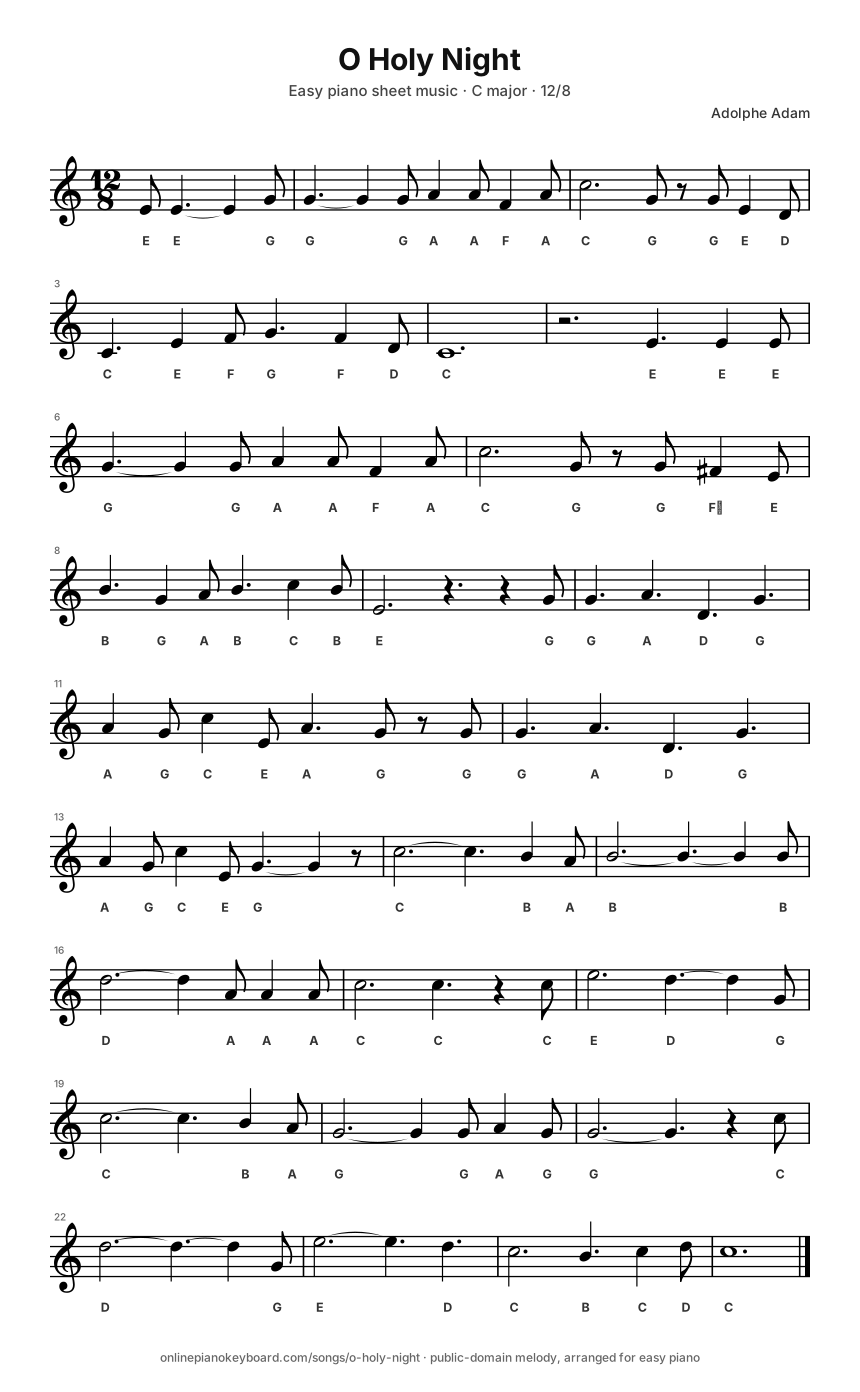
The O Holy Night sheet music above is written in C major and 12/8 time, with the letter name printed under every note; the Letter notes tab lists the same melody as plain letters. It covers the whole carol for one verse, from the quiet opening to the soaring final lines, arranged for the right hand alone. Listen plays it and highlights each note in the sheet as it goes, and Practice lights the next key and waits for you. The melody stays between middle C and the E an octave and a third above it and uses a single black key, F sharp, but its long tied notes make it an intermediate piece rather than a first song.
About O Holy Night
The carol began in 1847 in Roquemaure, a town in France, where the parish priest asked Placide Cappeau to write a new text for the Christmas Midnight Mass. Cappeau wrote the poem "Minuit, chrétiens" ("Midnight, Christians") in early December. Adolphe Adam, the composer of the ballet Giselle, set it to music within days, and it was first sung at Midnight Mass in Roquemaure that Christmas. The French title is Cantique de Noël.
The English words came in 1855 from John Sullivan Dwight, an American music critic, who rewrote the text rather than translating it word for word. His version, beginning "O holy night, the stars are brightly shining", is the English text most widely sung today.
Adam's early editions printed the voice part in 4/4 with dotted rhythms, over a piano part that moves in triplets. This arrangement keeps his melody in C major, the key of his edition for medium voice, leaves out two small grace notes, and writes it in 12/8, the rhythm singers actually use.
How to play O Holy Night
The first half of the carol is low and gentle; the second half climbs to its high point.
- The opening. Put your thumb on the E above middle C. The carol starts E, E, then three Gs, then A, A, F, A, before rising to the C above middle C. Stretch your little finger up for that C, then move your thumb down to middle C for the rest of the first line, which ends on middle C.
- The one black key. The second line starts like the first, but near its end the tune steps down G, F sharp, E. F sharp is the black key just right of F.
- The middle. The third line climbs from B to C and drops to the E above middle C. The fourth line has two phrases that each start G, A, D, G, reaching down to the D just above middle C; keep your hand around G and reach down for the D.
- The climb. The last three lines rise to their peak. Move your hand so your thumb rests on the A above middle C: B, C, D and E are fingers 2 to 5. The long high E, finger 5, is the top note of the carol, and it comes twice.
Counting the rhythm
In 12/8 each bar has four beats, and each beat divides into three eighth notes. Count "1-and-a 2-and-a 3-and-a 4-and-a", slowly. The carol starts with a long pickup: the first E comes on the last "a" of beat 2, the next E is held from beat 3 almost to the end of the bar, and G falls on the final "a". The first full bar begins with G held for most of two beats.
The most common rhythm inside a beat is long-short, a quarter note taking two of the three counts and an eighth note taking the last. Many notes are tied: a curved line joins two notes of the same pitch, and you hold the key down for both. At the end of the first line middle C is held for a whole bar, and the carol ends the same way on the C above middle C.
Practice tips
- Practice with Listen first. Hearing the rocking three-count beat a few times makes the written rhythm much easier to follow.
- Learn it in two halves. The first half has two similar lines and a short answering phrase; the second half builds to the climax.
- Hold the tied notes. Count every beat of a long note aloud instead of guessing, especially before a pickup.
- Keep it quiet at first. The carol grows toward its end; if you play on a keyboard with touch-sensitive keys, save your strongest notes for the high E.
For a simpler carol with the same gentle feel, try Silent Night, also in C major.
Printable sheet music
Here is the same arrangement on a single page, with the letter name under every note. Open the image to print it or save it; the Print sheet music button above the keyboard prints it too.
Frequently asked questions
What are the letter notes for O Holy Night?
It begins with the E above middle C twice, the second one held long, then G three times, the middle one held long. The complete letter notes are shown above.
What key and time signature is O Holy Night in here?
C major and 12/8. Each bar has four slow beats, and each beat divides into three eighth notes, which gives the carol its gentle rocking motion.
Why is it written in 12/8?
Adam wrote the voice part in 4/4 with dotted rhythms over a flowing triplet accompaniment, and singers fit those rhythms to the triplets. Writing the melody in 12/8 shows the rhythm the way it is sung.
Is O Holy Night hard to play?
It is an intermediate piece. The notes stay between middle C and the E an octave and a third above it, with only one black key, but the long tied notes and the pickup of more than half a bar take careful counting.
Who wrote O Holy Night?
Adolphe Adam composed the music in December 1847 for a French poem by Placide Cappeau, Minuit, chrétiens. The English words most people sing are John Sullivan Dwight's version from 1855.
Is O Holy Night in the public domain?
Yes. Adam's music dates from 1847 and Dwight's English words from 1855, so the carol is free to play and share. This simplified arrangement is our own.