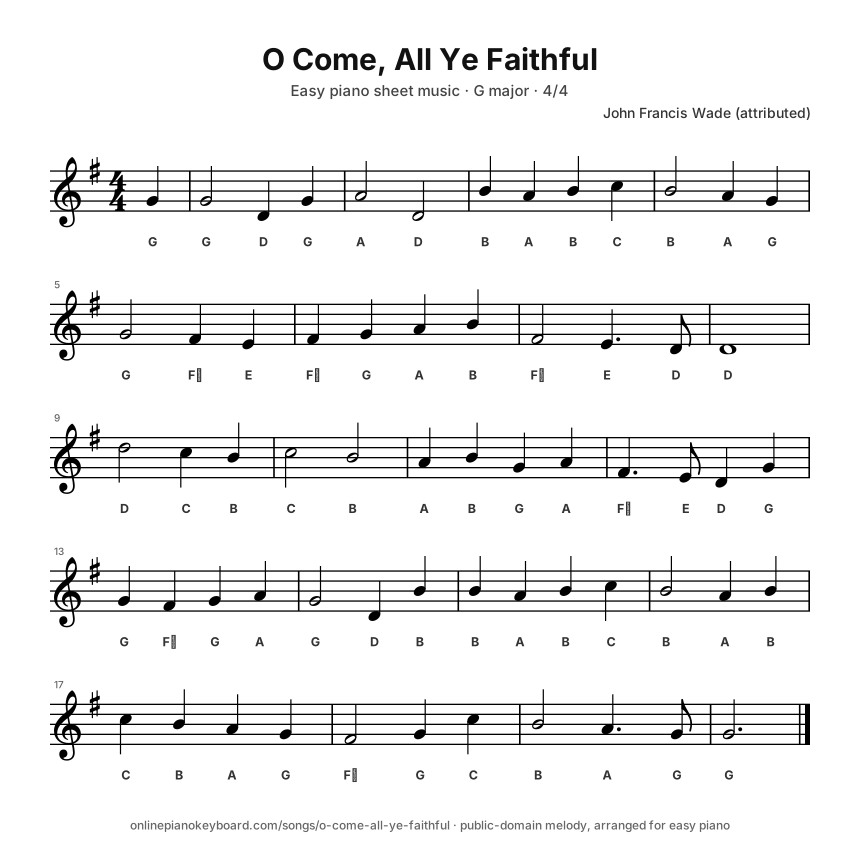
The O Come, All Ye Faithful sheet music above is in G major and 4/4 time, with the letter name printed under every note, and the Letter notes tab gives the same melody as plain letters. It covers one verse and the refrain, arranged for the right hand and kept in G major, the key many hymnals use. The notes run from the D just above middle C to the D an octave higher, and the only black key is F sharp. Listen plays the hymn and highlights each note in the sheet, and Practice lights the next key and waits for you to press it.
About O Come, All Ye Faithful
The hymn began in Latin as Adeste Fideles. It was first printed in 1751 in Cantus Diversi, a collection published by John Francis Wade, an English Catholic who lived in France and made his living copying music by hand. Whether Wade wrote the words and tune himself or copied them from an older source is not known, and the music has also been credited to others, from the English organist John Reading to King John IV of Portugal. It was once known in England as the "Portuguese Hymn", after it was heard at the Portuguese embassy chapel in London in 1795.
The English words most people sing are by Frederick Oakeley, who translated the hymn in 1841. The melody on this page follows the common hymnal version, which is very close to the one Wade printed.
How to play O Come, All Ye Faithful
The hymn moves between two hand positions a fifth apart.
- The first line. Put your thumb on the G above middle C, with A, B, C and D under fingers 2 to 5. The opening G G D G drops to the D below, so let your thumb reach down for it and come back. The line then climbs B A B C and settles on G.
- The second line. Move your hand down so your thumb is on D: E, F sharp, G and A are fingers 2 to 5, and the one B needs a small stretch. The line steps down G F sharp E, climbs back up to B, and falls through F sharp and E to a long D.
- The third line. It starts on the high D, the top note of the hymn, so return to the G position with D on finger 5. It walks down through C, B and A, then ends with F sharp, E and D before the pickup G of the refrain.
- The refrain. Its opening words come three times, and each time the tune starts a little higher: around G, then around B, then from C downward. Stay in the G position and reach down for the F sharps. The hymn ends with a slow B, A and a long G.
Counting the rhythm
The hymn is in 4/4, four beats to a bar, and it begins with a single G on beat 4, a pickup. Most bars mix quarter notes with half notes, which last two beats. Three places use a dotted rhythm, a dotted quarter note held for a beat and a half followed by an eighth note: the E and D at the end of the second line, the F sharp and E near the end of the third, and the A and G just before the last note. The final G lasts three beats, completing the bar that began with the pickup.
Practice tips
- Learn the refrain first. It is the part everyone knows, and its three phrases share the same shape, so it comes quickly.
- Mark the F sharps. Before you start, press F sharp a few times so your hand expects the black key; it appears in most lines.
- Practice the move to the high D. The jump from the long low D at the end of the second line to the high D that starts the third is the widest in the hymn.
- Let half notes ring. The hymn sounds best slow and broad, so give every half note its full two beats.
For another hymn from the same era with a bright, confident tune, try Hark! The Herald Angels Sing.
Printable sheet music
Here is the same arrangement on a single page, with the letter name under every note. Open the image to print it or save it; the Print sheet music button above the keyboard prints it too.
Frequently asked questions
What are the letter notes for O Come, All Ye Faithful?
After a pickup G, the first line is G D G, A D, B A B C, B A G. The rest of the verse and the refrain are shown above as sheet music and as letter notes.
What key is O Come, All Ye Faithful in?
This version is in G major, the key many hymnals use, so nothing is transposed. Its one black key, F sharp, appears in every line except the first.
What does Adeste Fideles mean?
It is the Latin opening of the hymn, roughly Come, faithful ones. The English words O come, all ye faithful are Frederick Oakeley's translation of 1841.
Who wrote O Come, All Ye Faithful?
Nobody knows for certain. The hymn was first printed in 1751 in a collection by John Francis Wade, an English Catholic music copyist, and the tune is usually credited to him, though others have been suggested.
Where is F sharp on the piano?
F sharp is the black key just to the right of F, the first of the group of three black keys. In G major every F is played as F sharp.
Is O Come, All Ye Faithful in the public domain?
Yes. The Latin hymn dates from the 1740s and Oakeley's English words from 1841, so both are free to play and share.