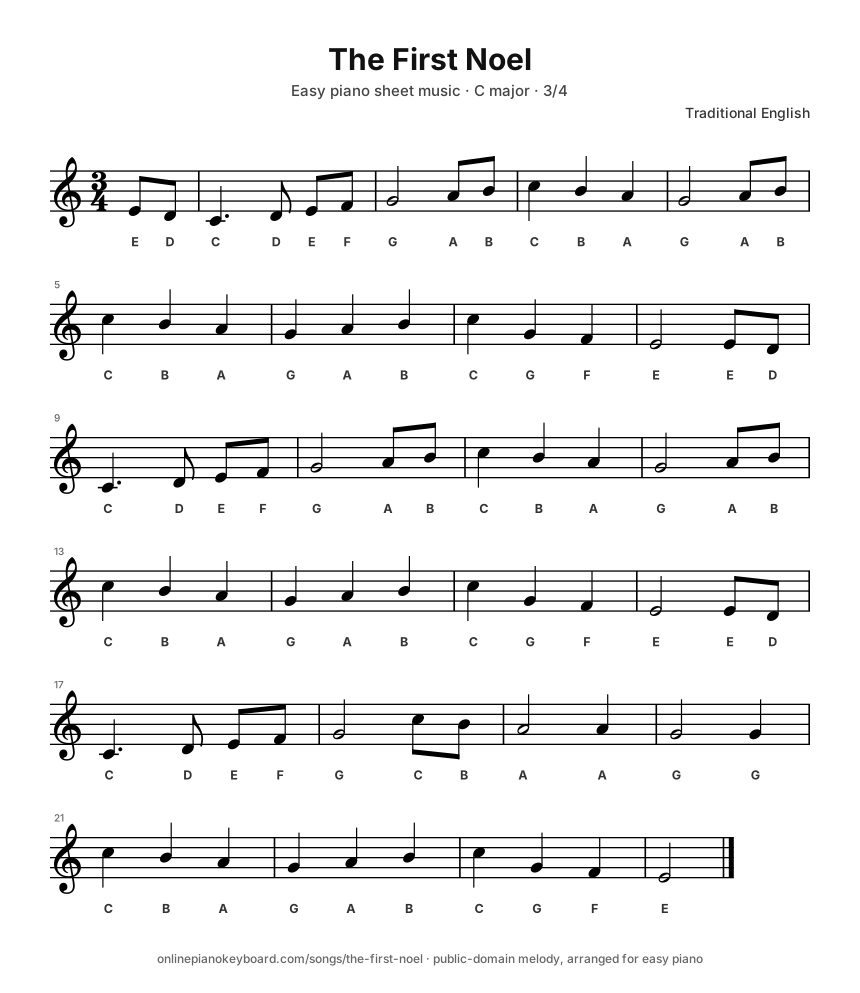
The First Noel sheet music above is written in C major and 3/4 time, with the letter name under every note; switch to the Letter notes tab to read the same melody as plain letters. It covers one verse and the refrain, arranged for the right hand, entirely on white keys between middle C and the C above it. Listen plays the carol and highlights each note in the sheet, while Practice waits on each lit key until you press it. The First Noel is an easy carol and a useful one to learn, because most of its lines begin by climbing the C major scale.
About The First Noel
The First Noel, also spelled The First Nowell, is a traditional English carol with roots in Cornwall. Its words and tune were first printed in the 1820s and 1830s, in carol collections edited by Davies Gilbert and William Sandys, and most people today sing it in the four-part arrangement that John Stainer published in 1871 in Carols, New and Old. Nowell is an old English word for Christmas, taken from the French Noël.
The melody has an unusual shape for an English folk tune. It consists of one musical phrase sung twice, followed by a refrain that varies the same phrase, and all three end on the third note of the scale rather than the first. In 1915 the folk song scholar Anne Gilchrist suggested that the tune might have started life as a harmony part to another carol and been remembered as a melody. Stainer's version is in D major; this page moves it down a step to C major.
How to play The First Noel
The carol follows one pattern: a climb up the scale, then a walk back down.
- The pickup and the scale. The two quick notes before the first bar, E and D, take fingers 3 and 2 with your thumb resting on middle C. Then climb C D E, fingers 1 2 3, pass your thumb under to F, and continue G A B C with fingers 2 3 4 5. This is the right-hand C major scale fingering, covered in the C major scale lesson.
- The turn at the top. From the C above middle C the tune steps down B A, then back up G A B. Keep your hand where the scale left it: B is finger 4, A is 3 and G is 2.
- The walk down. The second line goes C B A, G A B again, then C, G, F and a long E. Play F with your thumb and cross finger 3 over it to reach E.
- The refrain. It starts with the same rising scale, then reaches the high C sooner and comes down in longer notes, A held and A, G held and G, before finishing exactly like the verse.
Counting the rhythm
The carol is in 3/4: three beats to a bar. The pickup, E and D, is two eighth notes on beat 3. The first full bar has a dotted quarter note on C, a beat and a half long, and three quick eighth notes, D, E and F. Half notes, two beats long, come at the top of the scale and at the end of each line, and most of the rest are quarter notes, one beat each.
Practice tips
- Warm up with the scale. Play C D E F G A B C with the thumb passing under a few times before starting; the first line is then half learned.
- Notice the repeats. The second pair of lines repeats the first pair exactly, and the refrain ends like the verse, so there are only three different lines.
- Keep the eighth notes even. The pickup and the three quick notes after the dotted C should sound smooth and equal.
- End on E. It may feel unfinished at first, but the long final E is correct.
For another carol with a simple, singing line, try Away in a Manger.
Printable sheet music
Here is the same arrangement on a single page, with the letter name under every note. Open the image to print it or save it; the Print sheet music button above the keyboard prints it too.
Frequently asked questions
What are the letter notes for The First Noel?
After a pickup E D, the first line is C D E F G A B C, the C major scale going up, then B A and G A B. The complete letter notes are shown above.
What key is The First Noel in?
Hymnals usually print it in D major, the key of John Stainer's 1871 arrangement. This version is in C major, so the rising scale in each line is the C major scale and every note is a white key.
What does Noel or Nowell mean?
Nowell is an old English word for Christmas, taken from the French Noël, which goes back to the Latin for day of birth. In medieval carols the word was sung as a joyful refrain.
Why does the melody end on E instead of C?
All three phrases of The First Noel end on the third note of the scale, E in C major. That is unusual; most tunes end on the first note of their scale.
Who wrote The First Noel?
No one knows. It is a traditional English carol of Cornish origin, first printed in the 1820s and 1830s, and most people sing it in the four-part arrangement John Stainer published in 1871.
Is The First Noel in the public domain?
Yes. The carol is traditional and was first printed nearly two centuries ago, so it is free to play and share.