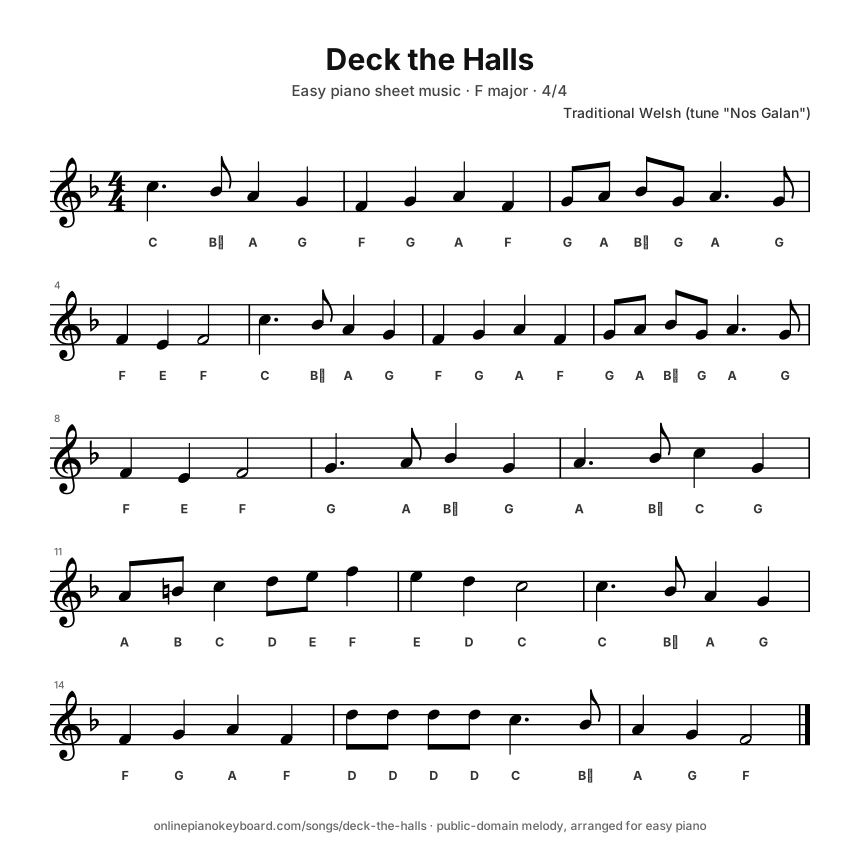
The Deck the Halls sheet music above is in F major and 4/4 time, with the letter name printed under every note, and the Letter notes tab shows the same carol as plain letters. It covers one verse with all its fa la las, arranged for the right hand. The tune runs from the E above middle C to the F more than an octave above it and uses one black key, B-flat. Listen plays it and highlights each note in the sheet, and Practice lights the next key and waits for you. It is an easy piece whose lines mostly repeat, so there is less to learn than its length suggests.
About Deck the Halls
The melody is Welsh. It belongs to "Nos Galan" ("New Year's Eve"), a winter carol that was published in 1794 and is thought to be much older. The Welsh version differs a little in the fa la la lines: the third one of the English song corresponds to an instrumental flourish in the original.
The English words were written by Thomas Oliphant, a Scottish musician, and first printed in 1862 in the second volume of Welsh Melodies, a collection arranged by John Thomas with Welsh words alongside. The original title was singular, "Deck the Hall"; the plural is found from about 1892. Oliphant's first printing is in F major, the key used on this page.
The carol is in AABA form: the first line is played twice, the third line brings something new, and the last line returns to the opening.
How to play Deck the Halls
- The A lines. Put your thumb on the F above middle C, with G, A, B-flat and C under fingers 2, 3, 4 and 5. The line begins C, B-flat, A, G, falling from finger 5 to finger 2, then F G A F. The fa la la that follows is G A B-flat G, four quick notes, then A and G, and the line closes with F, a short reach down to E with the thumb, and F again.
- The B line. The third line begins lower, on G, and climbs. Move your hand up so your thumb is on G for its first half. Then comes the rising run A, B natural, C, D, E, F: play A B C with fingers 1 2 3, pass your thumb under to D, and continue with 2 and 3 to reach the high F, the top note of the carol. The line settles back on C.
- The last line. Return to the F position. It begins like the first line, but its fa la la is four quick Ds, reached with a small shift up, before C, B-flat, A, G and the final F.
Counting the rhythm
The carol is in 4/4, and most of its notes are quarter notes, one count each. Every line starts with a dotted quarter note held for a beat and a half and a short eighth note. The fa la la groups move twice as fast, in eighth notes, two to a beat: count "1-and 2-and" for them. Each line ends with a half note, two beats long.
Practice tips
- Learn the A line first. It makes up three quarters of the carol, so once it is secure only the third line is new.
- Practice the run separately. Play A B C D E F slowly with the thumb passing under, then add the notes before and after.
- Keep the fa las light. The quick notes should sound playful, not heavy; let your fingers stay close to the keys.
- Watch the one B natural. It is easy to play B-flat out of habit, since every other B in the carol is flat.
For another bright carol, try We Wish You a Merry Christmas.
Printable sheet music
Here is the same arrangement on a single page, with the letter name under every note. Open the image to print it or save it; the Print sheet music button above the keyboard prints it too.
Frequently asked questions
What are the letter notes for Deck the Halls?
The first line is C B-flat A G, F G A F, then G A B-flat G A G and F E F. The complete letter notes are shown above.
What key is Deck the Halls in?
This version is in F major, the key of the first printing with English words in 1862. The key signature has one flat, B-flat.
Why is there a B natural in the third line?
There the fa la las run up A, B, C, D, E, F, and the B natural steers the tune toward C for a moment before the last line. A few versions print B-flat there instead.
Is Deck the Halls a Welsh song?
The tune is Welsh: it comes from the New Year's Eve carol Nos Galan, printed in 1794 and older still. The English words were written in 1862 by the Scottish musician Thomas Oliphant.
How many hand positions do I need?
Two. Keep your thumb on F for the first, second and last lines, and move up for the third line, which climbs to the high F. The E below F is a short reach with the thumb.
Is Deck the Halls in the public domain?
Yes. The Welsh tune is centuries old and Oliphant's words date from 1862, so the carol is free to play and share.