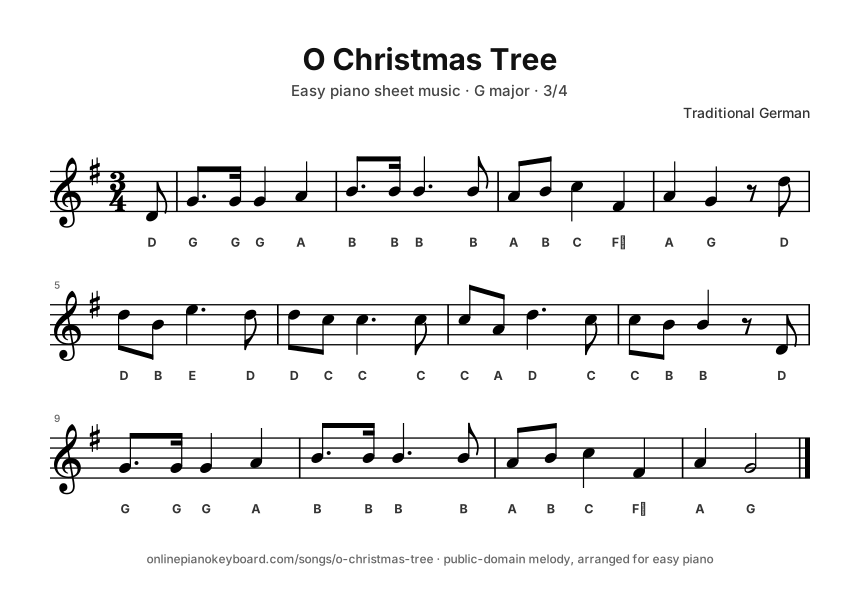
The O Christmas Tree sheet music above is in G major and 3/4 time, with the letter name printed under every note, and the Letter notes tab shows the same melody as plain letters. The song has three short sections, the familiar opening, a middle section that climbs higher, and the opening again, arranged for the right hand. The notes run from the D just above middle C to the E an octave and a step higher, with F sharp as the only black key. Listen plays it and highlights each note in the sheet, and Practice lights the next key and waits for you to press it.
About O Christmas Tree
O Christmas Tree is the English version of a German song, "O Tannenbaum", which means "O fir tree". Songs praising the fir tree for staying green through winter, and so for being faithful, go back to the 16th century in Germany. In 1820 the teacher August Zarnack printed a version as a lover's complaint, contrasting the faithful tree with a faithless girl.
The words sung today were published in 1824 by Ernst Anschütz, a teacher and organist in Leipzig. He kept Zarnack's first verse and added two verses that link the evergreen tree to the joy and hope of Christmas. Anschütz first printed the song with another tune; the melody that stuck is an old student song called "Lauriger Horatius". As Christmas trees became popular in the 19th century, the song became a favorite in both German and English.
How to play O Christmas Tree
The song has three sections of four bars. The first and last are the same, and the middle one moves higher.
- The opening. Put your thumb on the G above middle C, with A, B, C and D under fingers 2, 3, 4 and 5. The song starts with a short D below that hand, so play it with your thumb and move straight back to G. Then comes G G G A, fingers 1 1 1 2, and four Bs, finger 3. The line finishes A B C, a drop to F sharp, and A G: reach your thumb down to the black key and back.
- The middle section. It starts on the high D and reaches E, the top note of the song. Move your hand so your thumb is on A: B, C, D and E fall under fingers 2 to 5. The section moves in pairs of quick notes followed by a long one, D B then a long E, D C then a long C, C A then a long D, and ends on B.
- The return. The opening comes back unchanged, except that the final G is held a little longer to finish the song.
Counting the rhythm
The song is in 3/4, so count three beats in each bar. It starts with a pickup of half a beat, the D, on the "and" before beat 1. The first bar of the opening has a dotted rhythm: a long G and a very short G share the first beat, then G and A each take a beat. In the second bar a long-short pair on B is followed by a B that lasts a beat and a half and a short B that leads on.
The middle section uses pairs of eighth notes followed by a dotted quarter note, a quick-quick-long pattern. Short rests at the ends of the first two sections give you a moment to breathe before the next pickup.
Practice tips
- Learn the opening well. It is two thirds of the song, so every minute on it pays twice.
- Keep the dotted pairs crisp. The short note after each long one should be quick, like a small hop, not a second even note.
- Practice the move to the middle section. Play the end of the opening, A and G, then the high D pickup and the B and E after it, a few times until the shift feels natural.
- Count the long notes. The dotted quarter notes in the middle section last a beat and a half; count them rather than rushing to the next pair.
For another carol first sung in German, try Silent Night, which dates from 1818.
Printable sheet music
Here is the same arrangement on a single page, with the letter name under every note. Open the image to print it or save it; the Print sheet music button above the keyboard prints it too.
Frequently asked questions
What are the letter notes for O Christmas Tree?
After a short D pickup, the first line is G G G A, B B B B, A B C F sharp, A G. The complete letter notes are shown above.
What key is O Christmas Tree in?
This version is in G major. Its only black key is F sharp, which comes once in each of the outer sections.
What does O Tannenbaum mean?
Tannenbaum is German for fir tree, so the title means O fir tree. The song praises the tree for staying green all year, a traditional symbol of faithfulness.
Is O Christmas Tree the same song as O Tannenbaum?
Yes. O Christmas Tree is the English version of the German song, sung to the same melody.
Who wrote O Christmas Tree?
The German words sung today were written by Ernst Anschütz, a teacher and organist in Leipzig, and published in 1824. The melody is an old German student song, Lauriger Horatius, that later became attached to his words.
Is O Christmas Tree in the public domain?
Yes. Anschütz's words date from 1824 and the tune is older, so the song is free to play and share. This simple arrangement is our own.