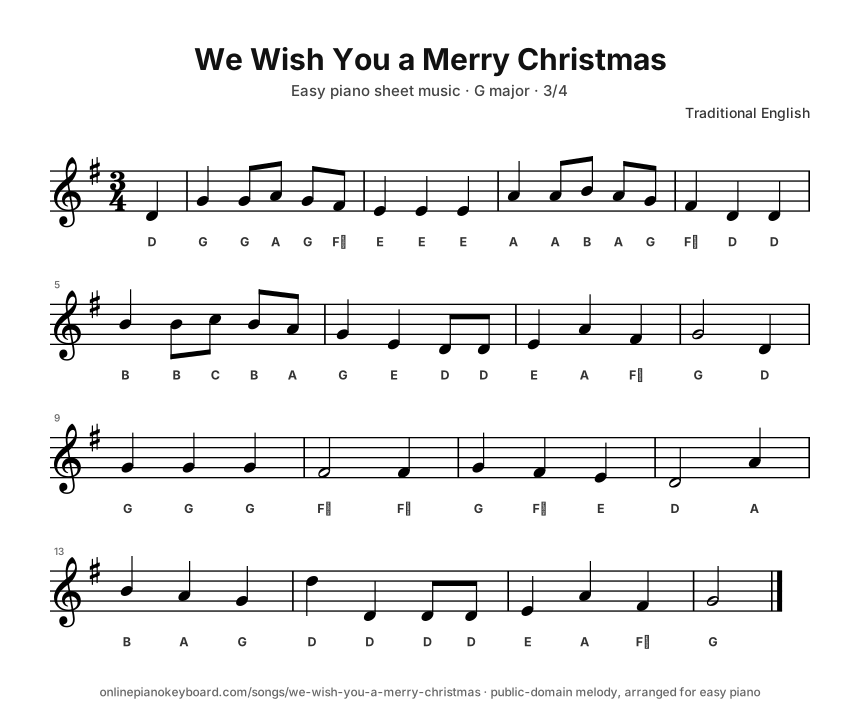
The We Wish You a Merry Christmas sheet music above is in G major and 3/4 time, with the letter name under every note, and the Letter notes tab shows the same melody as plain letters. It has the verse and the refrain, arranged for the right hand, within one octave from the D above middle C to the D above that. The only black key is F sharp. Listen plays the carol and highlights each note in the sheet; Practice lights one key at a time and waits for you to press it. It is an easy, cheerful tune, and its first half is built from one short pattern repeated at three different heights.
About We Wish You a Merry Christmas
This is a traditional carol from the West Country of England, the counties of the southwest. Its origin is unknown. It probably comes from the custom of carolers visiting wealthy households on Christmas Eve and being given treats, which explains the later verses asking for figgy pudding and refusing to leave until some arrives. The carol does not appear in the major carol collections of the 1800s, or even in The Oxford Book of Carols of 1928, and outside the West Country it was little known.
That changed in 1935, when Arthur Warrell, a composer and lecturer at the University of Bristol, arranged it for his madrigal singers and published the arrangement. Since then it has become a familiar Christmas song across the English-speaking world. The melody on this page is the traditional tune alone, in our own simple arrangement.
How to play We Wish You a Merry Christmas
- The hand position. Put your thumb on the E above middle C, then fingers 2, 3, 4 and 5 on F sharp, G, A and B. The first phrase is G, G A G F sharp, E E E: fingers 3, 3 4 3 2, 1 1 1.
- The rising sequence. The second phrase starts with the same figure one step higher, on A, and it ends by dropping to D; reach your thumb down for it. The third phrase climbs again, starting on B, and reaches up to C, so let your hand shift up one key.
- The end of the verse. After the three phrases the verse closes with E, A, F sharp and a long G.
- The refrain. It starts with three Gs and two F sharps, the first held for two beats, then walks down G, F sharp, E to a long D. The last line holds the one big leap in the carol: from the high D, the top note of the carol, down an octave to the D above middle C, then up again through E, A and F sharp to the final G.
Counting the rhythm
The carol is in 3/4, three beats to a bar, and it begins on a pickup: the D on beat 3 before the first full bar. The verse has one repeating rhythm. Each phrase starts with a quarter note and then four quick eighth notes, two to a beat, so count "1 2-and 3-and". The bar after it is mostly quarter notes.
The refrain is broader, with quarter notes and long notes of two beats. In both the verse and the refrain, a quick pair of eighth notes on D leads into the closing E, A, F sharp and G.
Practice tips
- Learn one phrase and move it. Because the first three phrases share one shape, practicing the first one carefully does most of the work for the other two.
- Keep the eighth notes even. The quick groups sound best light and steady; count "2-and 3-and" out loud if they start to rush.
- Rehearse the octave leap. Play the high D and the low D back and forth a few times before trying the last line.
- Let the ending ring. Hold the final G for its full two beats rather than lifting early.
For another cheerful carol, try Deck the Halls, which moves in steady quarter notes and a famous run of fa la las.
Printable sheet music
Here is the same arrangement on a single page, with the letter name under every note. Open the image to print it or save it; the Print sheet music button above the keyboard prints it too.
Frequently asked questions
What are the letter notes for We Wish You a Merry Christmas?
After a pickup D, the first bar is G, then G A G F sharp in quick notes, and the second bar is E E E. The whole carol is written out above as sheet music and as letter notes.
What key is We Wish You a Merry Christmas in?
This version is in G major, a common key for the carol, so its only black key is F sharp. Songbooks also print it in D and B-flat.
Which fingers should I use?
Start with your thumb on the E above middle C and fingers 2 to 5 on F sharp, G, A and B. Reach the thumb down to D when the tune dips there, and shift up one key when the third phrase needs C.
What is figgy pudding?
In the West Country of England, figgy pudding meant a raisin or plum pudding much like a modern Christmas pudding, and it did not have to contain figs. The carol's later verses ask for some.
Who wrote We Wish You a Merry Christmas?
No one knows. It is a traditional carol from the West Country of England, and it became widely known after the Bristol musician Arthur Warrell arranged it for choir in 1935.
Is We Wish You a Merry Christmas in the public domain?
The traditional words and tune are in the public domain. Arthur Warrell's 1935 choral arrangement is a separate work; this page uses only the traditional melody, in our own simple arrangement.