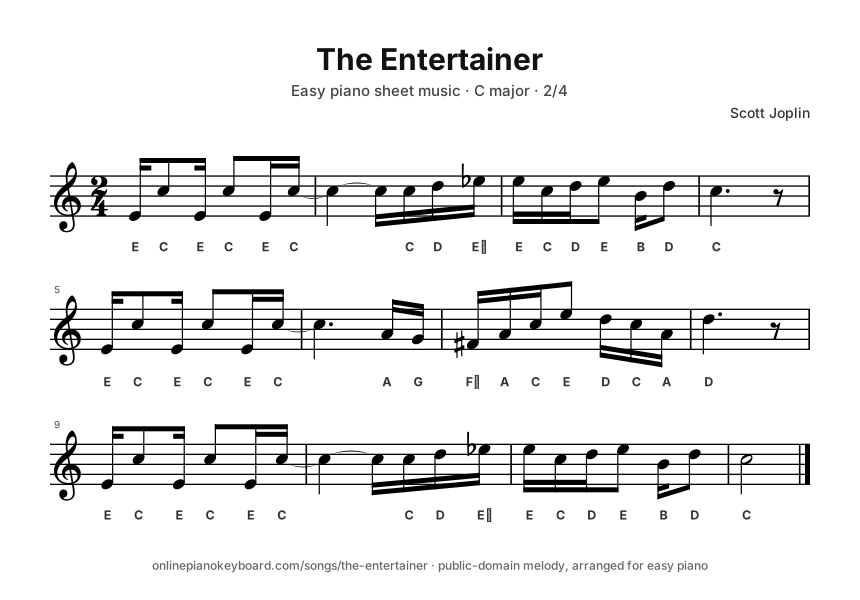
The Entertainer piano notes above teach the opening hook of Scott Joplin's A strain. The sheet music prints a letter name under every note; the Letter notes tab gives the same line as plain letters. Listen plays it and highlights the current note, and Practice lights the next key and waits for you. This is a short melody-only arrangement, with some high notes moved down an octave so a single right hand can reach them more easily. It begins after Joplin's separate four-bar introduction and leaves out the busy left-hand part of the full rag.
About Joplin's ragtime two-step
Scott Joplin published The Entertainer in 1902 and called it “A Ragtime Two Step.” Ragtime often makes the melody feel playful against a firm, even pulse underneath. In a complete performance of this piece, the left hand supplies a regular bass-and-chord pattern while the right hand places notes both on and between the beats. That contrast is a big part of the sound. With only the right-hand line on this page, you can concentrate on the rhythm and the recognizable shape before trying a two-hand score.
The original has an introduction and several strains, or sections. This page starts with the beginning of the A strain, where the familiar E-and-C figure first appears. It follows the hook through a few of its turns and returns to it once more before stopping. The published score has fuller chords, wide register changes and more material beyond this excerpt. The arrangement here keeps the important upper pitches, brings their highest notes down one octave and uses a quiet final C as its own ending.
Find the opening notes
Find middle C, the white key just left of the two black keys near the middle of the piano. The E above it is two white keys to the right. The hook jumps E, C, E, C, E, C. Try it first with fingers 3 and 1, keeping the hand gently curved. Avoid making each E louder just because the hand reaches for it: the movement should be light and even.
The next part steps through C, D and E-flat before reaching E. E-flat is the black key between D and E, just left of E. Later you will touch F-sharp, the black key between F and G. These are short passing notes, not a change of key. Find both black keys slowly before you press Listen so they do not surprise you when the pattern moves away from C and E.
Count two beats, even when the notes shift
The score is in 2/4, two quarter-note beats per bar. Some notes are sixteenths, four to one beat; others are eighths, two to one beat. Start by tapping two steady beats with your free hand and saying “one-and-a, two-and-a” only when you need to place the little notes. Do not count faster just because several keys come close together.
Near the end of the first bar, a C ties into the next bar. Hold that key through the bar line instead of striking it again. The tied C lets the steady beat carry on underneath a note that began early, which gives the phrase its offbeat lift. The later held C and short rest provide space before the E-and-C figure comes back. Let that silence happen rather than rushing to the next E.
A practical way to learn the excerpt
Play the E-and-C hook by itself until your hand can return to each key without looking. Then practice the C–D–E-flat turn at half speed and connect it to the following E. Take the next, higher phrase as a separate exercise; because this arrangement moves it down an octave, you can stay close to middle C instead of jumping to the top of the keyboard. Finally, use Practice for the whole excerpt and Listen to check whether the held notes and rests leave the right amount of space.
When the melody feels easy, try tapping the two beats steadily with your left hand while the right hand plays. That will expose any place where the short notes make you hurry. To build your sheet-reading skill for this rhythm, see how to read piano sheet music. For another measured classical melody, try Minuet in G.
Printable sheet music
Here is the same arrangement on a single page, with the letter name under every note. Open the image to print it or save it; the Print sheet music button above the keyboard prints it too.
Frequently asked questions
What piano notes start The Entertainer?
This excerpt begins with the A-strain hook: E, C, E, C, E, C. The complete shortened line is shown above as sheet music and letter notes.
Is this the whole of The Entertainer?
No. It teaches a short version of the opening A strain, after Joplin's four-bar introduction. The full rag has several longer contrasting strains and a left-hand accompaniment.
What key and meter is The Entertainer in?
The opening A strain is in C major and 2/4 time in the source score. There are two quarter-note beats to each bar, with many short sixteenth-note figures.
Why does the rhythm sound bouncy?
Ragtime places important notes between the steady beats. The melody uses short notes, ties and rests while the underlying two-beat pulse keeps moving.
Which black keys appear here?
The main melody uses white keys, but the short chromatic turn touches E-flat and F-sharp. E-flat is the black key just left of E; F-sharp is just right of F.
Who wrote The Entertainer?
Scott Joplin published The Entertainer in 1902 with the subtitle A Ragtime Two Step. This page uses its public-domain melody in a simplified one-hand arrangement.