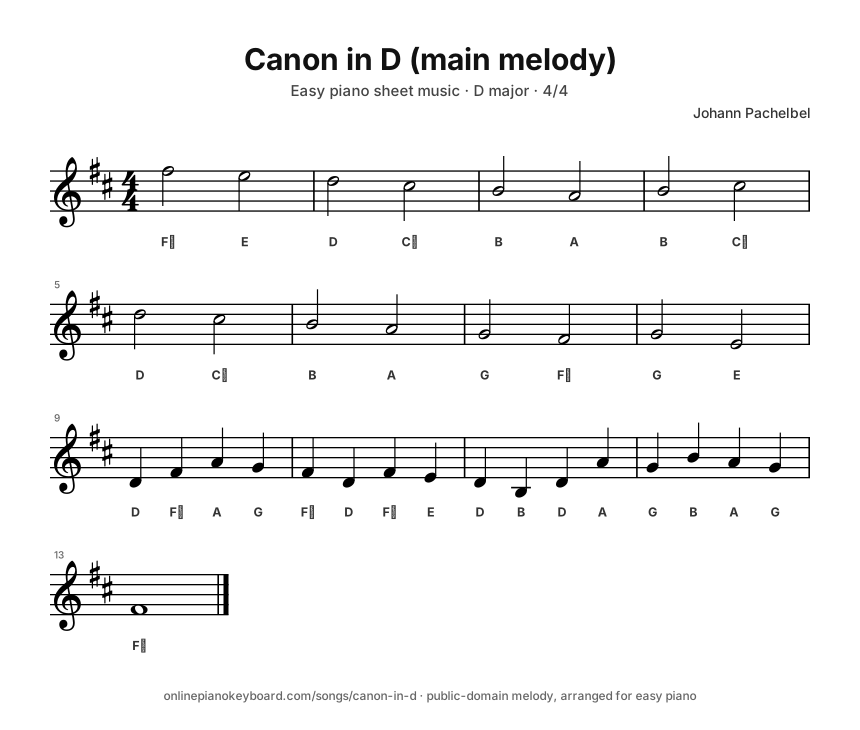
The Canon in D sheet music above is the main melody, the line most people know, in D major, with the letter name under every note. It opens with a slow scale falling from the high F# to A, in notes two beats long, and later breaks into flowing quarter notes. There are two black keys to learn, F# and C#, the two sharps of D major; everything else is white keys.
About Pachelbel's Canon
Johann Pachelbel (1653–1706) was a German organist and composer of the Baroque era. His Canon in D is the first of a pair of pieces, the Canon and Gigue in D major, for three violins and basso continuo. It was written sometime between about 1680 and 1706.
A canon is a piece in which several voices play the same melody, each starting a little after the one before, the same idea as a round like Frère Jacques. In Pachelbel's Canon, the three violins enter two bars apart over a bass line of eight notes, D, A, B, F#, G, D, G and A, that repeats from beginning to end.
The piece was little known for a long time. It became hugely popular in the second half of the 20th century, and a 1968 recording by the Jean-François Paillard Chamber Orchestra is often credited with starting that popularity. Today it is a favorite at weddings.
How to play the main melody
The first two lines walk down the D major scale, so the scale fingering works well:
- First line. Put finger 3 on the high F#, play E with 2 and D with your thumb. Then cross finger 4 over your thumb for C#, the black key just left of D, and continue with 3 on B and 2 on A. The line turns back up to B and C#, fingers 3 and 4.
- Second line. Carry on from D with the same shape: 5 on D, 4 on C#, 3 on B, 2 on A and 1 on G. Then cross finger 3 over your thumb for F#, the black key just left of G, and finish with 4 on G and 2 on E.
- Third line. Your hand is now in D position: thumb on D, 2 on E, 3 on F#, 4 on G, 5 on A. The quarter notes stay close to this position, but they dip once to the low B and reach once up to the B above, so let your hand move a little for those two notes.
Counting in 4/4
Canon in D is in 4/4. In the first two lines every note lasts two beats: count "1 2, 3 4", with a new note on 1 and on 3. In the third line, a new note falls on every beat, and the last F# lasts a whole bar, four beats.
Play it smoothly: the melody was written for violins, which can sustain a tone, so on the piano, hold every note until the next one sounds.
Practice tips
- Warm up with the scale. The opening is the D major scale going down, so play it on the scales page first: choose D and Major and listen to it go up and back down.
- Take the crossings slowly. Practice waits at each key, so you can repeat the thumb crossings until finger 4 finds C# without looking.
- Hear the harmony. The bass line moves through D major, A major, B minor, F# minor, G major, D major, G major and A major. Step through those chords on the chord finder to hear the progression behind the melody.
Once you know it, Für Elise is another classic with a famous opening to learn.
Printable sheet music
Here is the same arrangement on a single page, with the letter name under every note. Open the image to print it or save it; the Print sheet music button above the keyboard prints it too.
Frequently asked questions
What are the letter notes for Canon in D?
The notes of the main melody are shown above. The first line is F# E D C# B A B C#, each note held for two beats: a slow walk down the D major scale from F# to A, then back up to C#.
What key and time signature is Canon in D in?
D major, in 4/4 time. D major has two sharps, F# and C#, and they are the only black keys in this melody.
Which fingers should I use for the C# and F#?
Use the D major scale fingering: 3 on the high F#, 2 on E, 1 on D, then cross finger 4 over your thumb to C#. In the second line, cross finger 3 over your thumb to reach the lower F#.
Is this the whole of Pachelbel's Canon?
No. It is the main melody, the first violin's opening, which is the part most people know. The full piece continues with many faster variations over the same repeating bass line.
Why is it called a canon?
In a canon, several voices play the same melody but start at different times. Pachelbel's three violins enter two bars apart over a bass line that repeats throughout.
Is Canon in D in the public domain?
Yes. Pachelbel died in 1706, so the music is free to play, record and share.