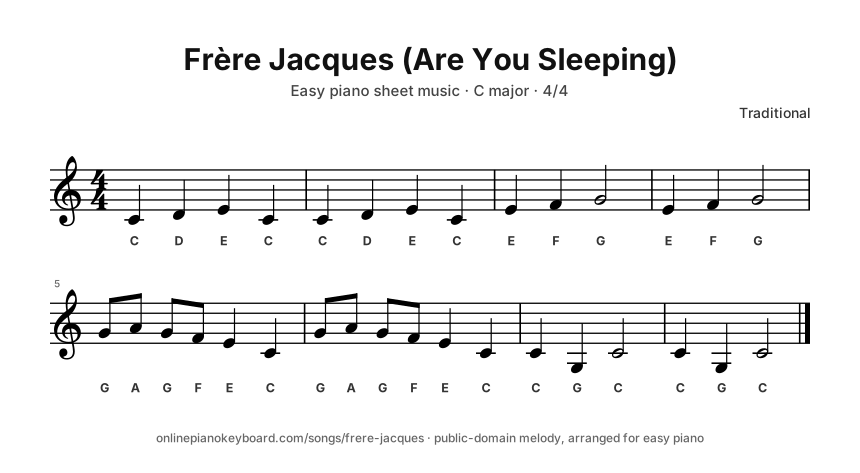
The Frère Jacques sheet music and letter notes are shown above. Every note is a white key close to middle C: the tune uses C, D, E, F, G and A, plus the G just below middle C at the very end. There are no sharps or flats, and each phrase is played twice, so there are only four short ideas to learn.
About Frère Jacques
Frère Jacques is a French round from the 18th century, and its composer is not known for certain. The words ask a sleepy friar, Brother Jacques, whether he is still asleep, and tell him to ring the bells for the morning prayers. In English it is usually sung as Are You Sleeping, with Brother John in place of Brother Jacques.
A round is a song in which several voices sing the same melody, each one starting a little later than the one before. Frère Jacques works as a round because every phrase is built on the notes of one chord, C major (C, E and G), so any phrase sounds good against any other. Gustav Mahler borrowed the tune for the third movement of his Symphony No. 1, where it becomes a slow march in a minor key.
How to play Frère Jacques
Put your right hand in C position: thumb (finger 1) on middle C, and fingers 2, 3, 4 and 5 on D, E, F and G. The first two phrases fit under your hand without moving, so each finger simply stays over its own key.
Two spots need a small change:
- The quick phrase. The third phrase starts on G and reaches one key higher, to A. Open your hand so your little finger covers A, your ring finger G, your middle finger F and your index finger E, while your thumb stays on middle C. The whole phrase is then fingers 4 5 4 3 2 1.
- The low G. The last phrase drops to G3, the G just below middle C. The easiest way is to let your left thumb play it: with your right thumb on middle C and your left thumb on G3, the phrase goes right, left, right.
Counting the rhythm
Frère Jacques is in 4/4, so count "1 2 3 4" steadily through every bar. Most notes last one beat. The last note of the second phrase (G) and of the fourth phrase (C) each last two beats, so hold them through "3 4".
The third phrase is the only quick one. It starts with four notes squeezed into two beats, two to a beat, which you can count as "1 and 2 and", followed by two ordinary one-beat notes on 3 and 4. Keep the quick notes even rather than rushed.
Practice tips
- Learn it phrase by phrase. Because every phrase is repeated, practicing the four phrases one at a time covers the whole song.
- Play it as a round. When the tune is steady, one person starts and a second person begins from the top when the first reaches the third bar, each on their own device. Row, Row, Row Your Boat is another round to try this way, and Canon in D uses the same idea with three violins.
If the C position is new to you, the hand position lesson shows how to curve your fingers and where each one goes.
Printable sheet music
Here is the same arrangement on a single page, with the letter name under every note. Open the image to print it or save it; the Print sheet music button above the keyboard prints it too.
Frequently asked questions
What are the letter notes for Frère Jacques?
They are shown above, line by line. The song begins on middle C with C D E C, played twice, and every note in it is a white key.
What key and time signature is Frère Jacques in?
This version is in C major and 4/4 time, with four beats in each bar. It has no sharps or flats.
Which fingers should I use for Frère Jacques?
Start in C position, with your right thumb on middle C and fingers 2 to 5 on D, E, F and G. For the quick phrase that reaches up to A, open your hand so your little finger covers A while your thumb stays on C. Play the low G near the end with your left thumb.
Why is Frère Jacques called a round?
A round is sung by several voices that start the same melody at different times. In Frère Jacques each new voice starts from the beginning when the one before it reaches the third bar, and the parts fit together because every phrase is built on the notes of the C major chord.
Who wrote Frère Jacques?
Nobody knows for certain. It is a traditional French round from the 18th century, and it has been translated into many languages, including English as Are You Sleeping.
Is Frère Jacques in the public domain?
Yes. The melody is traditional and well over two hundred years old, so you can play it, record it and share your recording freely.