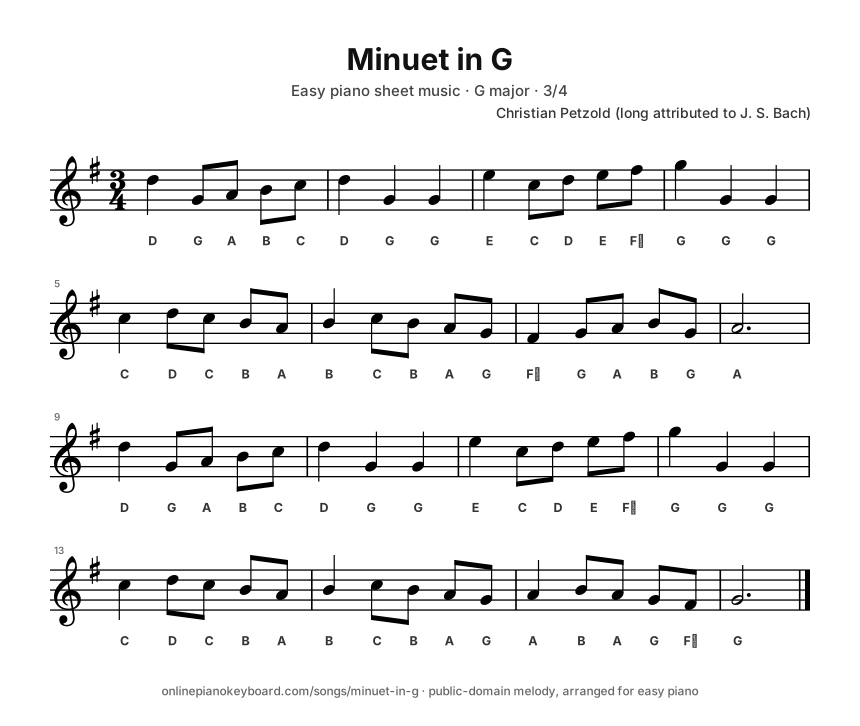
The Minuet in G sheet music above is the melody of the minuet's first half, the 16 bars most people know, without the left-hand part. It is in G major, so there is one black key to watch, F#, which appears high in bars 3 and 11 and low in bars 7 and 15. Everything else is white keys, moving mostly by step in an even, dance-like rhythm.
About the Minuet in G
This minuet was long known as Bach's Minuet in G. It comes from the Notebook for Anna Magdalena Bach, a book of keyboard music that Johann Sebastian Bach's second wife, Anna Magdalena, kept from 1725, filled with pieces by Bach and by other composers. In the 1970s, scholars identified the minuet, together with its companion in G minor, as movements from a harpsichord suite by Christian Petzold (1677–1733), an organist in Dresden. Its catalog number, BWV Anh. 114, places it in the appendix of the Bach catalog, among works that are doubtful or by other composers.
A minuet is a graceful dance in triple time that was popular in the Baroque era.
How to play the Minuet in G
Start with your right thumb on G4 and fingers 2, 3, 4 and 5 on A, B, C and D, a G position. If you are not sure which G that is, the piano keys lesson explains how octaves are numbered.
- The first two bars. Finger 5 plays the high D, then the thumb and fingers 2, 3 and 4 walk up from G. The second bar is D again, then two Gs with the thumb.
- The high F#. The third bar starts on E, drops to C and climbs through D, E and F# to the high G. Move your hand up so your thumb is on C, play the first E with finger 3, then walk up with 1 2 3 4 5; F# falls under finger 4. It is the black key just left of G. Then drop back to G4 for the two low Gs.
- The low F#. In the seventh bar the melody dips below G4 to F#4. One comfortable fingering puts your thumb on F#, so the bar is 1 2 3 4 2 and the long A after it is finger 3. In bar 15 the same F# comes at the end of the bar instead: 3 4 3 2 1, then the final G with finger 2.
Counting in 3/4
Count "1 2 3" in every bar. Most bars are either one quarter note and four eighth notes, or three quarter notes. In the first bar, D is on 1 and the four eighth notes, G A B C, fill beats 2 and 3: count "1, 2 and 3 and". Keep the eighth notes even and light, like dance steps.
Bars 8 and 16 hold a single note for all three beats. The first time, the phrase stops on A and sounds unfinished; the second time it ends on G, the home note of G major, and sounds complete.
Practice tips
- Learn it in four-bar pieces. Bars 9 to 12 repeat bars 1 to 4 exactly, and bars 13 and 14 repeat bars 5 and 6, so the first half is two four-bar ideas, each played twice, with a new ending the second time.
- Warm up with the scale. The G major scale on the scales page uses the same seven notes as this melody, F# included.
After the minuet, Für Elise and Canon in D are two more classics to try.
Printable sheet music
Here is the same arrangement on a single page, with the letter name under every note. Open the image to print it or save it; the Print sheet music button above the keyboard prints it too.
Frequently asked questions
What are the letter notes for Minuet in G?
The notes are shown above. The first phrase starts D G A B C, D G G: a high D, a run up from G, then the D again and two Gs.
What key and time signature is the Minuet in G in?
G major, in 3/4 time with three beats per bar. G major has one sharp, F#, and it is the only black key in this melody.
Which fingers play the F# notes?
For the high F# in bars 3 and 11, put your thumb on C so fingers 1 to 5 cover C, D, E, F# and G. For the low F# in bars 7 and 15, move your thumb down to F# so fingers 2, 3 and 4 fall on G, A and B.
Did Bach write the Minuet in G?
It is now credited to Christian Petzold, an organist in Dresden. It was long credited to Johann Sebastian Bach because it appears in the 1725 Notebook for Anna Magdalena Bach, until scholars identified Petzold in the 1970s.
Is this the whole minuet?
It is the melody of the first half, the 16 bars most people recognize. The full minuet also has a second half and a part for the left hand.
Is the Minuet in G in the public domain?
Yes. It dates from the early 18th century and Petzold died in 1733, so it is free to play, record and share.