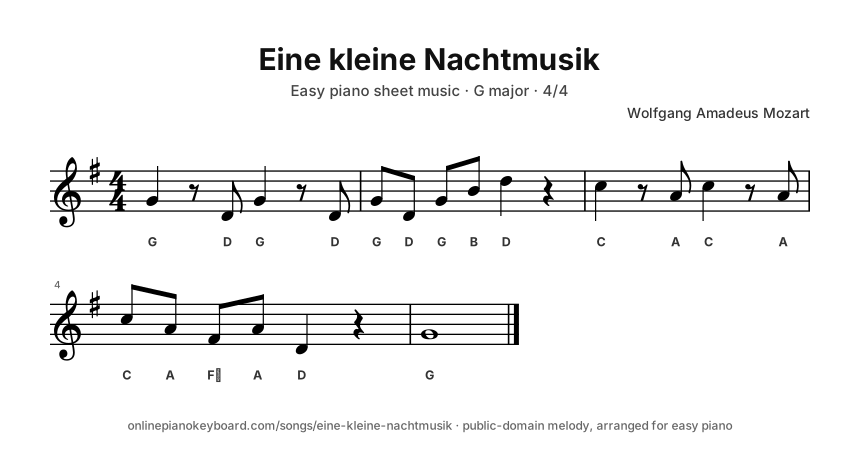
Eine kleine Nachtmusik sheet music above gives a one-hand version of the opening violin melody from Mozart's Serenade No. 13 in G major, K. 525. The notes sit an octave below the original violin line so they stay near middle C on the piano. Letter names appear under the staff; Listen shows where the short silences fall, and Practice waits for you to press each key. The excerpt covers only four bars and adds a long G at the end as a stopping point. The full string serenade is much longer and includes several other parts.
Hear the opening gesture
Mozart begins with a strong G, a short silence, a D, and a return to G. Another short silence and D complete the first bar. Those rests matter: without them, the line can sound like a stream of evenly connected notes. Press Listen once and tap four steady beats. Hear how the G notes claim the main beats while D answers between them. When you try the keys, release G before the rest and wait until the D's entrance; the quiet gap is part of the melody.
The second bar continues G, D, G, B, D before a longer rest. The rise to B and D gives the opening its celebratory lift. The source first violin part plays that high D above the staff; this page lowers all the melody notes one octave, keeping the relationships between them intact. You do not need to jump to the far right side of the keyboard to recognize the theme.
Find the G-major notes
Find middle C, the white key just left of a pair of black keys. D is the next white key to its right, and G is four white keys farther right from C. Begin with G and the D below it. Put a comfortable finger over each and let the hand move when the melody reaches B and the higher D. The third bar introduces C and A, both white keys. The fourth bar uses F sharp, the first black key of the group of three; it belongs to the G-major key signature.
Try the first two bars as one small unit and the next two as another. In the third bar, C and A have the same rest-separated shape as G and D had in the first. In the fourth, C–A–F sharp–A leads to D. That parallel helps you remember the phrase: a strong note, its answer, a higher shape, then a step toward a close. Our long final G gives the short piano exercise a resting point; Mozart's first movement continues from there.
Count the silences
The source is in 4/4, four quarter-note beats per bar. In bar one, G lasts one beat. The following rest and D each last half a beat. The second G also lasts one beat, followed by another half-beat rest and D. Say “one, two-and, three, four-and” slowly to place the two D notes. Bar three repeats that pattern with C and A. Keep the count moving even when the keyboard is silent.
Play softly enough that the keys release cleanly between notes, then try a brighter first G without getting louder everywhere. If the second bar's rise feels awkward, isolate G–B–D and practice those three notes before joining the full four-bar excerpt. For Mozart's contrasting A-minor opening, try Turkish March. The Minuet in G offers another short classical melody in the same key.
Printable sheet music
Here is the same arrangement on a single page, with the letter name under every note. Open the image to print it or save it; the Print sheet music button above the keyboard prints it too.
Frequently asked questions
What notes start Eine kleine Nachtmusik?
The opening melody alternates G and D with short rests, then rises through G, B and D. This page places the first violin line one octave lower for easy piano.
What does Eine kleine Nachtmusik mean?
The German title means 'a little night music.' Mozart's K. 525 is a serenade for strings, rather than an original piano solo.
What key is the opening in?
G major. Its key signature has one sharp, F sharp, which appears in the fourth bar of this excerpt.
Is this the entire serenade?
No. It is the first four bars of the first violin's opening theme, moved down an octave, plus our own last G. The full serenade has several movements and string parts.
Why are there rests in the first bar?
They separate the short answering D notes from the stronger G notes. Leave the key silent for each rest to keep Mozart's opening shape clear.
Who composed K. 525?
Wolfgang Amadeus Mozart composed the Serenade No. 13 in G major, K. 525, in 1787. Its opening movement is the source of the melody on this page.