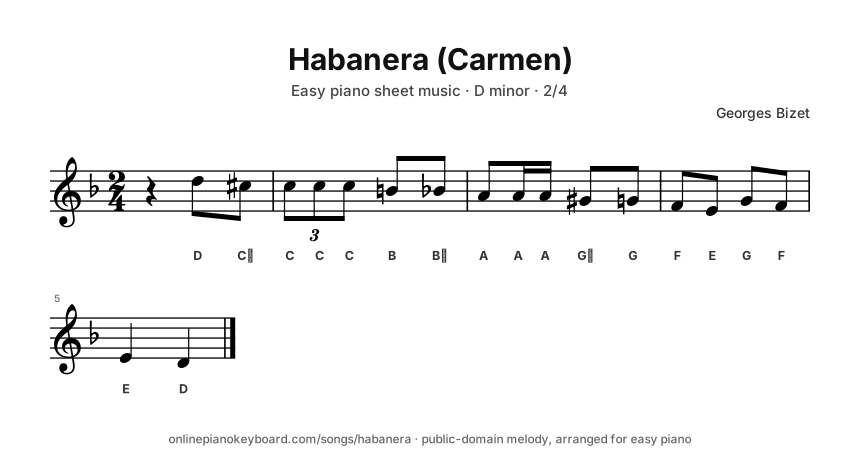
Habanera sheet music above gives a short one-hand version of Carmen's opening vocal phrase from Bizet's opera. The staff puts a letter beneath every note; Listen plays the line, and Practice waits for you to find each key. The phrase descends through half steps that are easy to hear but take care to play: D, C sharp, C natural, B, B-flat and A. This version starts at the singer's entrance after the instrumental introduction, simplifies the quickest turn near the end, and closes on D. It does not include the full aria or its accompaniment.
Carmen's entrance
Bizet's Carmen was first performed in 1875. The Habanera is the heroine's Act I entrance aria, known by its opening French words, “L'amour est un oiseau rebelle.” The tune begins after the accompanying instruments have already established the dance pulse. On this page there is a one-beat rest before the vocal D, so the first piano note enters after you have started counting. That small wait makes the descending line feel like an entrance rather than an isolated scale exercise.
The source opera line is in D minor and 2/4. Historical vocal editions sometimes move the tune to another key to suit a singer's range; a score in E minor will start two keys higher. The notes above follow the D-minor line. The melody and the repeating dance accompaniment are separate parts in the full score. Our piano version gives only the melody, which is enough to learn its contour and chromatic steps.
Trace the half-step descent
Find middle C. D is the white key to its right; C sharp is the black key between C and D. The first sung D falls one half step to C sharp, then another half step to C natural. Play those three keys slowly and listen to how close they sound. The repeated C naturals form a short group of three before the line moves to B and B-flat. B-flat is the black key immediately left of B. The phrase then reaches A, a white key just left of B-flat.
The next part repeats A, then moves through G sharp and G natural. G sharp is the middle black key in a group of three; G natural is the white key immediately to its left. The line continues toward F and E. Practice each neighboring pair separately before you attempt the entire descent. If you miss a black key, slow down and look at the staff's accidental: it tells you whether that note is raised, lowered or natural at that moment.
Keep a two-beat pulse
Count “one, two” for each 2/4 bar. The opening rest takes the first beat; D and C sharp divide the second beat. The next bar places three evenly spaced C naturals inside one beat, a triplet, followed by shorter B and B-flat notes. Say “one-trip-let, two-and” slowly while tapping the two main beats. The following bar has a mix of eighths and sixteenths; keep the pulse constant instead of speeding up during the repeated A.
The original has a quick ornamented turn after the descending notes. This beginner excerpt straightens that small turn into even notes so you can hear the pitch direction first. The final D is an ending added for the short piano page. For another expressive minor-key line, try Swan Lake. The sheet music guide explains triplets, rests and accidentals before you try the phrase at a livelier tempo.
Printable sheet music
Here is the same arrangement on a single page, with the letter name under every note. Open the image to print it or save it; the Print sheet music button above the keyboard prints it too.
Frequently asked questions
What are the first notes of Carmen's Habanera?
After a short rest, the singer begins D, C sharp, then repeats C natural before descending B, B-flat and A. This page shows a shortened one-hand version of that line.
What key is the Habanera in?
The version here is in D minor, matching the opera's opening vocal line. Some historical vocal editions transpose the aria for other voice ranges.
Is this the complete Habanera?
No. It is the opening vocal phrase with the fastest small turn simplified and a short D ending. The full aria has many more phrases, accompaniment and chorus.
Who wrote the Habanera?
Georges Bizet composed it for his 1875 opera Carmen. The aria's French opening is L'amour est un oiseau rebelle.
Why are there so many black keys in D minor?
The melody steps chromatically, using both raised and natural versions of nearby notes. C sharp, B-flat and G sharp are black keys; follow each accidental on the staff.
What is a habanera rhythm?
It is a dance pulse with a distinctive offbeat accompaniment. This page plays only the vocal melody, so count its two-beat bars while imagining the steadier pattern beneath it.