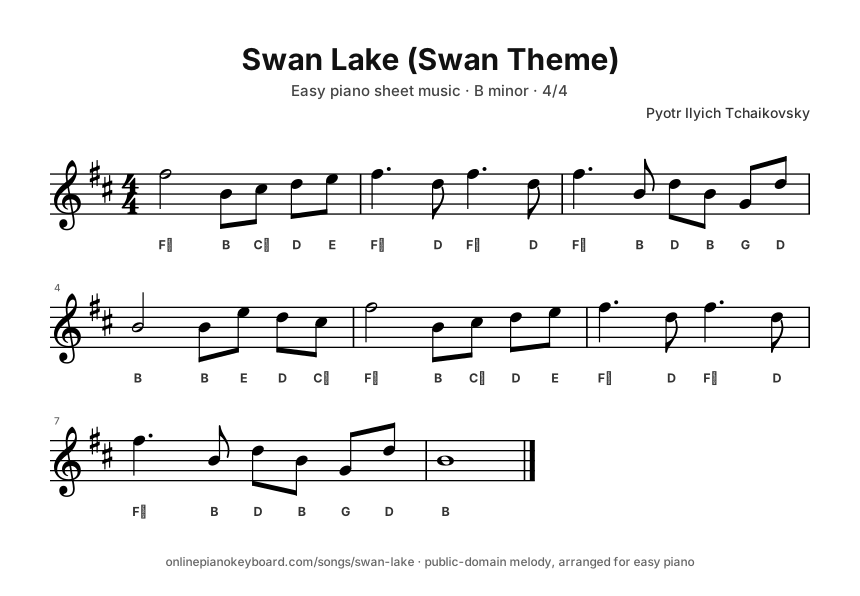
Swan Lake sheet music above presents the oboe's Swan Theme from Tchaikovsky's ballet as a one-hand piano melody. A letter name appears beneath every note. Listen plays the line and shows which note is sounding; Practice waits for the next key, so you can take as long as you need to find it. This short page gives two statements of the opening idea and ends on B. It leaves out the orchestra, the later contrasting music, and the ballet's other scenes.
The oboe line from Act II
The theme comes from the Act II Scène, No. 10, of Swan Lake. In orchestral performances, its first statement is led by the oboe over a soft accompaniment. The single upper line is clear enough to learn on a keyboard without trying to imitate every string and wind part. B minor gives it a reflective sound. The score used for this excerpt is in 4/4, four quarter-note beats in each bar.
The first note, F sharp, lasts two full beats. After that long sound, the melody starts lower on B and climbs C sharp, D and E. The rise points toward F sharp again at the start of the next bar. Try singing the F sharp, then the lower B, and listening for the climb. The long note and the quicker rising notes should feel connected, not like two unrelated ideas.
Find the notes on the piano
Find middle C just left of a pair of black keys. C sharp is the black key immediately to its right; B is the white key immediately to its left. D and E are the next white keys to the right of C, and F sharp is the first black key of a group of three. The melody's main rise uses B, C sharp, D, E and F sharp. You will also reach G natural in the third bar, a white key just right of F sharp. Watch for that G on the staff; it is higher than F sharp even though it is a white key.
The second bar answers with F sharp, D, F sharp, D. Both F sharps are held for a dotted-quarter length, one and a half beats, before a shorter D. Practice those pairs on their own. Keep the hand relaxed while holding the key; there is no need to press harder during a long note. In the third bar, F sharp returns but the line moves down through B, D, B, G and D. That lower G gives the phrase a new color before the held B.
Count the slower rhythm
At a calm pace, count “one, two, three, four” in each bar. Hold the first F sharp through one and two; play B and C sharp on the two halves of beat three, then D and E on the halves of beat four. For a dotted-quarter F sharp in the following bar, count one-and-two before playing D on the second half of beat two. The sheet's note lengths matter more than speed. If you hurry through the holds, the melody loses the space that makes it expressive.
Learn the first four bars with Practice, then play the repeat. The final held B is a quiet ending chosen for this learning version, not the end of the full ballet passage. For another slow melody that rewards careful spacing, try Gymnopédie No. 1. The sheet music lesson explains the dotted and half-note values used here.
Printable sheet music
Here is the same arrangement on a single page, with the letter name under every note. Open the image to print it or save it; the Print sheet music button above the keyboard prints it too.
Frequently asked questions
What are the first notes of the Swan Lake theme?
The oboe theme begins with a long F sharp, then B, C sharp, D and E rising toward F sharp again. The staff above shows this shortened piano version.
What key is the Swan Lake theme in?
The famous Act II Swan Theme is in B minor. F sharp and C sharp belong to its key signature.
Is this the full Swan Lake score?
No. It is an excerpt of the oboe melody only, repeating its opening phrase and ending on B. The ballet score includes many other instruments, scenes and themes.
Which instrument plays the theme in the ballet?
The opening Swan Theme is associated with a solo oboe. This page puts that single melodic line on a piano staff.
How should the long notes sound?
Hold each note for its written value and count through it. The first F sharp lasts two quarter-note beats; some later F sharps last one and a half.
What scene is this from?
It is the Scène from Act II, No. 10, often placed first in the Swan Lake orchestral suite.