The Gymnopédie No. 1 sheet music above teaches Satie's melody in a shortened one-hand version. Each note on the staff has its letter name beneath it, and the Letter notes tab gives the same line without notation. Listen plays the melody while each note lights up; Practice waits at the next key until you press it. The full piano piece has a left-hand accompaniment and long spaces between its melodic phrases. This version begins where the tune first enters, keeps two statements of its opening idea and closes with a later phrase so you can learn the shape without having to coordinate both hands.
About the first Gymnopédie
Erik Satie published his three Gymnopédies in 1888. The first is marked Lent et douloureux, French for “slow and sorrowful.” Its recognizable sound comes from the space around the melody and the gently changing chords beneath it. In the original, four bars of the chord pattern pass before the melody begins; then the melody waits until beat two of its first bar. The notes on this page start at that entrance. The accompaniment-only opening is omitted, so the first sound you hear in Listen is a rest followed by F sharp.
The original score is a complete piano composition. The version here is deliberately smaller: it follows the upper melodic line, skips some long held passages and leaves out the lower chords. That makes it a way to learn the tune first, then return to the full score if you want to study Satie's voicing and harmony. Do not expect the right hand alone to fill every quiet space in the original piece; the spaces are part of its character.
Find the melody notes
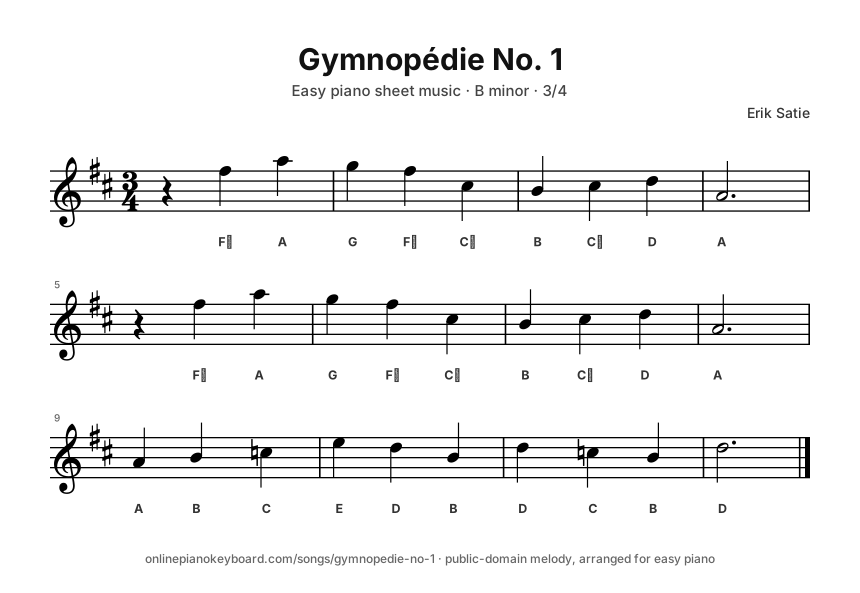
The first sound is F sharp above middle C, the black key between F and G. The line rises to A, then falls through G, F sharp and C sharp. C sharp is the black key between C and D. The next bar begins on B, then returns to C sharp and reaches D. Put your right hand near the middle of the keyboard with your thumb ready for B and your other fingers able to reach F sharp and A; move naturally as the melody climbs instead of stretching a fixed position across the whole phrase.
The first phrase settles on A for a whole bar. The same opening idea then returns: after a rest, F sharp and A lead into G, F sharp and C sharp again. Repeating it is useful for listening as well as for finger memory. The later phrase changes direction: A, B and C natural climb into E, then D and B. Notice that C natural is a white key, different from the C sharp used earlier. The melody has shifted color for a moment; look at the accidental in the staff rather than relying only on the key signature.
Count slowly and leave space
The time signature is 3/4, three quarter-note beats per bar. Count “one, two, three” at an unhurried pace. In the first bar, stay silent on one and play F sharp on two, A on three. The next two bars put a new note on each beat. When you reach the three-beat A, let it sound while you count the whole bar; do not turn it into a quick note just because nothing else is moving.
Try singing the phrase quietly before playing it. The opening rises once and then gradually falls; the second statement gives you another chance to make that same shape. On a piano, let each key stay down for its written length. Avoid punching the repeated entry harder than the rest of the phrase. If the jump back to F sharp is awkward, use Practice to stop there, find the key without rushing and then resume the steady count.
Practice one phrase at a time
First play only the opening four bars: rest, F sharp, A, then the descent and the held A. Repeat until the change from C sharp to B feels comfortable. Next play the returned opening, listening for how closely it matches. Finally, take the later A–B–C natural phrase by itself and finish on the long D. When all three sections are easy separately, join them and use Listen as a check on their spacing.
For another short classical melody with a distinctive keyboard pattern, try Für Elise. The scales page can help you hear B natural minor before you return to the two different C notes in Satie's melody.
Printable sheet music
Here is the same arrangement on a single page, with the letter name under every note. Open the image to print it or save it; the Print sheet music button above the keyboard prints it too.
Frequently asked questions
Is this the complete Gymnopédie No. 1 score?
No. It is a shortened version of the right-hand melody. The original begins with four bars of accompaniment before the melody enters, and the full piano piece includes left-hand chords and longer sustained passages.
What key is Gymnopédie No. 1 in?
The score used here is in B minor and 3/4 time. Its key signature has F sharp and C sharp; the later melody also uses C natural as a written accidental.
What notes start the melody?
After a quarter rest, the melody begins F sharp and A, then G, F sharp and C sharp. The staff and Letter notes tab above give the complete shortened melody.
Why is there a rest at the beginning?
The melody enters on beat two of its first bar. In Satie's complete score the left-hand chord sounds before it; this one-hand version leaves that chord out but preserves the melody's entrance.
How fast should I play it?
Slowly and evenly. The score marks it Lent et douloureux, or slow and sorrowful. Listen for the long notes at phrase ends and count through each full three-beat bar.
Do I need both hands?
Only the right hand for the version on this page. The full composition uses both hands, with a steady chord pattern under the melody.