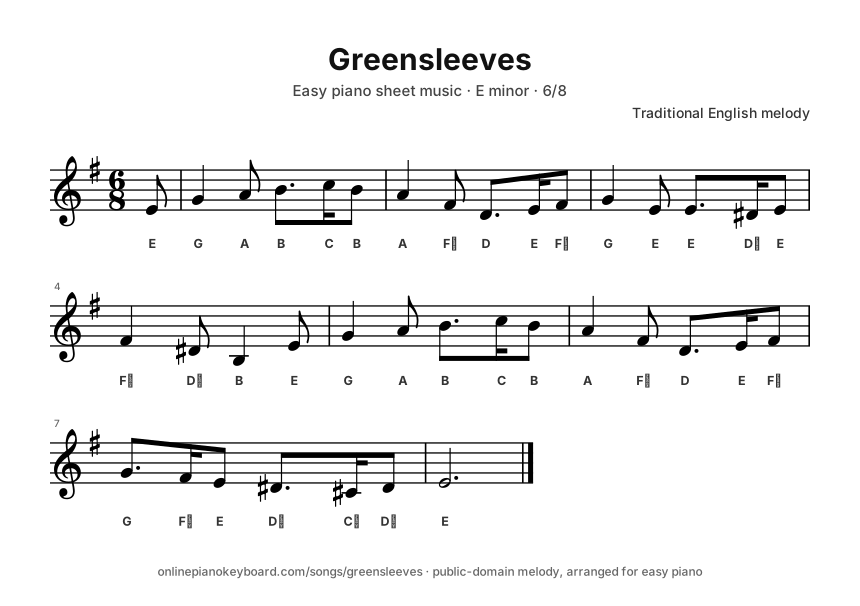
Greensleeves sheet music above shows a short piano version of the traditional English melody. The notes appear on a staff with letter names underneath, and the Letter notes tab gives the same pitches in plain text. Listen plays the phrase while highlighting each note; Practice waits for your next key. This E-minor version follows a historical printed tune through its opening and closes with a held E of our own. It teaches the melody with one hand, without a separate accompaniment or any song words.
A traditional tune in several forms
Greensleeves has circulated for centuries, so you may hear it in E minor, A minor or another key, sometimes with slightly different ornaments. A ballad bearing the name was registered in 1580, but the name of the original tune's composer is unknown. The version used here follows the melody printed in Grove's A Dictionary of Music and Musicians, which gives it in E minor and 6/8. It is also the tune often used for the later Christmas carol “What Child Is This?” This page stays with the instrumental line and does not print those words.
The melody begins with one pickup note before the first full bar. This little E leads into G, A, B, C and B. Try singing that rise and turn before you touch the keyboard. When you know the sound, find the five notes near middle C and let your hand follow the line. Do not force a fixed finger to reach every key; shift your hand gently as the melody moves above B.
Find the sharp notes
E minor has one sharp in its key signature, F sharp. On the piano, it is the first black key in a group of three. In the second bar, the line moves from A to F sharp and then down to D before turning through E and F sharp. Later you will see D sharp, the black key between D and E. The raised D helps the phrase lean back toward E. Look for the sharp sign beside that D in the staff rather than assuming every D in an E-minor tune stays natural.
The later phrase also touches C sharp, a black key immediately right of C. That note is part of the particular printed version followed here. Find F sharp, D sharp and C sharp separately in Practice before you attempt the longer phrase. The sheet shows the exact notes of this arrangement; another traditional version may ornament or spell some parts differently.
Feel two groups of three
The time signature is 6/8. Each full bar contains six eighth-note units, often felt as “ONE-two-three, TWO-two-three.” The opening E pickup uses only one eighth-note unit, so it arrives just before the first strong G. Count that E as the last small step leading into the new bar. Some melody notes last two eighths, and the dotted notes last one and a half. Their mix gives Greensleeves its gentle lilt; it should not sound like six heavy equal accents.
Practice the pickup and first two bars repeatedly. Let the longer G and A notes breathe while keeping the underlying groups of three steady. Then add the next pair of bars and listen for D sharp returning to E. Finally join the repeated rise and the shortened ending. If you need a second tune with the same reflective feel, try The First Noel; the scale finder can show the E-minor notes under your fingers.
Printable sheet music
Here is the same arrangement on a single page, with the letter name under every note. Open the image to print it or save it; the Print sheet music button above the keyboard prints it too.
Frequently asked questions
What notes start Greensleeves?
In the E-minor version here, a pickup E leads to G, A, B, C, B. The score and Letter notes tab show the complete short excerpt.
What key is Greensleeves in?
This historical tune version is in E minor. Other printed and sung versions use different keys, so a recording may begin on another piano note.
What time signature is this version?
6/8. There are six eighth-note places in each full bar, often felt as two larger beats of three eighths each.
Is Greensleeves the same tune as What Child Is This?
Yes. William Chatterton Dix's later Christmas words are commonly sung to the traditional Greensleeves tune. This page teaches the instrumental melody without lyrics.
Who wrote Greensleeves?
The composer of the traditional English tune is not known. A ballad with the Greensleeves name was registered in 1580; this page uses a public-domain printed tune version.
Why do I see D sharp in E minor?
The raised seventh, D sharp, pulls toward E at a phrase ending. It is a common minor-key change even though E natural minor otherwise uses D natural.