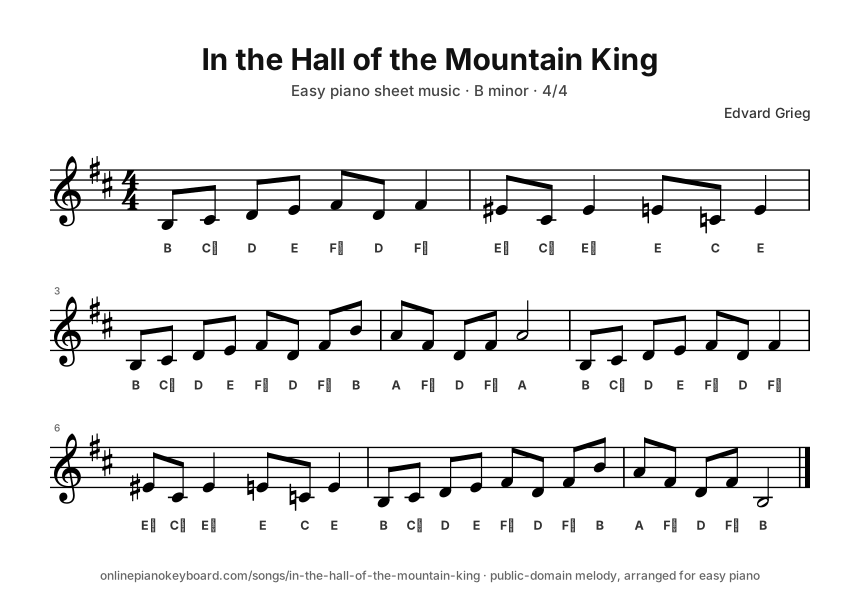
In the Hall of the Mountain King piano sheet music above teaches the quiet opening idea from Grieg's Peer Gynt music. The staff prints a letter name under each note; Listen plays the phrase, and Practice waits until you find each key. This version follows the first four bars of the theme in Grieg's piano arrangement, repeats them, and ends on B. The source starts low in bass clef, so these notes are moved up into a comfortable one-hand range. The full work has a long, increasingly forceful build. This page concentrates on the small musical idea that begins it.
The theme and its setting
Edvard Grieg wrote music for Henrik Ibsen's play Peer Gynt, and “In the Hall of the Mountain King” became one of its most recognizable numbers. Grieg later included it in his first Peer Gynt suite. The tune begins quietly, almost as if it is creeping forward. As the complete piece goes on, repeated statements get faster and stronger. You can hear that larger effect without trying to copy it all at once: first learn the shape of one clear statement, then decide how to give the repeat a little more energy.
The printed piano source opens with a long low chord before the theme begins. The arrangement here begins at the moving theme instead, with one note at a time. It leaves out the original accompaniment, much of the later music, and the large changes of register. That keeps the sheet usable for someone who has learned the notes near middle C and wants a first introduction to minor-key chromatic notes.
Climb five notes from B
Find B just below middle C. The theme climbs B, C sharp, D, E, F sharp. C sharp is the left black key in the pair above middle C; F sharp is the first black key in the group of three. Try those five notes slowly before looking at the rest of the bar. The line then returns to D and rises again to F sharp. In the score, the first six notes are eighths and the final F sharp is a quarter note. Count “one-and, two-and, three-and, four” to give that last note room.
The second bar is less predictable. It touches E sharp, the piano key usually called F, and later C natural, the white key just left of C sharp. They are deliberate accidentals, not printing errors. Point to the note names in the Letter notes tab, find the two keys separately, and then play the bar without stopping. The contrast between the familiar B-minor climb and these tighter chromatic turns is part of the theme's uneasy sound.
Count the four-bar phrase
There are four quarter-note beats in each bar. The first bar has a chain of quick eighths followed by a longer F sharp. The third bar starts like the first but continues upward to B. In the fourth bar, A, F sharp, D and F sharp lead to a two-beat A in the original phrase. Here the repeated phrase finishes on B as a short ending of our own. Keep counting through every longer note; silence or a hold is still part of the bar.
Use Practice for the first four bars only, then play the repeat. Begin both statements quietly and keep the eighth notes evenly spaced. You can make the second statement a little firmer once the fingers know where to go, but avoid rushing the steps. Listen after you have played it yourself and compare how long you hold the quarter and half notes. For another repeating minor-key pattern, try Carol of the Bells; reading sheet music explains the note values used here.
Printable sheet music
Here is the same arrangement on a single page, with the letter name under every note. Open the image to print it or save it; the Print sheet music button above the keyboard prints it too.
Frequently asked questions
What are the first notes of In the Hall of the Mountain King?
The theme rises B, C sharp, D, E, F sharp, then falls to D and returns to F sharp. Our excerpt moves the low original notes into an easy piano range.
What key is the Mountain King theme in?
The opening theme is in B minor. The source score includes chromatic E sharp and C natural notes in the second bar; follow the accidentals on the sheet.
Is this the whole Peer Gynt piece?
No. This page gives the first four-bar theme twice with a short ending. Grieg's full piece develops the idea, grows louder and faster, and uses many instruments in its orchestral version.
Who wrote In the Hall of the Mountain King?
Edvard Grieg wrote it as part of the music for Henrik Ibsen's Peer Gynt. It later appeared in Grieg's Peer Gynt Suite No. 1, Op. 46.
How fast should I play it?
Start slowly enough to keep the eighth notes even. The dramatic build belongs to the full piece; this short learning version works best with a steady four-beat pulse.
Why are there E sharp and C natural keys?
The second bar changes the usual B-minor notes for a tense chromatic turn. E sharp is the same piano key as F, while C natural is the white key just left of C sharp.