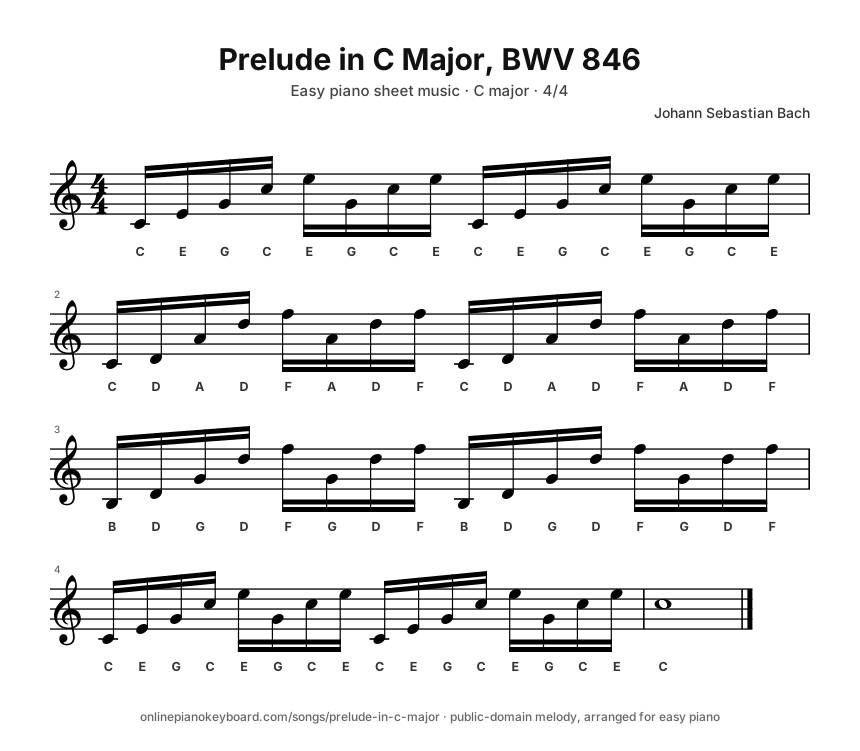
Prelude in C Major sheet music above gives the first four changing chord patterns of Bach's BWV 846 as a single line. The staff puts a letter name under every note, Listen lets you hear the flow, and Practice waits for you at each key. Bach's complete prelude is a two-hand keyboard work that carries the same rippling idea through many harmonies. This page is a short introduction to its opening. It combines the low and high notes into one sequence, then adds a held C so the excerpt has a clear place to stop.
A chord played one note at a time
A broken chord, or arpeggio, sounds the notes of a chord in sequence instead of pressing them together. The first pattern climbs C, E, G, the next C, and the next E. It then falls back to G and rises through C and E again. The eight notes fill two beats; Bach repeats that shape in the second half of the bar. Count four beats for the whole bar and keep the notes light and equal. If you hear a lurch at the middle, practice the join from the last E back to the low C.
Find middle C and the E and G above it. The high C is an octave above middle C, and high E sits two white keys farther right. The notes are all white keys in this first bar, but the span is wider than a fixed five-finger hand position. Let your hand travel from the low C toward the higher notes. Use Practice without a tempo until the path feels familiar, then listen to the bar as one continuous stream.
The pattern stays; the harmony changes
The second bar keeps the same rhythmic shape but changes the notes to C, D, A, D and F, then A, D and F. The third bar starts from B and moves through D, G, D and F. Finally the fourth bar returns to the first bar's C–E–G shape. That sequence is the reason the short excerpt already sounds like more than one chord: Bach changes the harmony while allowing your ear to recognize the same motion.
Do not try to memorize all four bars as a string of dozens of separate notes. Learn the five-note ascent of each bar and let the last three notes of the half-bar be a return to its upper part. Say the low note aloud before each new bar: C, C, B, C. Then notice the upper note of each bar: E, F, F, E. These two landmarks make the changing chord shapes easier to follow.
Count the sixteenths evenly
The meter is 4/4. Each short note on this sheet is a sixteenth, four per beat, so sixteen of them fill one bar. Tap a steady four and say “one-e-and-a” for the first group if that helps. A smooth, moderate pace is more useful than a fast stream with uneven gaps. Keep your wrist loose and let each key release as the next key sounds.
In the original score, the opening pattern is divided between the hands, and some low notes continue to sound while the higher notes move. Our single line removes those overlapping holds so you can see and hear the pattern first. The final long C belongs to this teaching version; the complete prelude continues after its fourth bar. For another repeating keyboard pattern, try Canon in D, or review reading sheet music before trying the sixteenth notes.
Printable sheet music
Here is the same arrangement on a single page, with the letter name under every note. Open the image to print it or save it; the Print sheet music button above the keyboard prints it too.
Frequently asked questions
What notes start Bach's Prelude in C Major?
Its opening broken chord climbs C, E, G, C, E, then returns to G, C, E. That eight-note pattern repeats in the first bar.
Is this the entire BWV 846 prelude?
No. It is a one-hand reduction of the first four bars followed by a short C ending. The full prelude continues through many changing harmonies and uses both hands.
What key and time signature is the prelude in?
This first prelude of The Well-Tempered Clavier is in C major and 4/4. The opening notes are mostly sixteenths: four evenly spaced notes per beat.
Why do the notes change in the second bar?
Bach keeps the same rising-and-returning pattern while changing the chord beneath it. The second bar uses C, D, A and F instead of only the first bar's C-major chord notes.
Can I play this with one hand?
Yes, this page presents the notes one after another in a single line. In Bach's keyboard score the low notes and upper notes are shared between the hands, so use the full score when you are ready for that coordination.
What is BWV 846?
It is Bach's Prelude and Fugue No. 1 in C major from Book I of The Well-Tempered Clavier. BWV is the catalog number used for Bach's works.