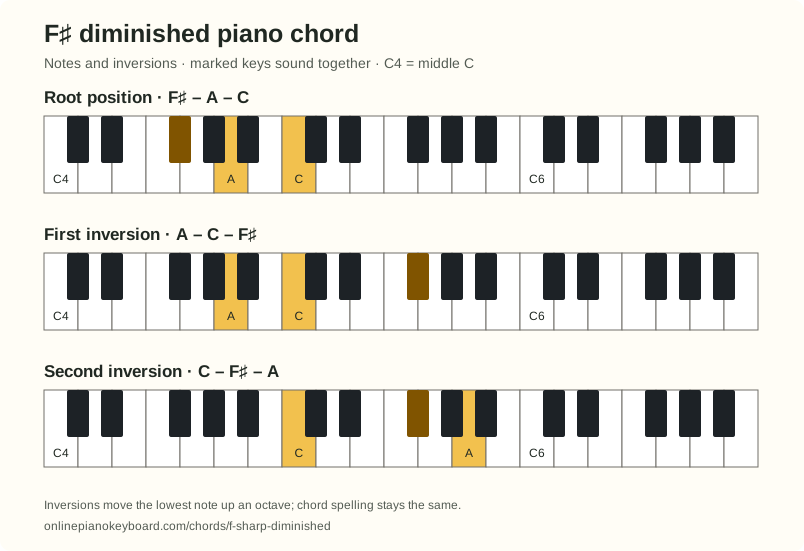
F♯dim contains F♯ – A – C. Start at F♯, move three half steps to A, then three more to C. That makes two minor thirds and a diminished fifth from the root to the top note. F♯ is a black key.
Find the notes on the piano
- F♯: the first black key of a group of three.
- A: the white key between the second and third of the three black keys.
- C: the white key just left of a pair of black keys.
Play the three notes together. Begin with right-hand fingers 1, 3 and 5 or left-hand fingers 5, 3 and 1; if the black-key pattern feels awkward, use whichever fingers keep the hand relaxed. Play the notes one after another to hear how the two small intervals build tension.
Why the chord is diminished
A three-note diminished chord stacks two minor thirds. From F♯ to A are three half steps, and from A to C are another three. The outside notes, F♯ and C, are six half steps apart. A major or minor triad spans seven half steps instead; that smaller outside interval is the diminished fifth, often called a tritone. Press only the outside notes, then add A in the middle to hear what the third contributes.
This is a diminished triad, with three notes. A diminished seventh chord adds a fourth note nine half steps above the root; a half-diminished seventh adds a fourth note ten half steps above it. The chord finder has both types. Select Diminished to return to the three-note sound on this page.
Inversions: the same three notes in a new order
In root position the order is F♯ – A – C. Move the lowest note up an octave and you get first inversion, A – C – F♯, with A in the bass. Do it again for second inversion, C – F♯ – A, with C in the bass. The names and overall pitch range change, but each shape still contains the same three pitch classes.
Try root position with fingers 1–3–5 in the right hand, then shift your hand to play first and second inversion. Use whichever of 1–2–5 or 1–3–5 allows the black and white keys to sit comfortably under your fingers. In the left hand, begin with 5–3–1 and let the fingering change if your wrist twists. These are starting points, not a fixed rule for every hand size.
Where this chord appears
In G major, F♯dim is the vii° chord, built on scale degree 7. In E natural minor, it is the ii° chord on scale degree 2.
The Roman numeral includes a small circle to mark the diminished quality. These are two different ways of reaching the same three-note chord: the seventh degree of one major scale and the second degree of one natural-minor scale. The chord's name still follows its own root, F♯, regardless of the surrounding key.
Try it in a progression
Open a pattern, then press Play to hear the chord change.
In G major, play vii° – I: F♯dim (F♯ · A · C) then G major (G · B · D). The F♯ at the bottom of the diminished chord can move up one half step to G, the tonic. C can move down to B. Hold the first chord for two beats and the second for four; listen for the second chord to feel like an arrival.
In E minor, try ii° – V – i: F♯dim, then B major, then E minor (E · G · B). That major V borrows the raised seventh from harmonic minor, so one note differs from the natural-minor scale. First play one chord per four beats; then try two beats for ii° and V, followed by four beats for i. This turns the chord from an isolated sound into a useful move toward home.
A short practice routine
Press Practice chord to find F♯ · A · C in any order. The highlights show which notes remain. Choose an inversion for another position or Stop to end practice. This checks note selection without grading timing or held notes.
Find F♯ without looking at the highlighted keyboard, then check it here. Play F♯, A, C one after another, up and down, before pressing them together. Say each note name aloud. After the root-position chord feels even, try both inversions and return to root position without stopping. Compare the chord with the nearby minor triad: keep the first two keys, raise C by one piano key, and listen to how the changed fifth releases some of the tension.
Compare this with F♯ minor: its fifth is a half step higher, so the chord feels more settled. The chord finder lets you hear both. For a longer sequence, the chord progression generator includes diminished triads among each key's seven chords.
Frequently asked questions
What notes are in F♯dim?
F♯dim contains F#, A, C: two minor thirds stacked above F#.
What makes F♯dim diminished?
The root and fifth are six half steps apart instead of seven, so the chord has a diminished fifth.