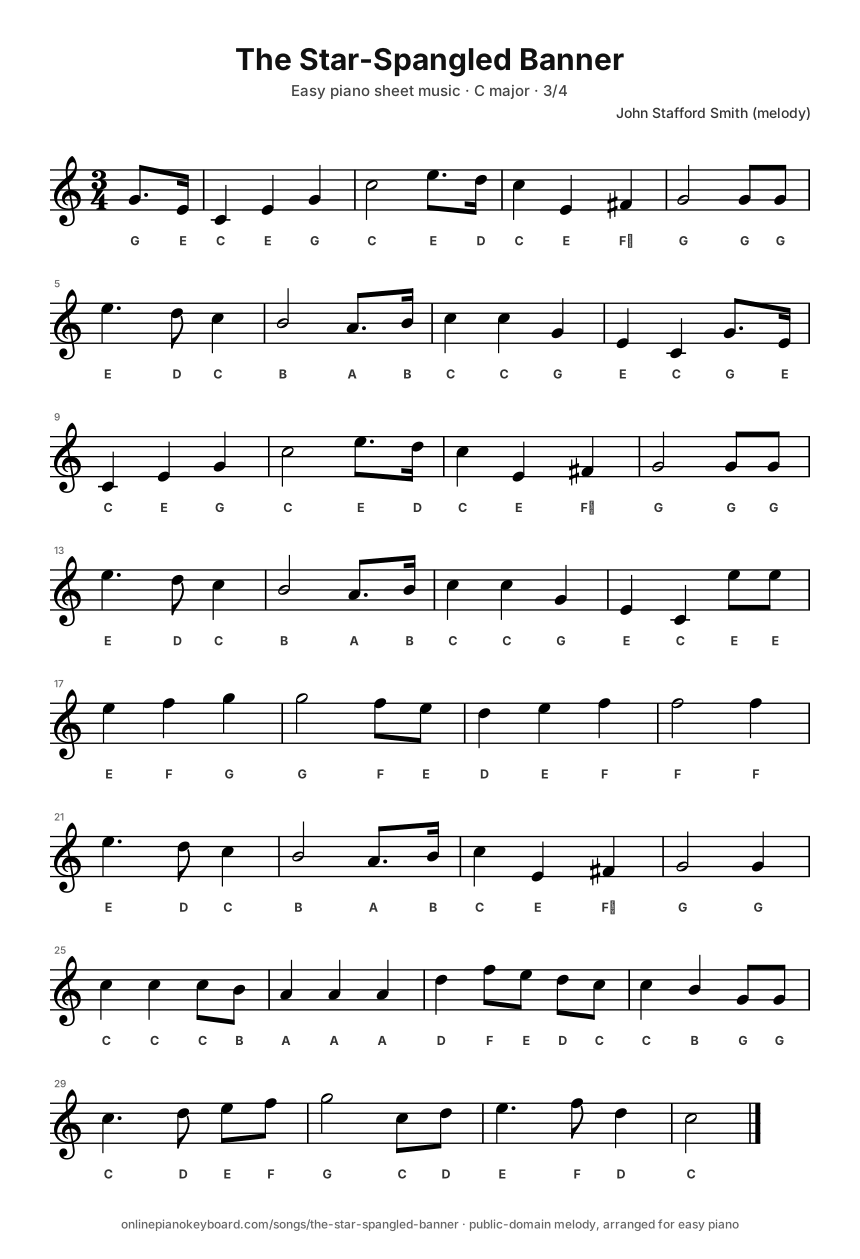
The Star-Spangled Banner sheet music above is written in C major and 3/4 time, with the letter name printed under every note, and the Letter notes tab lists the same melody as plain letters. It is the whole tune as Americans sing it, one verse from "O say can you see" to the final line, arranged for the right hand alone. Listen plays it and highlights each note in the sheet as it sounds; Practice lights the next key and waits for you. The anthem is an intermediate piece because of its range, but it uses only one black key, F sharp, and a Print sheet music button gives you a paper copy.
About the Star-Spangled Banner
The words come from a poem Francis Scott Key wrote on September 14, 1814, after watching the British navy bombard Fort McHenry in Baltimore during the War of 1812. The flag still flying over the fort in the morning gave the song its name.
The music is older. John Stafford Smith wrote it in the 1770s as The Anacreontic Song, the club song of a London society of amateur musicians. The tune was already well known in the United States, and Key's poem was soon printed and sung to it. The US Navy adopted the song for official use in 1889, and Congress made it the national anthem on March 3, 1931.
Different books once printed slightly different versions, so in 1917 five musicians, among them John Philip Sousa and Walter Damrosch, agreed on a standard one, which was printed for Army and Navy songbooks and for school singing. This page follows that version, moved from B-flat major up a step to C major so that almost every note is a white key.
How to play the Star-Spangled Banner
The melody runs from middle C to the G an octave and a half above it, so plan three hand positions and let Practice give you time to move between them.
- Middle C position. Put your thumb on middle C with one finger on each white key up to G. The opening notes, G E C E G, are fingers 5 3 1 3 5. The same position covers the rising E, F sharp, G that comes three times: fingers 3, then 4 on the black key, then 5.
- The first leap. After the opening chord the tune jumps to the C above middle C and carries on to E and D. Move your thumb to that C so fingers 3 and 2 fall on E and D.
- The second line. It begins high on E and steps down through D, C and B to A, rises back to C, then drops through G and E to middle C. Place your thumb on A for the start of the line so your hand covers A up to E, then move down for the last few notes.
- The high position. In the second half the tune climbs to its top note, G, in two places. Put your thumb on the C above middle C: now C, D, E, F and G sit under fingers 1 to 5. The closing climb, C D E F then G, is simply 1 2 3 4 5.
Counting the rhythm
Count three beats in every bar. The anthem starts with a pickup: a long G and a very short E share the last beat before bar one, so count "3-and-a", playing G on 3 and E just before the next 1. That long-short pair comes back often, as a dotted eighth note followed by a sixteenth, most clearly on the E and D straight after the first high C. Keep the short note quick and light rather than even.
Half notes, two beats long, come in almost every line. Hold each one for its full value before moving on; the anthem sounds hurried when they are cut short.
Practice tips
- Learn it in halves. The first half is one eight-bar passage played twice, changing only at its very end, so once the first two lines are secure the next two are mostly learned. The second half is new material and deserves its own sessions.
- Rehearse each move. Play just the last note before a hand move and the first note after it, several times, until your hand lands without looking.
- Sing or hum the tune while you play. Knowing where the words fall makes the pickup and the dotted rhythms feel natural.
- Hear the whole shape. Press Listen again after each session; the sheet music highlights every note, so you can follow along away from the keys.
When you are comfortable with the anthem, America the Beautiful is a gentler patriotic song in the same key.
Printable sheet music
Here is the same arrangement on a single page, with the letter name under every note. Open the image to print it or save it; the Print sheet music button above the keyboard prints it too.
Frequently asked questions
What are the letter notes for the Star-Spangled Banner?
The full letter notes are shown above, line by line. The opening is G E C E G, then a leap to the C an octave above middle C, so the first bars outline a C major chord.
What key is the Star-Spangled Banner in?
The standard 1917 version is in B-flat major, and many singers use A-flat. This easy piano version is in C major, where the only black key you need is F sharp.
Why is the national anthem hard to play and sing?
The melody covers 19 semitones, an octave and a fifth, and it leaps as well as climbs. Here it runs from middle C up to the G an octave and a half above, which means moving your hand several times.
Who wrote the music of the Star-Spangled Banner?
The tune is John Stafford Smith's The Anacreontic Song, written in London in the 1770s. Francis Scott Key's poem of 1814 was set to it, and the song became the national anthem in 1931.
Does this version include every verse?
It plays the melody once, for the first verse, which is the one sung at almost every event. Key's other verses use the same tune.
Is the Star-Spangled Banner in the public domain?
Yes. The tune dates from the 1770s and Key's words from 1814, so both are free to play and share. This simple arrangement is our own.