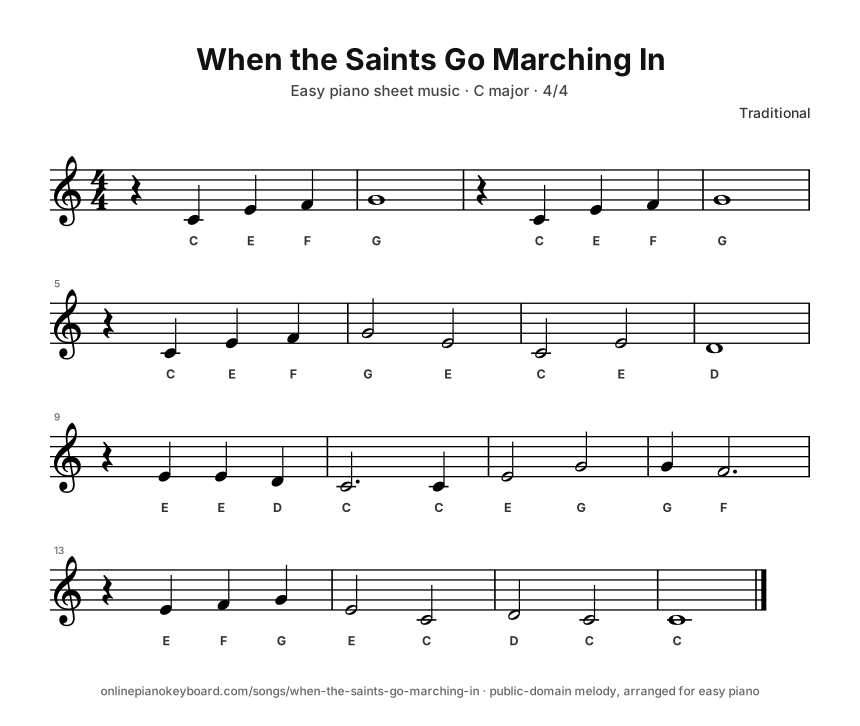
The When the Saints Go Marching In sheet music and letter notes are shown above. The whole melody uses just five white keys, C, D, E, F and G, starting at middle C, so your right hand can stay in one place from the first note to the last. What keeps it from being a very easy song is the rhythm: each phrase begins after a rest, and several notes are held for three or four beats.
About the song
When the Saints Go Marching In is an American spiritual, a religious folk song handed down by singing, and nobody knows who first wrote it. Its words picture the saints marching into heaven and a singer who hopes to be among them.
By the early 20th century it had become a standard for New Orleans jazz bands, and it has stayed one ever since. Louis Armstrong recorded it in 1938, and his version is one of the best known. This page gives the familiar melody on its own, in C major.
How to play it
Put your right hand in C position: thumb (finger 1) on middle C, finger 2 on D, 3 on E, 4 on F and 5 on G. That is the only hand position you need. Every note in the song is already under a finger, and each finger always plays the same key, so you can keep your eyes on the letter notes instead of hunting for keys.
The song opens with a climb from C through E and F to G, fingers 1, 3, 4 and 5, and that climb comes three times in the first half. Finger 2 has the lightest job: D appears only three times in the whole song.
Counting the rests and long notes
The song is in 4/4, so count "1 2 3 4" in every bar and keep counting through the silences.
- The rest. The first beat of each phrase is silent. Count "1" without playing, then play C, E and F on "2 3 4", and land on G on the next "1".
- The long G. Hold that first G for four full counts before the next phrase begins.
- Two-beat notes. In the second line, after the climb, G, E, C and E last two counts each, and the D that follows lasts four.
- Three-beat notes. In the third line, a C lasts three counts before it is played again, and the line ends on an F that also lasts three.
- The ending. The final C lasts a whole bar.
Practice tips
- Say the counts out loud. It is easy to rush the rest and start a phrase too early; counting aloud keeps every long note its proper length.
- Use Practice for the order, Listen for the rhythm. Practice waits for each key, so it teaches which note comes next but not how long to hold it. Go back and forth between the two until you can hear the rhythm while you play.
- Try your computer keyboard. Set Labels to Computer keys to see which key on your keyboard plays each note, then play the tune with five fingers on five keys.
- Add a left hand later. The song can be accompanied with just the three primary chords of the key, I, IV and V, which in C major are the C, F and G major chords. The basic chords lesson shows how to play them under a melody.
New to five-finger positions? The hand position lesson covers the C position for both hands. For another tune that stays close to middle C, try Ode to Joy.
Printable sheet music
Here is the same arrangement on a single page, with the letter name under every note. Open the image to print it or save it; the Print sheet music button above the keyboard prints it too.
Frequently asked questions
What are the letter notes for When the Saints Go Marching In?
The full letter notes are shown above. The first phrase is C E F G, starting after a one-beat rest, with the G held for four beats, and then the same phrase comes again.
Is When the Saints Go Marching In easy on the piano?
Yes. Every note falls under the five fingers of your right hand in C position, so you never have to move your hand. The only real challenge is counting the rests and the long notes.
What key and time signature is this version in?
It is in C major and 4/4 time, with four beats in every bar, and it uses only white keys.
Which finger plays which note?
Your thumb plays middle C, and fingers 2, 3, 4 and 5 play D, E, F and G. Each finger keeps the same key for the whole song.
Why does each phrase start with a rest?
The melody begins on the second beat of the bar, so beat 1 is silent. Counting that beat makes the long notes land where they belong, on the first beat of the next bar.
Who wrote When the Saints Go Marching In?
No one knows. It is a traditional American spiritual that became a New Orleans jazz standard in the early 20th century, and the melody is in the public domain.