The Auld Lang Syne sheet music above gives you a complete verse and chorus in F major, arranged for the right hand. Every note on the staff has its letter name underneath, and the Letter notes tab shows the same melody without a staff. Press Listen to hear each note as its key and place in the sheet light up. In Practice, the next key waits for you to press it. The tune stays between middle C and the D above the next C. Only five white-key note names appear, so it is an approachable song for a beginner who can already find middle C.
About Auld Lang Syne
Robert Burns sent the words of Auld Lang Syne to the Scots Musical Museum in 1788. The words draw on an older Scottish song rather than beginning with him alone. The melody now familiar with them was printed alongside the words in George Thomson's Select Songs of Scotland in 1799; an earlier melody had accompanied the text before that. This page uses the familiar later tune, not that earlier setting.
The tune is pentatonic, meaning it uses five note names rather than all seven of a major scale. Here those notes are F, G, A, C and D. F major normally has B-flat in its key signature, but neither B-flat nor E appears in this melody. That is why you can play this version on white keys only. The simple pitch set also makes the tune easier to remember: the phrases return to the same few notes, even when the chorus starts higher than the verse.
The arrangement gives the melody alone. It does not add the harmony or a left-hand part you may hear in a group performance. Its rhythm follows the printed tune, including the short pickup at the start and the held notes at the ends of phrases.
How to play Auld Lang Syne
Find middle C, the white key just left of the two black keys near the center of an 88-key piano. That C is the pickup. Play it with your right thumb, then move the hand so F is comfortable under your thumb for the first full bar. The first phrase repeats F three times before reaching A. Listen to the two different lengths of those Fs: the first is dotted and lasts one and a half beats, the second takes half a beat, and the third takes one beat.
The next phrase goes G, F, G, A. It uses the same dotted-and-short rhythm, so learn the rhythm once and reuse it. The third phrase starts like the first but rises to the C above middle C, then the line reaches D. Shift the hand upward before that C and D instead of stretching the little finger across the whole range.
In the second line, start from high C and walk down through A to F. Later the melody dips to D just above middle C and then to middle C itself. Bring your hand back toward the center of the keyboard for that low turn. The chorus begins higher, but it borrows the same C–A–F descent and G–F–G motion. Notice those repeated shapes in the sheet; they help you learn the longer tune without memorizing each note separately.
Counting the pickup and long notes
The time signature is 4/4, so count four beats in every complete bar. The first C is a one-beat pickup: count it on beat four, then start the first F on the next beat one. Near the ends of the lines, D or F is held for three beats, leaving one beat for the following note when a pickup leads into the next phrase. Keep counting through the held note; do not tap the next key early just because your finger is ready.
For the dotted rhythm, say “one-and-two” while holding the first note, play the short note on the “and” after beat two, and continue with the next full beat. Listen once while following the highlighted sheet music, then use Practice to stop at each key. When your fingers know the notes, turn the guide off and count aloud. If the high D or the return to low C causes a pause, rehearse only that hand move a few times before playing the whole song again.
For another melody that stays on a small set of notes, try When the Saints Go Marching In. The scales page lets you hear all eight notes of F major and compare that full scale with the five notes used here.
Printable sheet music
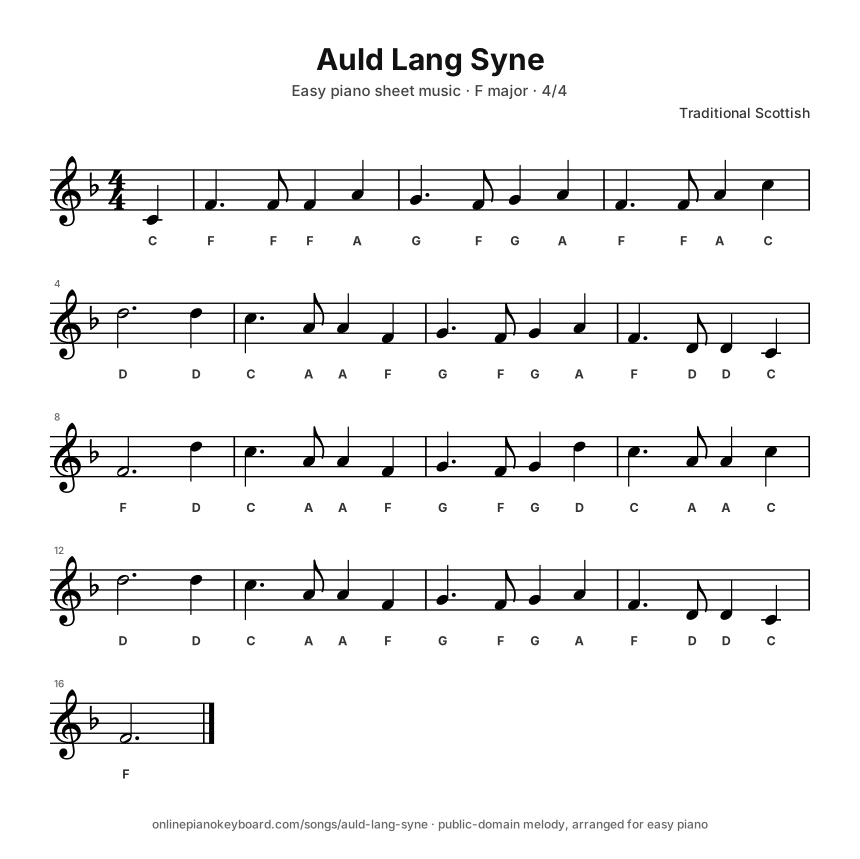
Here is the same arrangement on a single page, with the letter name under every note. Open the image to print it or save it; the Print sheet music button above the keyboard prints it too.
Frequently asked questions
What are the letter notes for Auld Lang Syne?
The pickup is middle C. The first phrase goes F F F A, G F G A, F F A C, then a long D. The complete verse and chorus appear above as sheet music and letter notes.
What key is Auld Lang Syne in on this page?
F major, in 4/4 time. The tune uses only F, G, A, C and D, so this arrangement needs no black keys even though the F major key signature includes B-flat.
Is Auld Lang Syne easy to play on piano?
Yes. It uses five white-key note names and mostly moves by steps or small skips. The main challenge is counting the dotted notes and the pickup before the first full bar.
Does this page include the verse and chorus?
Yes. The right-hand arrangement plays one verse and one chorus, with sheet music, letter notes, Listen and Practice. It has no separate left-hand accompaniment.
Who wrote Auld Lang Syne?
Robert Burns sent the words to the Scots Musical Museum in 1788. The Scottish folk melody now usually sung with them was first printed with the words in George Thomson's collection in 1799.
Why are there no black keys if the key is F major?
This melody is pentatonic: it selects five notes from the F major scale and leaves out B-flat and E. Its key signature still shows B-flat, but the melody never asks you to play it.