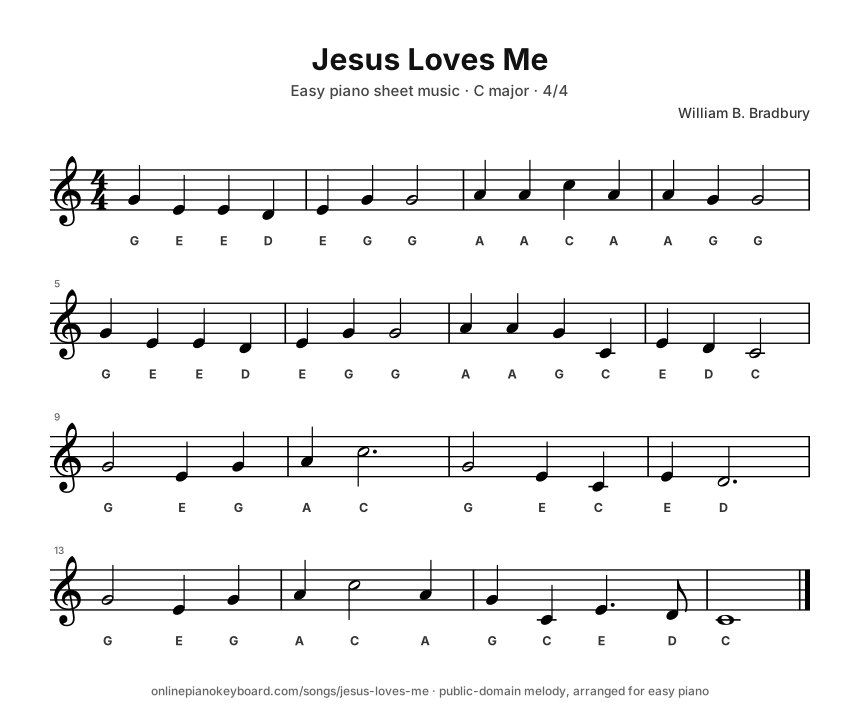
The Jesus Loves Me piano notes above are shown as sheet music in C major and 4/4 time, with the letter name under every note, and as plain letters on the Letter notes tab. The arrangement has the verse and the refrain, arranged for the right hand, and it uses just six white keys: C, D, E, G and A, plus the C an octave above middle C. Listen plays the hymn and highlights each note in the sheet, and Practice lights the next key and waits for you. With simple rhythms and almost no hand movement, it is a very easy first hymn for children and adults alike.
About Jesus Loves Me
The words were written by Anna Bartlett Warner. They first appeared in 1860 as a poem inside Say and Seal, a novel by her older sister Susan Warner, where a character recites them to comfort a dying child.
Two years later, in 1862, the American composer William Batchelder Bradbury set the poem to music for a collection of Sunday school songs, and he added the refrain that begins "Yes, Jesus loves me". It became a popular hymn in English-speaking churches, and some later hymnals named the tune China. Bradbury's own books print it in E-flat major; this page moves it to C major so that it needs no black keys.
How to play Jesus Loves Me
The whole melody fits one hand position with a single reach.
- The hand position. Put your thumb on middle C, finger 2 on D and finger 3 on E. Then skip F and place finger 4 on G and finger 5 on A. These five keys are the C major pentatonic scale, and every note but one is among them.
- The first line. It begins G E E D, fingers 4 3 3 2, then E G G, fingers 3 4 4, with the last G held for two beats. The second half climbs to A and reaches up to the high C: stretch your little finger from A to C and come straight back to A.
- The second line. It starts exactly like the first, then turns downward, A A G and a drop to middle C, finger 1, before E D C closes the line.
- The refrain. It begins with a long G, then E, G and A, and leaps up to the high C, held for three beats. The second half answers with G, E, middle C and E again, then D held for three beats. The last line repeats the start of the refrain and ends on middle C.
Counting the rhythm
The hymn is in 4/4, so count four beats in every bar. The verse moves in steady quarter notes, one per beat, and every second bar ends with a half note of two beats. The refrain slows down: it opens with half notes and has two dotted half notes of three beats, on the high C and on D. Near the very end, E lasts a beat and a half and D only half a beat, then the final C fills a whole bar of four beats.
Practice tips
- Say the finger numbers. For the first bar, "4 3 3 2", spoken while playing, helps the hand position settle.
- Practice the reach. Play A and the high C back and forth a few times before the first line; it comes three times in the song.
- Notice the repeats. The two verse lines start the same way, and the refrain's first bar returns in its last line, so there is less to learn than the length suggests.
- Try both hands later. Once the melody is easy, play a low C with your left hand at the start of each bar, and a low G under the long D that ends the third line.
For another well-loved hymn that stays on the white keys, try Amazing Grace.
Printable sheet music
Here is the same arrangement on a single page, with the letter name under every note. Open the image to print it or save it; the Print sheet music button above the keyboard prints it too.
Frequently asked questions
What are the letter notes for Jesus Loves Me?
The first line is G E E D, E G G, A A C A, A G G. The verse and the refrain are written out above, as sheet music and as letter notes.
What key is Jesus Loves Me in?
Bradbury's own songbooks print it in E-flat major. This version is in C major, so every note is a white key, from middle C to the C above.
Which fingers should I use?
Spread your hand over C, D, E, G and A with the thumb on middle C, skipping F. The only other note is the high C, which your little finger reaches from A.
Who wrote Jesus Loves Me?
Anna Bartlett Warner wrote the words as a poem in the 1860 novel Say and Seal. William Batchelder Bradbury wrote the tune in 1862 and added the refrain that begins Yes, Jesus loves me.
Why is the tune sometimes called China?
Some hymnals name the tune China. The Modern Hymnal of 1926 explained the name with a note calling it the favorite hymn of China.
Is Jesus Loves Me in the public domain?
Yes. The words date from 1860 and Bradbury's music from 1862, so the hymn is free to play and share.