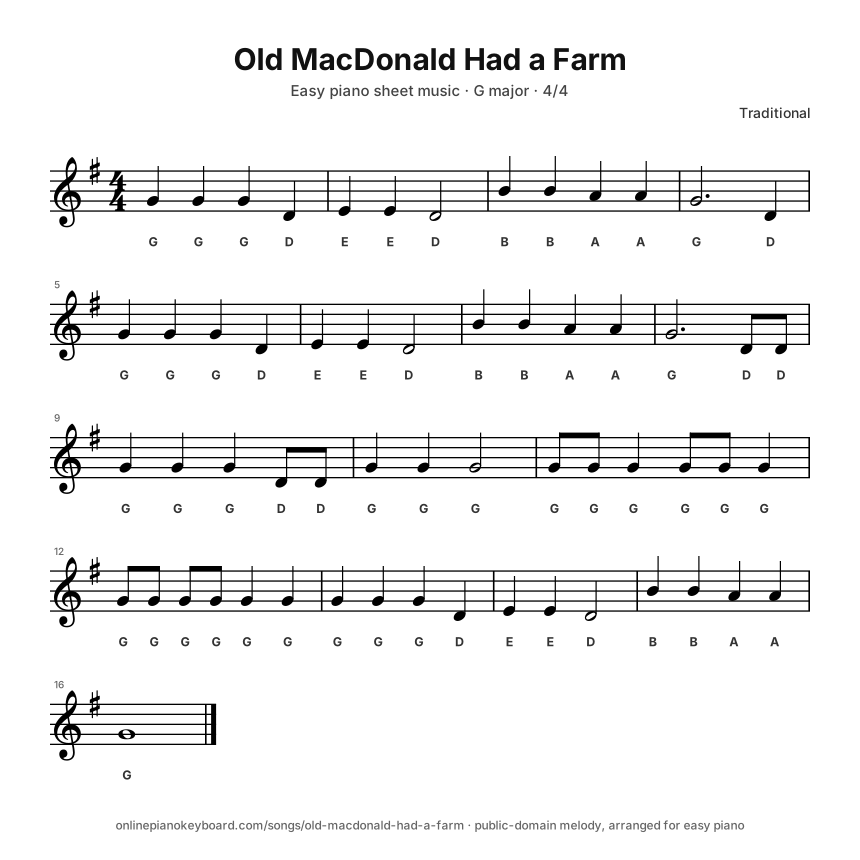
The Old MacDonald Had a Farm piano notes above are written as sheet music in G major and 4/4 time, with the letter name under every note, and the Letter notes tab shows the same notes as plain letters. The arrangement is one full verse, with a cow and its moo, and it uses only five different notes, D, E, G, A and B, all of them white keys just above middle C. Listen plays the song and highlights each note in the sheet, and Practice lights the next key and waits until you press it. With no black keys and no hand moves, it is one of the easiest songs to start with.
About Old MacDonald Had a Farm
The farmyard song has a long family tree. In 1706 the English writer Thomas d'Urfey included a song in one of his operas about keeping a father's cows, with "booing here, booing there", although it was sung to a different, minor-key tune. Versions with a farm, animals and their sounds were collected from English singers in the late 1800s and early 1900s, and a World War I songbook of 1917 prints one about "Old Macdougal" with an E-I-E-I-O refrain.
The melody sung today, and the name Old MacDonald, appear on American records made in 1925 and 1927, which may be the earliest versions to use them. Since then it has become one of the first songs many children learn, and every verse invites a new animal and a new noise.
The five notes of this version, G, A, B, D and E, make up the G major pentatonic scale, a five-note scale with no half steps that many folk tunes use.
How to play Old MacDonald
Spread your right hand over five white keys, skipping one: thumb on D, the key just to the right of middle C, finger 2 on E, then skip F and put finger 3 on G, finger 4 on A and finger 5 on B. Every note of the song is now under a finger, so you never have to look for a key.
- The opening. "Old MacDonald had a farm" is G G G D, E E D: fingers 3 3 3 1, 2 2 1. The D is held for two beats.
- E-I-E-I-O. This is B B A A and a long G, fingers 5 5 4 4 3. It comes three times, at the end of every line except the third.
- The animal sounds. The third line, where the moos go, uses only G and D. It moves faster, in eighth notes, two quick notes to a beat, with G on finger 3 the whole time and D on your thumb.
- The ending. The last line repeats the first, but the final G lasts a whole bar.
Counting the rhythm
The song is in 4/4, so every bar gets four counts. Most notes are quarter notes, one count each. The D that ends the second bar of a line lasts two beats, and the G after each E-I-E-I-O lasts three, with the last beat of the bar leading into the next line. The final G lasts all four.
In the third line some beats hold two eighth notes instead of one quarter note. Count "1-and 2-and 3-and 4-and" there, so each quick pair falls on a number and the "and" after it, while the longer notes take a whole beat.
Practice tips
- Name the fingers first. Say "3 3 3 1, 2 2 1" out loud before you play the opening; the pattern sticks faster than the letters.
- Slow down the moo line. Its repeated Gs are quick, so let each key rise fully before pressing it again, or notes will run together.
- Change the animal. Playing a second verse with a duck or a pig keeps practice fun for children, and the notes do not change.
- Watch the long G. Hold it for three full counts; rushing the end of each line is the most common slip.
When this feels easy, Itsy Bitsy Spider uses almost the same keys and adds a gently rocking 6/8 rhythm.
Printable sheet music
Here is the same arrangement on a single page, with the letter name under every note. Open the image to print it or save it; the Print sheet music button above the keyboard prints it too.
Frequently asked questions
What are the letter notes for Old MacDonald Had a Farm?
The first line is G G G D, E E D, B B A A, G. The complete song is shown above, both as sheet music and as letter notes.
What key is Old MacDonald in here?
This version is in G major, and it only uses D, E, G, A and B, so every note is a white key. The range is just six white keys, from the D above middle C to B.
Which fingers should I use?
Spread your right hand so the thumb is on D, finger 2 on E, 3 on G, 4 on A and 5 on B. Your hand never has to move.
Which notes are the E-I-E-I-O?
It is B B A A and then a long G: the highest notes of the song stepping down to G, the home note. Fingers 5 5 4 4 3.
How do I play more verses with other animals?
Play the song again for each animal. In the version where the animals pile up, repeat the third line once for every animal already named before going on to the last line.
Is Old MacDonald Had a Farm in the public domain?
Yes. It is a traditional song; the tune has been sung for about a hundred years and the farmyard idea goes back to 1706. This arrangement is our own.