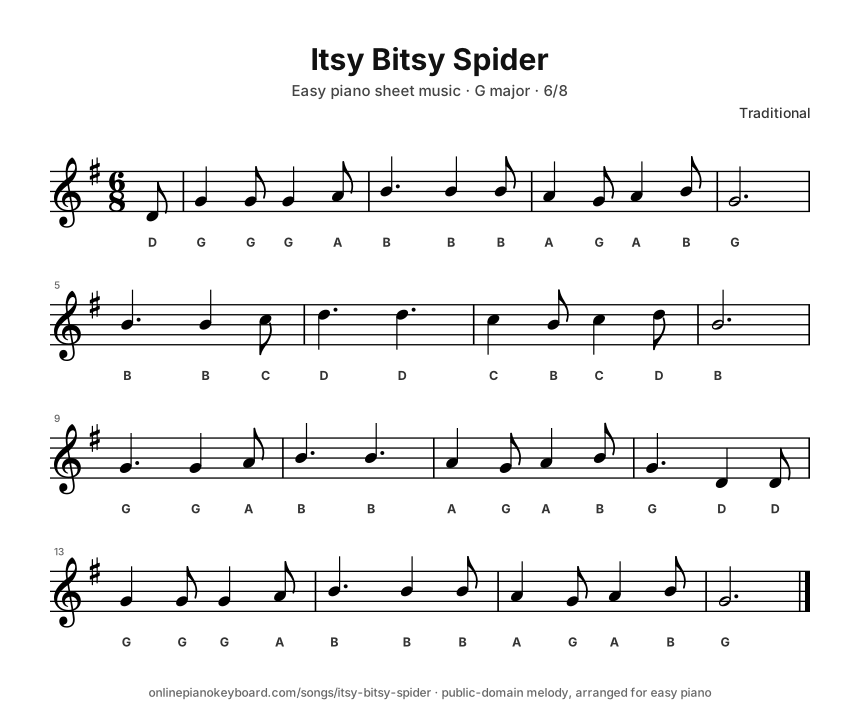
The Itsy Bitsy Spider piano notes above appear as sheet music in G major and 6/8 time, with the letter name printed under each note, and as plain letters on the Letter notes tab. The tune uses only six white keys: G, A, B, C and D above middle C, and the D just above middle C at the start. That makes it one of the easiest songs on the site for a child or a complete beginner. Listen plays the tune and highlights each note in the sheet, and Practice lights the next key and waits for you, so a young player can learn it without reading music at all.
About Itsy Bitsy Spider
Itsy Bitsy Spider is a nursery rhyme and fingerplay: a song with hand motions that act out the story of a spider climbing a water spout, being washed out by the rain, and climbing back up when the sun comes out. Children usually walk their fingers upward for the climb and flutter them downward for the rain.
Nobody knows who wrote it. A version of the words was printed in 1910 in a travel book about Baja California, where it is called the "Spider Song", and another version was reported from an Indiana college in 1912. In Britain the same rhyme is known as Incy Wincy Spider. The melody here is the familiar American one.
How to play Itsy Bitsy Spider
Put your right hand in the G position: thumb on the G above middle C, then fingers 2, 3, 4 and 5 on A, B, C and D. Nearly the whole song is now under your fingers.
- The first line. The song opens on the low D, a pickup, so reach your thumb down for it, then bring the thumb back to G. The rest of the line uses only G, A and B, fingers 1, 2 and 3, and it ends on a long G.
- The middle line. This is where the spider gets washed out. The tune climbs B, C and up to D, your little finger, then turns back through C, B, C and D before settling on B. The high D is played twice in a row, each note lasting half the bar.
- The third line. It starts like the first but more slowly, with longer Gs and Bs, and it ends with two low Ds, the pickup into the last line. Reach down with your thumb again.
- The last line. It is the same as the first line, so by now you already know it.
Counting the rhythm
The time signature, 6/8, means six eighth notes in a bar, grouped in two sets of three. Count "1-2-3, 4-5-6" and put a little weight on 1 and 4. Two rhythms appear again and again. The first is a long note of two counts followed by a short one: the first bar is G long, G short, G long, A short. The second is a dotted quarter note that fills a whole group of three counts, like the first B of the second bar.
Three of the four lines end on a dotted half note, a note that lasts the whole bar. Hold it for all six counts before starting the next line; the third line ends instead with a shorter G and the two low Ds.
Practice tips
- Sing the words as you play. The syllables fit the notes one to one, and singing makes the long-short rhythm natural.
- Learn the middle line on its own. It is the only one that climbs up to C and D, so give it a few extra turns in Practice.
- Keep the thumb near G. Every trip down to the low D is short; return to G straight away and the rest of the line stays easy.
- Try the motions. Once the tune is secure, a second person can sing and do the hand motions while you play.
After this song, Old MacDonald Had a Farm also sits around the G above middle C and is just as easy.
Printable sheet music
Here is the same arrangement on a single page, with the letter name under every note. Open the image to print it or save it; the Print sheet music button above the keyboard prints it too.
Frequently asked questions
What are the letter notes for Itsy Bitsy Spider?
The first line is D, then G G G A, B B B, A G A B and a long G. The whole song is written out above as sheet music and as letter notes.
What key is Itsy Bitsy Spider in here?
It is in G major. The tune never uses F, the one note that is sharp in G major, so every key you press is white.
Which fingers should I use?
Use the G position: thumb on G, then fingers 2, 3, 4 and 5 on A, B, C and D. Only the low D falls outside the hand; reach down to it with your thumb.
What does 6/8 time mean?
Each bar holds six eighth notes, felt as two groups of three. That gives the song its rocking, swaying feel, so count 1-2-3, 4-5-6.
Is Itsy Bitsy Spider the same song as Incy Wincy Spider?
Yes. The rhyme is called Incy Wincy Spider in Britain and Incey Wincey Spider in Australia, and the words and hand motions are nearly the same.
Is Itsy Bitsy Spider in the public domain?
Yes. It is a traditional nursery rhyme with no known author, and a version of the words was already in print by 1910.