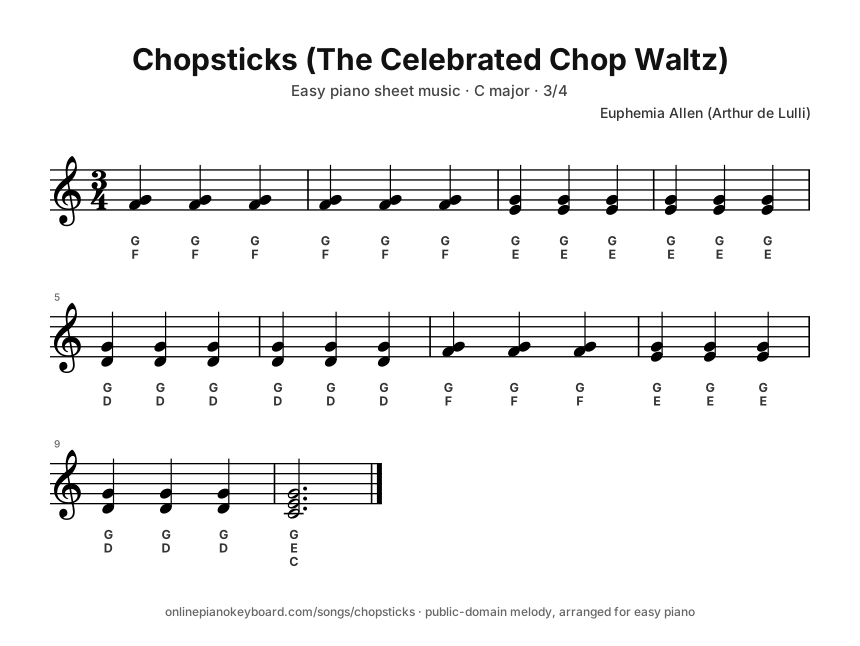
Chopsticks piano sheet music above shows the familiar opening of The Celebrated Chop Waltz in a short beginner arrangement. Two nearby keys sound together on each beat. Letter names sit under the notes on the staff, and the Letter notes tab offers another way to follow them. Press Listen to hear the even waltz pulse, then Practice to find each pair on the keyboard without a timer. This version moves the notes down an octave to put them close to middle C, repeats the opening pattern, and adds its own simple ending. It is an exercise in the recognizable hook, not the complete waltz.
From the original Chop Waltz
Euphemia Allen published The Celebrated Chop Waltz in 1877 under the pen name Arthur de Lulli. The original solo score starts with repeated pairs of adjacent notes in the right hand while the left hand supplies bass notes and chords. There was also a duet version. The upper part of the opening goes F and G together, then E and G, then D and G. In the original print, those pairs sit an octave above the keys used here. The page above keeps the changing lower note and the fixed G but leaves the left-hand part out.
The word “chop” describes the direct, repeated motion of the paired notes. It can be tempting to jab at the keys. A lighter touch will keep the sound even and make it easier to move from one pair to the next. The short version here returns to the first pair after the three-note descent and finishes on a C-major chord. That last bar is our ending; it is not the ending of Allen's full score.
Find the two starting keys
Locate middle C: a white key just left of a pair of black keys near the center of the keyboard. Move right through D and E to F, the white key just left of a group of three black keys. G is the next white key. Put two neighboring fingers on F and G and press them at exactly the same moment. The first two bars repeat this pair six times in all, so take those bars slowly until both keys sound together every time.
Keep the upper finger on G. For the next pair, move the lower finger left from F to E; for the following pair, move it left again to D. Your hand does not need to jump across the keyboard. If a finger has to stretch awkwardly, release the pair between beats and let the hand settle before the next press. Practice will wait for you, so there is no need to rush a shift.
Count the waltz
Chopsticks is a waltz in 3/4, with three quarter-note beats in each bar. Count “one, two, three” steadily and press the pair on each number. Accenting beat one very gently can help you feel the start of each bar. The three presses should still be equally spaced. If the repeats start to run away from you, set Listen to a comfortable pace, tap the beat on your lap, and then try the keys again.
The repeated notes can make the bar lines hard to hear. Say “F–G, F–G, F–G” over one bar, then begin the next count at one, rather than counting endlessly to six. When the lower note changes to E, the three-beat count stays exactly the same. The move to D also happens at the start of a new bar; listen for the new lower pitch while the G remains steady.
A short practice route
First play only the F-and-G pair for two bars. Once it is even, add the E-and-G pair for two bars and the D-and-G pair for two bars. Stop at each change and check which finger moves. Then try the return through F, E and D without stopping, and hold the final C–E–G chord for all three beats. This final chord uses three fingers instead of two; find C, E and G separately before you press them together.
For another piece with a repeated right-hand pattern, try The Entertainer. The C-major chord page shows the three notes used in this arrangement's last bar.
Printable sheet music
Here is the same arrangement on a single page, with the letter name under every note. Open the image to print it or save it; the Print sheet music button above the keyboard prints it too.
Frequently asked questions
What are the first notes of Chopsticks?
The recognizable opening strikes F and G together three times per bar, then moves the lower note down to E and D while G stays. This version places the notes near middle C.
How do you play Chopsticks with two fingers?
Press F and G together with two neighboring fingers. Keep the upper finger on G while the lower one steps left to E and then D. Start slowly so both keys sound at the same time.
Is this the whole Chopsticks waltz?
No. It is the opening two-note idea, repeated and given a short C-major ending. The original solo score continues with more chords, higher notes and a left-hand part.
What time signature is Chopsticks in?
The Celebrated Chop Waltz is in 3/4. Count one, two, three for every bar, with one pair of notes on each beat.
Who wrote Chopsticks?
Euphemia Allen published The Celebrated Chop Waltz in 1877 under the pen name Arthur de Lulli. This page uses a short arrangement of its public-domain opening.
Do I need a duet partner?
No. The original was published in solo and duet versions. The excerpt above is a short, one-player exercise; you can try it with a partner later if you like.