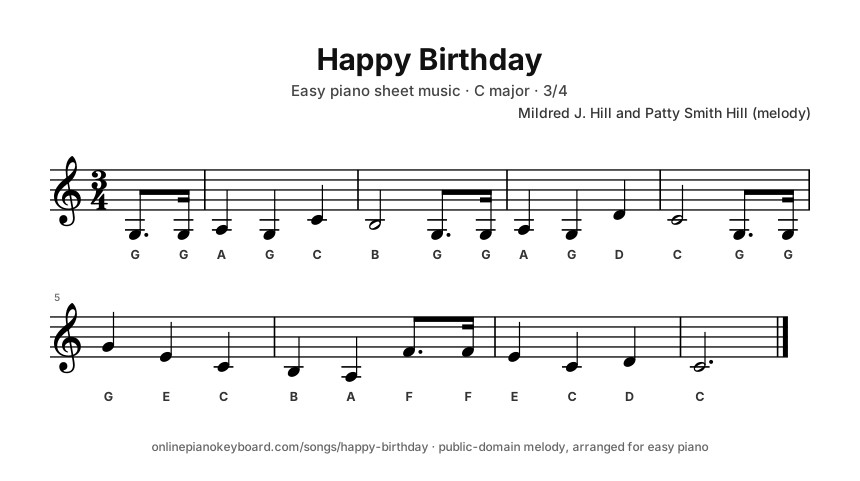
The sheet music and letter notes for Happy Birthday are shown above, along with a keyboard that can play the tune for you in Listen mode or light each next key and wait in Practice mode. This version is in C major and 3/4 time. It uses eight notes, all white keys, from the G below middle C up to the G above it, so your hand has to move more than in a five-finger song.
About the song
The melody comes from "Good Morning to All," a song for young children by the sisters Mildred J. Hill and Patty Smith Hill, published in 1893 in their book Song Stories for the Kindergarten. Patty Hill was a kindergarten principal in Louisville, Kentucky, and the song was meant to be easy for small children to sing. The birthday words were later sung to the same tune, and the two first appeared in print together in 1912. Happy Birthday to You is in the public domain in the United States.
How to play it
Start with your right thumb on the G below middle C, marked G3 in the letter notes, and rest fingers 2, 3, 4 and 5 on A, B, C and D. The first two lines stay in this position. They open with the same four notes and part ways only at the end, where each line reaches up to a different note and settles on the key just below it.
Each line begins with a quick pair of the same note in a long-short rhythm: the first lasts three quarters of a beat and the second only a quarter, like the two syllables of "happy." Count "1-e-and-a" across the first beat and play the second note on the "a," just before beat 2.
The third line holds the biggest jump. After the two low Gs, the melody leaps an octave to the G above middle C. Move your whole hand up so that finger 5 lands on that high G and your thumb is over middle C, play E with finger 3 and C with your thumb, then bring your hand back to where it started for the last two notes of the line, B and A, with fingers 3 and 2.
The last line moves to the C position: thumb on middle C, with fingers 2, 3 and 4 on D, E and F. It opens with the same long-short rhythm on a pair of Fs and comes down to finish on a long C. The first two lines end on a note held for two beats, the third ends on a short A that leads straight into the last line, and the final C is held for a whole bar of three beats.
Practice tips
- Rehearse the octave jump. Play the low G and then the high G, back and forth, until your hand lands on the high G without looking.
- Let Practice show the way. Because Practice lights the next key before you play it, you can see where the high G is while your finger is still on the low one.
- Plan the move to the last line. It starts right after the A that ends the third line, so shift to the C position as soon as you release that note.
The left-hand notes in the answers below come from the C, F and G chords, which basic chords explains. Once it goes well, record it on the full piano and send the share link as a musical birthday card: it plays your recording for anyone who opens it. For another song in 3/4 time, Amazing Grace also begins on the G below middle C.
Printable sheet music
Here is the same arrangement on a single page, with the letter name under every note. Open the image to print it or save it; the Print sheet music button above the keyboard prints it too.
Frequently asked questions
What are the letter notes for Happy Birthday?
Every line is printed at the top of this page. The first is G G A G C B, starting on the G below middle C, with the first G longer than the second and the final B held for two beats.
What key and time signature is Happy Birthday in?
This version is in C major and uses only white keys, from the G below middle C to the G above it. It is in 3/4 time, so you count three beats in every bar.
Which fingers should I use for Happy Birthday?
Begin with your right thumb on the low G for the first two lines. In the third line, move your hand up so finger 5 plays the high G, then come back down, and finish the last line in the C position with your thumb on middle C.
How do I play Happy Birthday with both hands?
Hold one low note per bar with your left hand. Play C then G in the first line; G in the second, changing to C for its final note; C then F in the third; and C in the last line, then G under the D and C for the final note.
Why does Happy Birthday start below middle C?
In C major the tune begins on G, the fifth note of the scale, and later climbs an octave to the next G. Starting on the G below middle C keeps the whole song within one octave around the middle of the keyboard.
Is Happy Birthday in the public domain?
Yes. The melody comes from "Good Morning to All" by Mildred J. Hill and Patty Smith Hill, published in 1893, and the song is in the public domain in the United States.