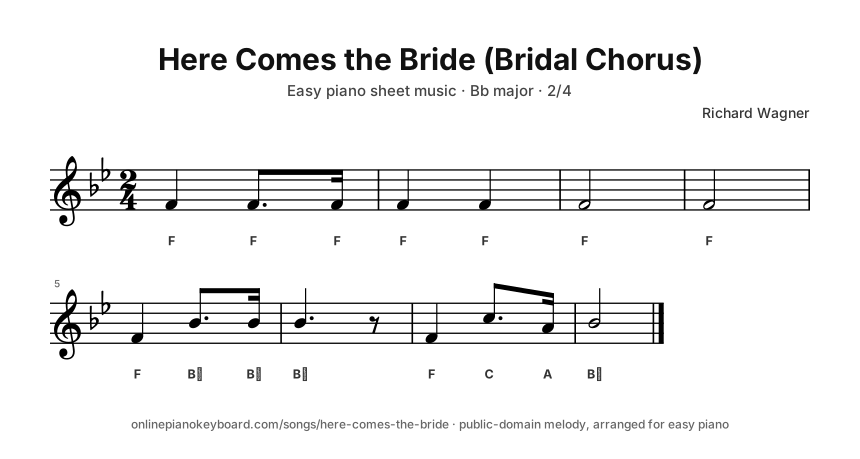
Here Comes the Bride sheet music above teaches the well-known opening of Wagner's Bridal Chorus from Lohengrin. The staff prints the note names beneath the melody, Listen lets you hear the rhythm, and Practice waits at each key. This is an eight-bar, single-hand version in B-flat major. The first repeated high Fs are placed one octave lower to bring the opening closer to the following phrase. The last B-flat is held as an ending for this page. A complete opera score contains many more vocal and instrumental lines.
Bridal Chorus and Wedding March are different
The tune commonly called “Here Comes the Bride” is the Bridal Chorus from Act III of Richard Wagner's opera Lohengrin. In the stage story, the chorus is heard after the wedding as Elsa is escorted away. Mendelssohn's Wedding March, often heard at a ceremony's exit, comes from his music for A Midsummer Night's Dream. The two pieces are easy to confuse because both are closely associated with weddings, but their composers, settings and melodies are distinct. The page above follows Wagner's opening, not Mendelssohn's fanfare.
The Bridal Chorus is in a moderate two-beat meter. Its first phrase can seem simple because F is repeated many times. The interest lies in how long each F lasts: a quarter note, a dotted eighth, then a quick sixteenth, followed by two quarters and two long half notes. Listen once without playing and notice how the phrase breathes between the repeated pitch and its answer.
Find F and B-flat
Find middle C, the white key just left of a pair of black keys. F is three white keys to its right and sits just left of a group of three black keys. Start the first four bars on that F. The source melody starts higher, but this arrangement keeps the Fs near the center of the piano. Do not change pitch just because you see several note values; the opening repeats the same key with different lengths.
The answer reaches B-flat, the black key immediately left of B. Find it before joining the phrase: play F, then B-flat, then return to F. Later the melody touches C above middle C and A, the white key just left of B-flat. The excerpt's final note is B-flat. In B-flat major the key signature also has E-flat, though this short melody does not need it. Follow the letter names on the staff if the black key feels unfamiliar.
Count the repeated notes
Each full bar has two quarter-note beats. Count “one, two” steadily. In bar one, the first F takes one beat, the next F lasts three quarters of a beat, and the last F takes a quarter beat. The total is still two beats. Bars three and four each hold an F for two full beats. Resist pressing the key again in the middle of those bars; the long notes give the opening its measured, processional feel.
Start with Practice on just the first four bars, then take the F-to-B-flat answer separately. When you join them, keep the same pulse through the long notes and the short rests. Play the last B-flat quietly for two beats, as a close to this learning excerpt. For the other familiar wedding piece, try Mendelssohn's Wedding March, or see reading sheet music for help with dotted notes.
Printable sheet music
Here is the same arrangement on a single page, with the letter name under every note. Open the image to print it or save it; the Print sheet music button above the keyboard prints it too.
Frequently asked questions
What are the notes for Here Comes the Bride?
This short version starts with repeated F notes. Its answering phrase uses F, B-flat, C and A before coming to rest on B-flat. The score above gives the exact note lengths.
Who wrote Here Comes the Bride?
Richard Wagner wrote the Bridal Chorus for Act III of his opera Lohengrin. The popular nickname is not the work's original title.
Is this Mendelssohn's Wedding March?
No. Wagner's Bridal Chorus and Mendelssohn's Wedding March are different pieces. The Wedding March is part of A Midsummer Night's Dream.
What key is the Bridal Chorus in?
This excerpt is in B-flat major, with B-flat and E-flat in the key signature. The played notes here include B-flat but do not reach E-flat.
Is this the full Bridal Chorus?
No. It teaches the familiar opening melody as a short one-hand excerpt. The original opera chorus has voices, orchestra and many more bars.
Why are the first F notes lower here?
The source melody begins those notes an octave higher. This piano version lowers them so the beginning and the next phrase fit comfortably near middle C.