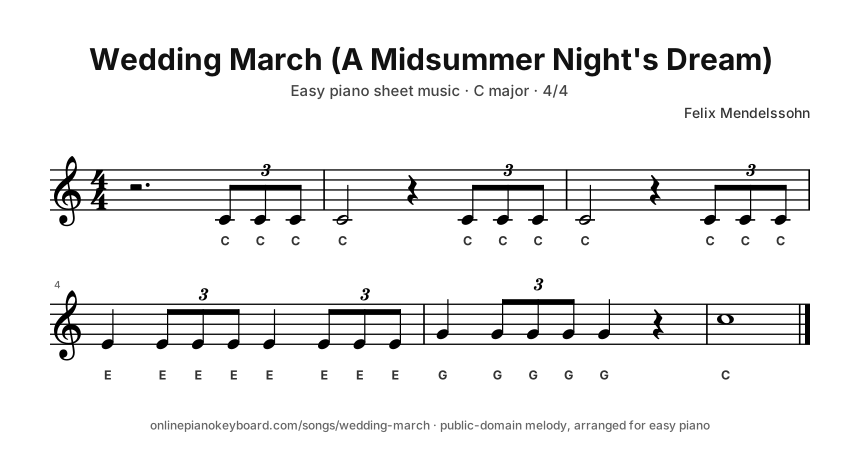
Wedding March sheet music above gives a short one-note-at-a-time version of the opening fanfare from Mendelssohn's A Midsummer Night's Dream. The staff names every note, Listen plays the rhythm, and Practice waits for each key. This page focuses on the repeated C, E and G notes that launch the march. It leaves out the full orchestral chords and the later melodies, and adds a held C as its own ending. For a complete performance at an event, use a full score; this is a way to learn the opening idea on a keyboard.
Which wedding piece is this?
Felix Mendelssohn wrote his Wedding March as part of the incidental music for Shakespeare's A Midsummer Night's Dream, Op. 61. Another famous wedding melody, often called “Here Comes the Bride,” is Wagner's Bridal Chorus from Lohengrin. They are separate compositions with different openings. The Mendelssohn march begins with a bright C-major fanfare: after a short wait, repeated notes rise through C, E and G. The fuller score assigns chords and other notes to the ensemble, giving that simple rising idea its ceremonial force.
The first bar starts with silence for three beats. On the fourth beat, three quick C notes arrive. The second and third bars continue with longer C notes and another three-C burst. Then the fourth bar shifts to E and the fifth to G. This one-line page follows the most obvious repeated pitch at each step. It does not reproduce the organ or orchestral texture, which would need several notes played together and much more music.
Find C, E and G
Find middle C, the white key just left of a pair of black keys near the center of the keyboard. E is two white keys to the right; G is another two white keys beyond E. You can practice the three notes as a rising outline before trying the rhythm. They are the notes of a C-major chord, which is why the fanfare sounds settled even when you play only one at a time.
Try the first three bars with just C. Because the pitch hardly changes, focus on the difference between a long note and the three quick notes. Release the key cleanly between the quick presses. Then shift to E for the fourth bar and G for the fifth, keeping the same confident sound without striking the keyboard too hard. Practice pauses at every note, so you can learn the C-to-E and E-to-G moves before trying them in time.
Make the triplets even
The score is in 4/4, four quarter-note beats per bar. A triplet places three equal notes inside one beat. Tap one steady beat with your free hand and say “trip-let-three” evenly, or “one-trip-let.” Each C in the first burst gets the same small slice of that beat. Do not play the first C slowly and the other two as a hurried afterthought. Listen for the timing, then copy it at a slower pace.
Count the opening silence as carefully as the sounded notes: “one, two, three,” then the triplet on four. The long Cs that follow give the fanfare room to breathe. The E and G bars grow naturally out of the same rhythm. Finish by holding the added high C for a full four beats. To compare the other familiar wedding tune, see Here Comes the Bride. For help reading the triplet group on the staff, visit reading sheet music.
Printable sheet music
Here is the same arrangement on a single page, with the letter name under every note. Open the image to print it or save it; the Print sheet music button above the keyboard prints it too.
Frequently asked questions
What notes start Mendelssohn's Wedding March?
The fanfare starts with three quick Cs after three beats of silence. It repeats C, then moves to E and G in this one-note teaching excerpt.
Is this the same as Here Comes the Bride?
No. Mendelssohn's Wedding March comes from A Midsummer Night's Dream. The tune often called Here Comes the Bride is Wagner's Bridal Chorus from Lohengrin.
What key and time signature is the Wedding March in?
The opening is in C major and 4/4 time. Its quick groups are triplets: three evenly spaced notes within one quarter-note beat.
Is this the entire Wedding March?
No. It is a short single-note version of the opening fanfare, with a final C added for this page. The complete work includes broad orchestral chords and later themes.
Who composed the Wedding March?
Felix Mendelssohn wrote it for his incidental music to Shakespeare's A Midsummer Night's Dream, Op. 61.
How do I play the triplets?
Say 'one-trip-let' over one beat and place a note on each syllable. Keep the three presses evenly spaced rather than squeezing the last two together.